
Machine and socket for dishwasher
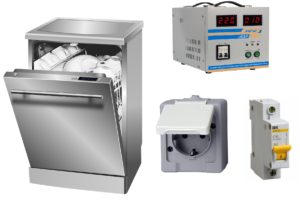 Connecting a dishwasher to the power grid is quite a responsible task. Before you can simply plug it into the outlet, you need to prepare the outlet. You also need to prepare and install a circuit breaker, a good cable, a waterproof outlet, and a voltage stabilizer. You might ask, why do all this? It might be enough to plug a tee into a standard outlet and connect the refrigerator, dishwasher, and microwave to it all at once. Many people do this, and nothing happens! We'll explore this and other similar questions in this article.
Where to connect the dishwasher?
First, let's reiterate the "truism": if several large loads are connected to the same outlet, an overload will occur, the wire will become very hot, and could catch fire. Regarding the "many people do this and nothing happens" argument, let's say that In Russia, thousands of fires occur every year, caused by electrical wiring. And in most cases, the user is to blame for connecting too many consumers to an outlet or extension cord.
Dishwashers are large appliances that can significantly impact the electrical system. They require a dedicated, reliable outlet. Dishwashers should not be connected to an extension cord, nor should they be connected to the same outlet with other large appliances such as a kettle, microwave, refrigerator, washing machine, and so on. Connecting multiple large appliances to a single outlet is only permissible if the outlet has been properly prepared in advance.
Please note! Preparation means installing the circuit breaker and laying high-quality electrical wiring with the specified cross-section.
How do I prepare for a dishwasher? It's best to prepare a separate wire and outlet for the dishwasher in advance, not only before purchasing the machine but also before renovating the kitchen. After all, running wires and cutting grooves in walls is quite a messy job. Let's figure out what you'll need to connect the dishwasher to the power supply.
Features of choosing components
Before installing a new dishwasher outlet, you'll need to gather all the necessary supplies. You'll need:
- suitable copper wire;
- machine;
- moisture-resistant socket;
- voltage stabilizer.
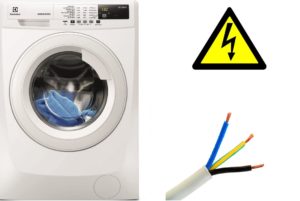
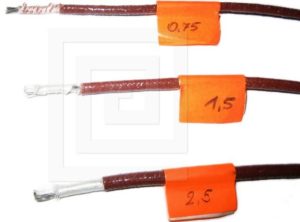 Any wire won't work for connecting a dishwasher. You need a three-core copper wire with PVC insulation and a cross-section of at least 1.5 mm. If you plan to connect another device to the outlet, you should use a wire with a cross-section of 2.5 mm, although you should of course calculate the voltage of the second device and the dishwasher combined. Electricians advise that when installing electrical outlets, the wiring cross-section should be calculated with a reserve, taking into account the potential for increased loads; this will reduce the risk of problems in the future.
In addition to the wiring, we'll need a separate circuit breaker. This should be installed in the electrical panel; it will be needed in case of an overload and will protect your home from fire. To connect the dishwasher, we'll need a single-pole, single-phase 16A circuit breaker.
Important! If you plan to connect several large appliances to the outlet, you will need a 20A circuit breaker.
Next, we'll need a special moisture-resistant outlet. The housing of such an outlet is perfectly protected from moisture, so even if you accidentally splash water on it, nothing will happen. It's best not to install a regular outlet in the kitchen. In addition to wiring and an outlet, you can purchase a voltage stabilizer. In our opinion, a voltage stabilizer is an absolute must, especially in Russia, where power grids are always problematic.
A voltage stabilizer is a fairly expensive component, so homeowners often neglect to install one, which is a mistake. A voltage stabilizer protects the electrical system from voltage drops or surges. A single power surge can destroy all kitchen appliances, including a dishwasher, in a second. So, saving $20–$70 could mean losing $2,000, or even more, depending on the cost of your appliances.
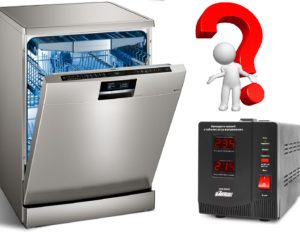
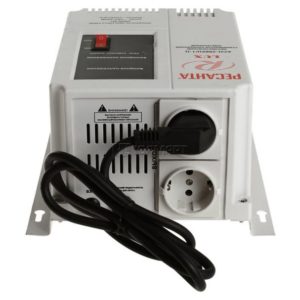 A voltage stabilizer is a special box with buttons and a sensor that displays information about the voltage in the electrical network on a special display. Any voltage stabilizer won't do either; you need to buy a device with sufficient power.
To properly connect a dishwasher, you can, for example, purchase a Resanta voltage stabilizer, model RESANTA ASN-2000 N/1-Ts. If you need to connect other electrical appliances in addition to the dishwasher, calculate their total power. Modern stabilizers have multiple outputs for connecting multiple appliances, as long as the stabilizer can handle them.
Installation of electrical communications
It's best to entrust the installation of electrical wiring, circuit breakers, and outlets to a qualified electrician, but if you have some experience with this type of work, you can do it yourself. Just remember to follow basic safety rules. Let's get started.
- Decide on the "route" for the wiring. It's up to you to decide whether to run the wires through cable channels or cut channels into the wall. The first option is better—it's safer and less labor-intensive.
- Decide on the location of the outlet. The main thing is that it's not too close to the floor and not too far from the dishwasher.
Please note: Place the outlet as close to the dishwasher as possible, as the cord length for any dishwasher model is limited to 1.5 meters.
- We prepare a place for the socket and install the wiring.
- We install the machine in the electrical panel and connect the electrical wiring to it.
- We screw on the socket, connect the wiring to it, turn on the circuit breaker and check.
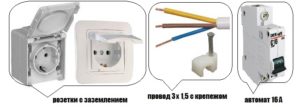 If you don't purchase a voltage stabilizer, connect the dishwasher directly to the outlet. If you do purchase a voltage stabilizer, connect it to the outlet and then connect the dishwasher to the stabilizer. For the dishwasher to function properly, it must be properly connected not only to electricity, but also to water. About that, How to connect a dishwasher yourself, is described in great detail in the article of the same name.
In conclusion, a dishwasher is too important and expensive a device to be hooked up haphazardly. Provide it with proper electrical connections, install a circuit breaker, and your efforts will be repaid a hundredfold in the long run.
Interesting:



Readers' comments
Headings
Washing machine repair




For buyers




For users


Dishwasher




Add a comment