
Why does my washing machine drum give me electric shocks?
 When using household appliances, it's essential to follow basic safety rules. Appliances plugged into the power supply can shock the user, which is extremely unpleasant and very dangerous. If your washing machine drum is causing electric shocks even at the slightest touch, you need to address the issue immediately. Let's explore why your washing machine might be causing your fingers to tingle, how to resolve this situation, and how to prevent electrical shocks.
There is no connection to ground
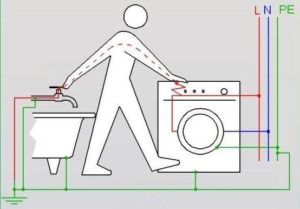
Even the most modern household appliances are manufactured with the understanding that a small amount of electrical current will be transmitted through the device’s body into the general building grounding system.The first and most common reason why a washing machine can shock a person is the lack of grounding in the home's electrical system. If there's no grounding, a small charge will accumulate on the walls of the washing machine, and this is what you'll feel when you touch the machine. Electric shocks will be more noticeable when you touch the drum with wet hands.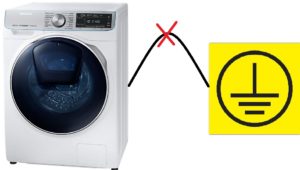
This problem can be solved by grounding the electrical wiring in the home. Electrical panels in multi-story buildings typically have grounding terminals. However, some Khrushchev-era buildings may not have them, so you'll have to ground the washing machine directly. There's another way to solve the problem; we'll discuss the second method below.
If the washing machine is installed in the kitchen, hallway, or corridor—rooms with low humidity—electric shocks may not be felt at all. But if the washing machine is in the bathroom, you won't be able to avoid the tingling sensation in your hands; the current will definitely be felt.
Damaged wiring or breakdown of the heating element
If the ground is connected, the washing machine is most likely giving you a strong electric shock due to some internal failure that has occurred in the system. Very often, charge accumulation on the body occurs due to damage to the wiring inside the unit or failure of the heating element.
To inspect the internal components, remove the rear panel of the housing, first unscrewing the bolts holding it in place. After removing the cover, inspect the machine's wiring for defects, kinks, or damage. If you find nothing suspicious, proceed to inspecting the heating element.
The heating element is located in completely different places in different washing machine models. In Ariston, Samsung, and Indesit models, it's at the back, while in Bosch, AEG, and Siemens models, it's at the front.
To simplify the process of finding the heating element, we recommend that you look for the connection diagram for the element in the user manual.
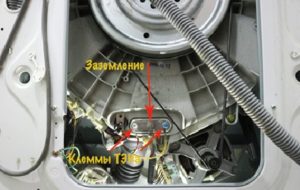 To check the heater's functionality, you'll need a multimeter. Disconnect the wires from the heating element, set the tester to resistance mode, set the meter selector to 200 ohms, and attach the multimeter probes to the heating element contacts. If the tester screen displays a value between 20 and 30 ohms, the heating element is working properly. A faulty heating element will be indicated by a reading of 1 or 0. A 1 indicates an open circuit within the element, while a 0 indicates a short circuit within the heater.
After performing the necessary steps to verify the component's functionality, it's necessary to conduct a breakdown test. Even a perfect resistance reading on a multimeter doesn't mean the current isn't flowing from the heating element to the washing machine body. There is a dielectric between the tubes and the walls of the heater, which can leak into the system.
You can also check the heating element for a breakdown using a tester. Select the buzzer mode, place one probe of the multimeter on the heating element terminal, and touch the other probe to its body. If the device makes no sound, the heating element is working properly; if the tester starts beeping, there is a breakdown. The heating element is not repaired; a new, functioning part is simply installed in its place.
If there is no breakdown, but there is a breakdown?
To minimize the risk of electric shock when using a washing machine, you should take additional precautions with your home's electrical system. You can protect yourself with the following methods:
- Connect a residual-current device (RCD) with a rated load current of 10 to 30 mA to the power grid. The RCD will trip even the smallest current leakage, shutting off power to the appliance at the electrical panel. If the apartment's wiring is old and two-wire, rather than the modern three-wire, installing the device may cause some inconvenience. The circuit breaker will trip frequently and unnecessarily, requiring regular power-ups at the electrical panel.
- Create a potential equalization system for household appliances.
- Ensure the ground connection is intact. In some cases, the washing machine may still experience shock even when the ground is connected. This could be caused by a damaged ground wire. It's worth finding the faulty location, inspecting the wire, and repairing it.
If you experience a tingling sensation in your fingers when touching the bathroom faucet, you should quickly turn off the power to the room and find the faulty wiring.
It is strictly forbidden to try to figure out why an automatic machine gets an electric shock at high voltage.
Incorrect methods of troubleshooting the problem
If you decide to deal with the problem on your own, you need to understand what actions are not advisable. When browsing forums, alongside good advice, you can come across incorrect recommendations from "poor experts." So, you should not take into account or use the following troubleshooting methods: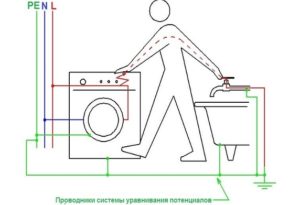
- If there's no grounding, you can simply plug the power cord into the outlet with the plug upside down and lay a rubber mat on the floor. This method may, of course, mitigate occasional shocks, but it won't solve the problem. Ultimately, shock may still occur.
- Disable the washing machine's surge protector. This component is designed to redirect electrical charges to the machine's body. Some people believe that disabling it will completely protect against electric shock when touching the machine. This is a misconception; the risk will be reduced only slightly.
- Connecting the grounding conductor from the washing machine to a pipe or radiator is extremely dangerous and can result in severe electric shock. Experts strongly advise against this method.
- Run a separate PE cable from the panel. Remember, you can't run a separate grounding conductor or plug equipment into a socket without a ground. The correct solution is to run a three-wire cable from the distribution box and connect it to a dedicated, safe socket.
By identifying the cause of your washing machine's intermittent electric shocks, you can eliminate this dangerous problem. It's important to carry out repairs consciously, following all safety precautions.
Interesting:


Readers' comments
Headings
Washing machine repair




For buyers




For users


Dishwasher




Add a comment