
Why does laundry get tangled up in a ball in the washing machine?
 Unfortunately, the washing process isn't always perfect. Occasionally, minor problems arise, such as laundry bunching up in the washing machine or, worse, forming a tight rope. This affects the wash and spin quality, and it's inconvenient for the homeowner to remove the clump from the drum and then separate all the items. How can this problem be avoided?
How does a lump form in a drum?
Twisting usually occurs when washing a duvet cover and many small items (socks, underwear, etc.) at the same time. The small items float freely in the water and move around the drum, while the duvet cover, already heavy and saturated with water, lies practically motionless in the drum.
During washing, a kind of centrifuge is created inside the drum, and the duvet cover, due to its clumsiness, sticks to its walls. Small items, under the influence of centrifugal force, become twisted, crumpled and get stuck in the hole of the duvet cover.
This causes the duvet cover to resemble a stuffed sack, and during the spin cycle, all its contents are compressed and compacted, especially at high speeds. However, due to the uneven distribution of the laundry in the drum, although it is twisted, it is not spun properly.
The laundry becomes tangled, bunched up, and forms a dense ball of fabric that's extremely difficult to untangle. This negatively impacts both the laundry, which is poorly washed and unevenly spun, and the machine itself, which suffers from imbalance and breaks down faster. The machine's "discontent" manifests itself in the form of strong vibration, knocking, and excessive rocking of the drum.
Important: It is recommended to always wash the duvet cover separately from any other clothing or linens.
But what if I only need to wash one duvet cover? Isn't it possible to combine it with something else so I don't have to do a full wash just for it? This is a question worth exploring.
Preventing lump formation
Stitching up a hole in a duvet cover every time you wash it is a crazy idea, but pinning it shut isn't a solution either. It's time-consuming, and the fabric in the hole deteriorates faster. Fixing this problem is relatively simple.
- Buy a set of mesh laundry bags and place the duvet cover in them. Then you can safely wash it with anything you like, without affecting the washing quality, and without overloading the machine.
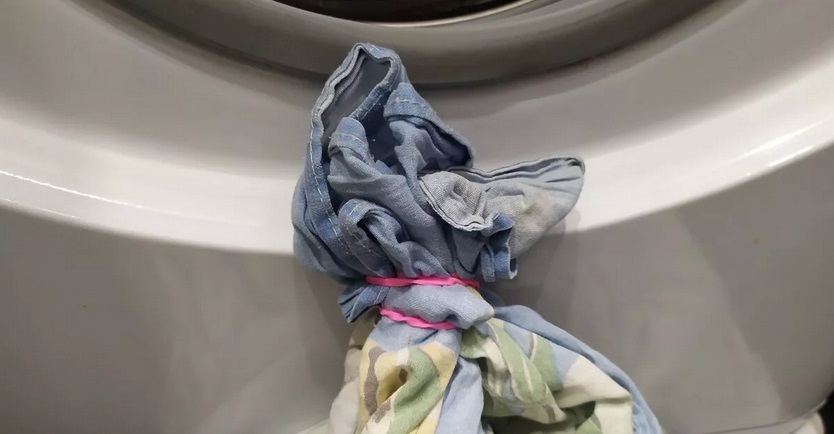
- Gather the edges of the duvet cover opening into a bundle and secure with a rubber band or a money rubber band, if you have one. This will prevent small items from getting inside the duvet cover.
- If you don't have elastic at hand, you can simply tie the corners of the duvet cover on the side with the opening into light knots.
The key is to close the hole in the duvet cover and prevent other items from getting caught in it. Doing this before every wash will prevent your laundry from bunching up and causing discomfort.
Interesting:






7 reader comments
Add a comment
Headings
Washing machine repair




For buyers




For users


Dishwasher




If there is no hole in the duvet cover, he will make a sausage out of the sheet.
And that's why it rinses poorly!
I zip it up, and it takes the things and wraps them in itself. And again, it's a lump, and the centrifuge doesn't know what to do.
I'm washing one duvet cover, and it still curls up. Spin speed is 800.
Ardo's old car never had such a mess! In the new Haier, the duvet cover swallows everything, even the sheets!
When my Bosch washing machine was new, this problem wasn't a problem. But now, for about five years, it's been rolling up all the bedding in a bag. It even rolls up a sheet and a large towel.
Same old nonsense. My old Indesit washed everything and didn't freeze during the spin cycle. My new Samsung will spin back and forth for half an hour and then stop with an error message.
I regretted taking Hair, it crumples the duvet cover even if you wash it alone, and it twists for a long time because of this.