
Washing machine giving you electric shock? We fix it ourselves!
 A washing machine shouldn't pose a danger to the people who use it. Moreover, the purpose of this type of household appliance is to create more comfortable living conditions. It washes, rinses, and spins laundry. And in this way, it benefits us, the people who use it. But what should you do if your washing machine gives you an electric shock during or after washing?
Perhaps you felt a slight tingling sensation from a mild electrical discharge when touching the body of your washing machine. Similar minor issues can occur with refrigerators, dishwashers, and other electrical appliances. Clearly, the problem is electricity. To double-check, you can disconnect the power to the appliance by unplugging it. Then touch the metal body again. Typically, the tingling sensation will not occur in this case.
Why does my washing machine give me electric shock?
The above experiment leads to a clear conclusion: voltage is applied to the housing of our household appliances. And it's greater than 30 volts. Voltages below this threshold are generally not felt when touched with a dry hand.
If you have access to a voltmeter, it's best to measure the voltage applied to the case. If it's high, you should seriously consider resolving this issue.
Surprisingly, we can still receive mild electric shocks even from a perfectly functional washing machine. This can happen because you're plugging it into a standard outlet found in Russian homes—one that isn't grounded. A surge protector could be the culprit. Without going into the specifics of its operation, simply put, Modern washing machines are designed to be used exclusively through three-wire grounded outlets. And if you use such sockets, the washing machine will not give you an electric shock.
Unfortunately, most apartments and private homes use the Soviet standard. That is, a standard two-wire outlet with no grounding. And we often experience discomfort from electric shock when touching metal parts of household appliances.
How to get rid of electric shocks?
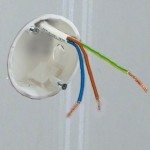 It's highly recommended not to disconnect the filter cord from the washing machine wall. While this will reduce the risk of electric shock when touching the washing machine, it won't completely eliminate the problem.
Over time, the wiring inside the machine can also deteriorate. This can also lead to voltage leaking out onto the machine's body.
 To avoid this possibility, we can use a residual-current device (RCD). This device will automatically cut off power to the wire if electricity leaks to ground. This way, it can protect you from a prolonged, strong electric shock. Unfortunately, avoiding a shock is inevitable. It won't work perfectly in the two-wire wiring used in many homes. But it's clearly better than the risk of a strong, prolonged electric shock.
The electric current generated by touching the housing is usually quite small. The rating of the residual-current device (RCD) should also be low, no more than thirty milliamps. You can also use a special RCD, one that's installed directly in the outlet you're using. This will protect you from unnecessary, incorrect tripping of this device.
What needs to be done to prevent the washing machine from giving us electric shocks at all?
 To prevent our washing machine from giving us electric shocks, we should use special grounding of the housing. This precaution removes the voltage from the machine body and directs it to the ground.
Don't use water pipes for grounding. This is prohibited. If your wiring only has two wires, you need to make sure the electrical panel housing is grounded. In this case, you can ground through it. You can find out whether your panel has this protection from the companies that handle your building's maintenance, such as your housing office.
Let's sum it up
- If your apartment's wiring has three wires (live, neutral, and ground), and the washing machine is still giving you a shock, you need to make sure the ground wire is intact. You can simply use a tester to check for voltage between the live wire and the machine's body.
- If your wiring is standard, meaning it has two wires (live and neutral), it's highly recommended to install a separate ground for the machine body. Water pipes should not be used for this purpose.
- If the wiring is two-wire, but there is no way to ground it, then you can at least use a residual-current device built into the socket.
Yes, it's worth clarifying that these options work well for a working washing machine. If the problem is damaged insulation inside the machine, then that's the first thing to address. If the machine was previously working fine and didn't generate shocks, but then suddenly started doing so recently, that's not normal. The problem is most likely a damaged insulation. To fix it, you need to find the damaged insulation and seal it. You can use electrical tape for this.
Alternatively, you can temporarily avoid touching the machine while it's running, and only touch it when it's unplugged. However, don't use this method if your appliance is obviously malfunctioning. It won't fix the problem and could be very dangerous!
Interesting:



4 reader comments
Add a comment
Headings
Washing machine repair




For buyers




For users


Dishwasher




You can dry the engine with a light bulb
No need for a light bulb!
After winter, the dishwasher won't start. The pump pumps water, then hums slightly, but doesn't operate as intended. This happened a year ago; a repairman came, poked something, and everything worked. It's a shame to shell out thousands for such a repair.
You should use your dishwasher more often, at least once a month. The high-pressure pump has graphite bushings (bearings). Disassemble the pump, separate it from the motor, and carefully separate the motor shaft by hand.