
What can I use to wash dishes in the dishwasher other than tablets?
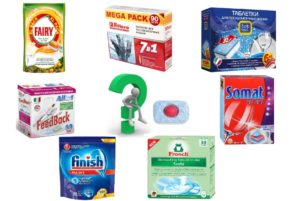
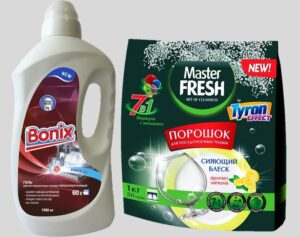 There are as many opinions as there are people, so it's no surprise that not all housewives enjoy washing dishes in the dishwasher using 3-in-1 tablets. Fortunately, finding a replacement is very easy. Today, stores offer a variety of specialized dishwasher powders and gels, and if even this option isn't to your liking, you can make your own detergent. We'll take a detailed look at all the possible dishwasher cleaning options so everyone can find the right one for themselves and their appliance.
Let's move on to the classics - powder
Regular dishwashing powder is a classic household cleaning product used by most dishwasher owners. Even though new types of detergents are appearing on the market every day, housewives are reluctant to switch to these types of detergents, preferring regular powder. While its formula is relatively simple, it still cleans dishes perfectly and is inexpensive for a dishwasher detergent.
A separate and significant advantage of the powder is its flexibility – the product can be dosed to suit the owner's needs. This is much more convenient than using a single tablet each time, which the instructions often even prohibit splitting into two or more parts. With powder, homeowners can save money not only because of the low cost but also because of the correct dosage.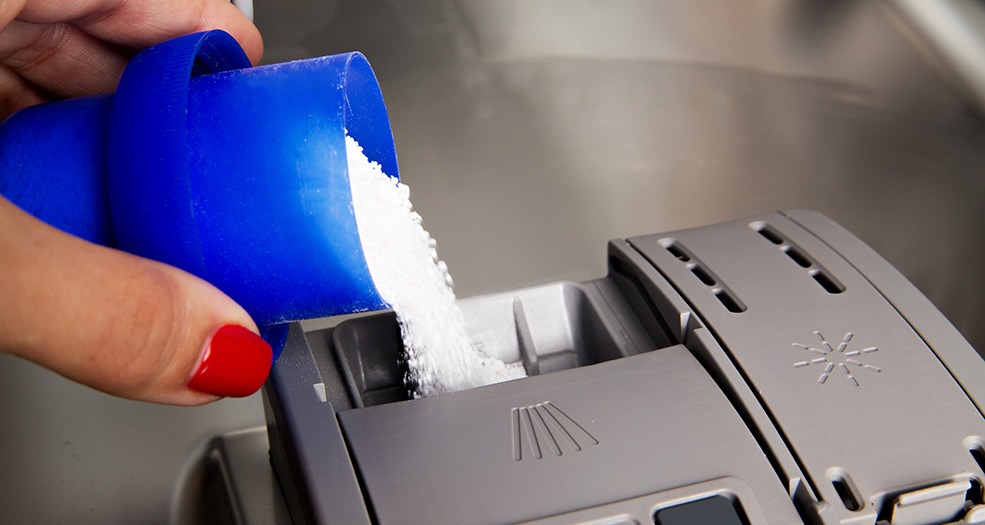
To achieve this, it's necessary to learn how to correctly determine the powder rate per work cycle. Two key documents can help you with this:
- Household chemical instructions. Carefully read the instructions for using the detergent, as the manufacturer always clearly specifies the correct dosage. Pay attention to the sections on the selected water temperature, cycle duration, and the degree of soiling of the dishes.
It's even more convenient to determine the dosage using a measuring spoon, which is usually included with large packages of dishwasher powder.
- The dishwasher user manual. The second document is the official instructions for the appliance, which always detail the process of adding detergent and other cleaning products to the machine's dispenser. This is crucial, as it's crucial not to confuse the detergent dispensers, which are separate for regenerating salt, detergent, rinse aid, and tablets.
Therefore, to use the powder correctly, you only need to carefully study the instructions for using the equipment and detergents. Never mix up the detergent dispensers in the machine, as each product is used at a specific point in the cycle, so misplacement will negatively impact dishwashing.
Washing gel
In addition to tablets, you can also use a special gel for PMM. This product has a homogeneous liquid consistency and a uniform color and is most often sold in plastic bottles with a convenient dispenser on the lid. Less commonly, you can find the product in soft packaging.
Typically, the manufacturer adds ingredients to the gel not only for cleaning dishes but also for other useful functions. This may include additional softening of hard tap water and cleaning of the dishwasher's internal components. Gels themselves differ from powders in that they are slightly gentler on dishes and the machine as a whole.
Don't confuse dishwashing gel and gel rinse aid, which are added to different sections of the dispenser and perform different functions: the former removes dirt from dishes, while the latter is used to give dishes a shine and remove streaks.
To use dishwashing gel, simply open the dishwasher door, select the required amount of detergent, and then add it to the appropriate reservoir. Then, simply close the dispenser lid tightly, select a wash program, and start the cycle.
The main advantage of choosing a gel over a powder is the product's uniform density, which means it's less expensive and more effective. Furthermore, it dissolves perfectly even in cold water, and can be stored for a long time because it doesn't accumulate dust or clump. Furthermore, it doesn't contain any abrasive particles that could penetrate the powder from outside and damage your dishes. Last but not least, the gel is much easier to remove from dishes, so you won't find any detergent residue on your cutlery after washing, meaning there's no risk of household chemicals getting into your body.
Let's prepare the remedy ourselves
The final, optimal alternative to 3-in-1 tablets is a homemade solution. There are many recipes for such cleaning products, but we'll look at three of the safest and most effective.
Never use recipes that contain regular soap or mustard, as these ingredients can damage your dishwasher.
For your first cleaning solution, you'll only need baking soda, salt, and citric acid. First, mix two cups of washing soda, one cup of special dishwasher salt, and half a cup of dry citric acid. Now slowly add water until the mixture reaches the consistency of thick sour cream. Store the mixture in a dry, warm place until it hardens. Transfer the resulting lumps of detergent to a jar or box.
The second option requires borax (sodium tetraborate), which can be purchased at any pharmacy or online, where it's cheaper. To create the gel, you'll need approximately five 30-gram bottles. Pour the borax solution into the prepared container, add about 200 grams of washing soda, and stir the mixture until it forms a gel. To make tablets from borax instead of a gel, add an additional 500 grams of special salt and 100 grams of citric acid. After stirring, pour the resulting mixture into molds and place it in a warm place to harden.
For today's final recipe, you'll need soap-free baby laundry detergent and washing soda. Mix 150 grams of the dry powder with 200 grams of washing soda, then carefully add water and stir until the mixture reaches the consistency of thick sour cream. Then, simply pour the mixture into prepared molds and set in a warm place to harden.
As you can see, there are many ways to replace standard 3-in-1 dishwasher tablets if you prefer not to use them for some reason. If you plan to use homemade detergents, be sure to alternate them with specialized household cleaning products from time to time. Also, remember to clean your dishwasher at least once a month with anti-corrosion protective products to ensure your machine lasts as long as possible.
Interesting:


Readers' comments
Headings
Washing machine repair




For buyers




For users


Dishwasher




Add a comment