
What to do if your dishwasher freezes
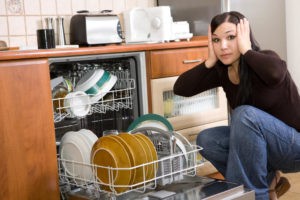 A dishwasher freezing is a fairly common occurrence and doesn't necessarily indicate a malfunction. Often, a dishwasher freezing in the first or last minute is the result of a localized glitch, but sometimes it's a symptom of a more serious problem that needs to be localized and fixed. Let's look at the possible causes of a dishwasher freezing, how to identify the cause, and how to quickly fix it yourself.
Why does the malfunction occur?
If your dishwasher suddenly freezes for no apparent reason, it can be quite difficult to determine the cause of the problem. Often, with such a problem, the machine does not display system errors., which means that the range of possible problems will have to be limited intuitively.
- If the freezing occurs within the first three minutes after starting the program, but the water has not yet had time to pour, the problem may be with the heating element.
- If the washing machine freezes within the first 15-20 minutes, it's worth checking the control module. This is usually a symptom of electronics, and the machine won't display any errors.
- There may also be trivial reasons: overloading the machine with dishes, a warped body, a power failure, or a clogged drain.
The list of possible malfunctions can be much longer. The leak protection sensor could be triggered, or the pump, inlet valve, or circulation pump could fail. However, we rule out these causes, as the dishwasher's self-diagnostic system responds when they occur, displaying an error code. In our case, the dishwasher freezing up is not accompanied by an error code, and based on this fact, we limit the range of possible malfunctions.
It is not uncommon for such a malfunction to be caused by serious damage to the dishwasher control module.
Urgent actions
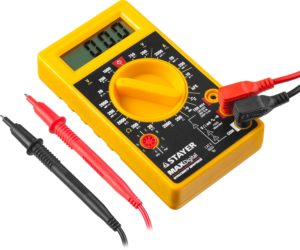 Knowing the cause of the problem is certainly good, but what should a user do in the first few minutes after discovering their "home assistant" has frozen? Surely they wouldn't rush to disassemble the dishwasher with a multimeter to check the heating element. And there's no need to do anything, at least not right away.
First, try resetting the dishwasher. This advice is probably trivial, but it works about 1/3 of the time, so it's a shame to ignore it. Resetting should be done correctly:
- turn off the machine using the button;
- disconnect the power cord plug from the socket;
- wait for 30 seconds;
- We turn the dishwasher on again and try to start it.
If a reboot helps, a power outage could be the likely culprit. To prevent future outages from bothering your appliance, it's worth purchasing dishwasher stabilizerIf rebooting doesn't help, let's start investigating. If your washing machine has been running for a while, and you haven't moved it, and it freezes mid-cycle, it's worth checking how well the water drains. A simple clog in the drain pipe might not be detected by the machine's self-diagnosis system, causing it to freeze.
Let's imagine you just recently purchased your washing machine and haven't been using it for more than a month. In this case, the freezing could be caused by the case being installed unevenly, with a significant difference. In general, dishwashers are not as sensitive to distortions in the housing as washing machines. A washing machine can stop working properly if it's tilted by 4-5 degrees, while a 10-15 degree difference can be critical for a dishwasher. The solution is to level the machine.
And don't discount overloading the baskets. If your dishwasher has a load sensor, it could very well have triggered an overload. So why didn't the machine generate a system error? It's simple: some Bosch dishwasher models from 2013 and 2014 had load sensors with a similar defect. They triggered without alerting the machine's self-diagnostic system, leaving owners baffled. Such machines can freeze for no apparent reason, and then it's anyone's guess what happened.
Before opening the machine, check everything possible. If the checks are inconclusive, an internal diagnostic should be performed.
Troubleshooting
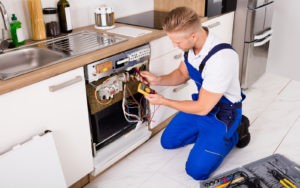 Before we tell you how to check the functionality of potential culprits causing freezing, we feel obligated to warn you: this isn't an easy task and requires some skill with a multimeter. If you've never heard of this device and haven't bothered diagnosing complex household appliances, entrust this work to a professional. At the very least, you won't waste your time. If your washing machine is new and under warranty, it's best not to bother with it at all. Let the service center technicians have a hard time with it.
If the warranty has expired, you should pay special attention to the heating element of your Electrolux dishwasher or any other brand. It is possible that the broken heating element was the cause of the mysterious freezing. What shall we do?
- We turn off the water supply to the dishwasher and turn off the appliance.
- We disconnect all the hoses, unplug the power cord from the socket and wind it up.
- We remove the fasteners holding the machine in the niche (for built-in dishwashers).
- We unscrew the screws holding the side panels of the case and remove these panels.
Most dishwashers have access to many parts through the side walls of the housing, including the heating element.
- We disconnect the wires from the heating element coil and check its resistance with a multimeter.
- Using the same multimeter, we check the heating element for breakdown.
If a fault is detected, the heating element needs to be replaced. You can order the part on the website of the company that manufactured your dishwasher. Assuming the heating element is OK, then the problem is most likely in the control module. Testing the electronics requires more than just a confident multimeter; it requires more advanced knowledge, which only a specialist possesses. If you suspect the control module is faulty, you should call a technician; there's nothing you can do.
Interesting:

Readers' comments
Headings
Washing machine repair




For buyers




For users


Dishwasher




Add a comment