
How to check a washing machine's temperature sensor
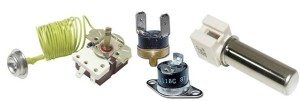 The temperature sensor is an internal component of the washing machine responsible for heating the water to a certain temperature and then turning off the heating element. If the machine is heating the water too much or not at all, the temperature sensor may be the cause. We'll discuss how to check its functionality and replace it if necessary below.
Types of sensors
There are three types of sensors that can be installed in a washing machine:
- gas-filled;
- bimetallic or
- thermistor.
Each of them has a different design and operating principle, and therefore has its own peculiarities when replacing and checking.
The gas-filled thermostat consists of two parts. The first is a metal tablet with a diameter of 20 to 30 mm and a height of up to 30 mm. This metal tablet is located inside the machine's tank, coming into contact with the water to measure its temperature. The second part of the sensor is a copper tube and is connected to an external temperature controller located on the machine's control panel. Gas – freon – is pumped into these sensor parts. Under the influence of water temperature, freon expands or contracts, which leads to the closing and opening of contacts leading to the heating element.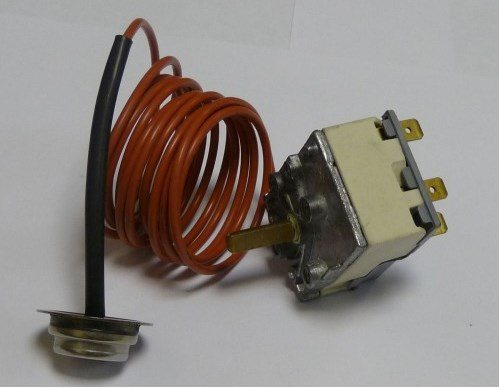
The bimetallic thermostat also has the shape of a tablet with a diameter of 20 to 30 mm and a height of up to 10 mm. There is a small bimetallic plate inside the tablet. When the water is heated to the selected temperature, the plate bends, which leads to the contacts closing and the water heating stops.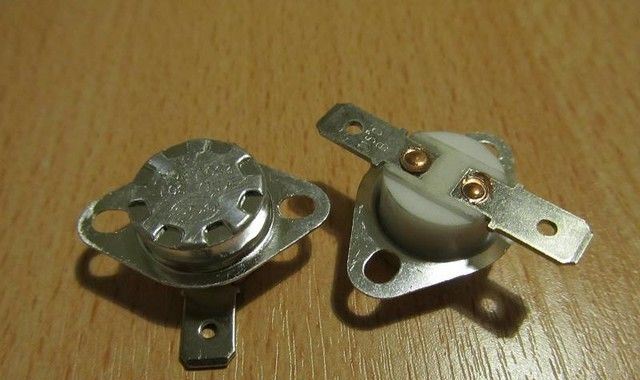
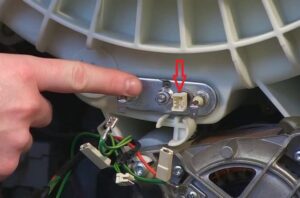
The latest washing machine models use a thermistor as a temperature sensor. It's a metal cylinder with a diameter of approximately 10 mm and a length of 30 mm. This type of temperature sensor is attached to the heating element itself. Its operating principle is based not on the mechanical operation of the elements, but on the change in resistance when heating water to the required temperature.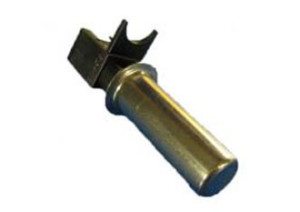
Checking the sensor's functionality and replacing it
To check if the washing machine's thermostat is working, you need to access it. To do this, first unplug the machine. Now you need to disassemble the machine itself. The easiest way to remove it is the thermistor, as it is located inside the heating element. In most models, the heating element is located at the bottom of the washing machine.
To remove the thermistor, you need to:
- Open the back cover of the washing machine.
- Disconnect the wires from the sensor going to the external temperature controller.
- Loosen the screw holding the heating element.
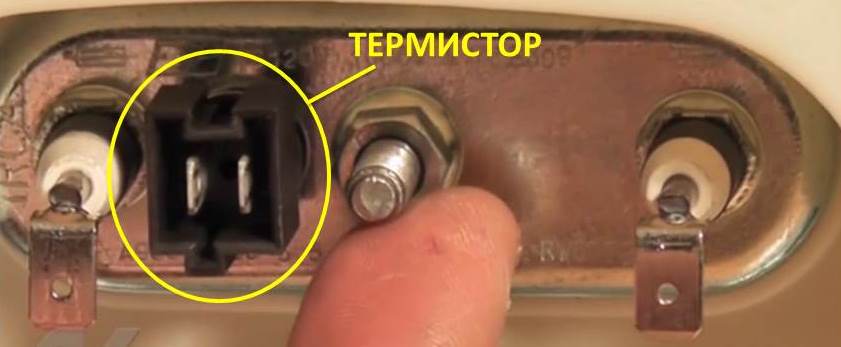
- Remove the thermistor from the heating element.
Now that the sensor is removed, take a multimeter and measure the resistance. Follow these steps:
- set up the multimeter to measure resistance;
- We connect the multimeter probes to the sensor contacts. At a temperature of 200The sensor resistance is about 6000 ohms.
- We place the sensor in hot water and observe the change in the multimeter reading as the sensor's temperature changes. If the sensor is working properly, the resistance will drop, and at a temperature of about 500C it will be equal to 1350 Ohm.
If the thermostat is faulty, it must be replaced with a new one. It cannot be repaired. Reassemble the machine in reverse order.
To access the gas-filled sensor, in addition to opening the rear panel of the washing machine, you will also need to remove the front control panel. This is necessary to disconnect the outer part of the sensor, as shown in the photo.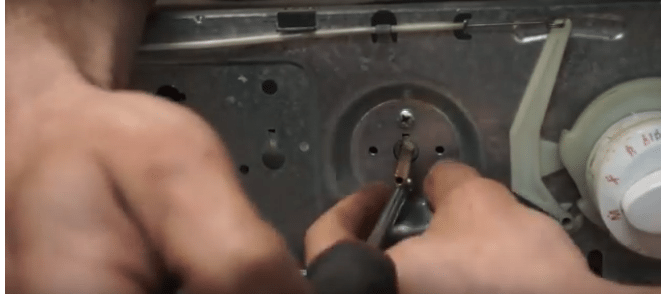
Returning to the rear of the automatic machine, we find the wire terminal on the tank body. Carefully, so as not to damage the sensor's copper tube, pull off the rubber insulation. Using a thin awl, carefully pry the rubber seal around the copper tube and pull it off. Gently press the base of the sensor inward until it pops out of the groove. Then, pull the temperature sensor out through the hole in the tank. Disconnect the wire from the sensor and test it for functionality.
The main malfunction in such sensors is a breakdown of the copper tube from which freon comes out.As a result, the sensor's functionality is impaired. To replace it, purchase a temperature sensor complete with a switch and install it, reassembling it in reverse order.
As for the bimetallic sensor, to remove it from the washing machine, as in the previous case, you need to access the drum. Then disconnect the thermostat from the wires. Now connect the sensor contacts to the multimeter probes and read the resistance reading. Next, heat the sensor in hot water to a certain temperature and observe how the resistance changes. If it drops significantly, the sensor is working properly; otherwise, it's not.
The main cause of bimetallic sensor failure is plate wear. Replacing the sensor is fairly easy: simply purchase a new, identical thermostat and install it in its place.
Signs of sensor failure: main faults
The proper functioning of the washing machine depends on the proper functioning of the temperature sensor. External signs of a faulty part of the machine include the following:
- in any washing mode and any selected temperature, the machine heats the water to boiling point;
- During washing, the body of the washing machine becomes very hot and hot steam comes out of the drum door.
Such a breakdown requires immediate repair, otherwise it may lead to the heating element burning out. A replacing the heating element will cost much more than replacing the temperature sensor.
Replacing a thermostat yourself is entirely possible. The most important thing is to remove the old temperature sensor and buy an identical one at the store. Happy repairing!
Interesting:



6 reader comments
Add a comment
Headings
Washing machine repair




For buyers




For users


Dishwasher




Thank you, clear and understandable
Everything is clear and understandable, thank you.
Specifically, the resistance varies depending on the brand of washing machine.
This sensor is from a Zhiguli.
Super
What if the water heats up, but not to the right temperature? We set it to 60, but the water is barely warm. I checked the thermal resistance, which is 11 kOhm; it decreases as it heats up. The heating element is 30 Ohm, which is fine. Where should I start looking? Samsung wf-r861. Thanks in advance :)