
Dishwasher diagnostics
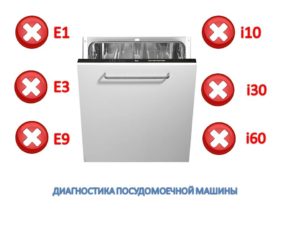 When a dishwasher breaks down, it's always frustrating. You quickly get used to good things, and washing dishes by hand is a real bummer. You want to quickly fix your "iron helper," ideally without spending a dime. Where do you start? Well, with diagnosing the machine and troubleshooting the problem, of course. In fact, the dishwasher itself largely performs diagnostics; the key is to understand its operation and draw the right conclusions. This is what this article will discuss.
Does a dishwasher help find a fault?
The manufacturer has ensured in advance that the dishwasher can detect faults on its own and inform the consumer about them. The control module contains a special software algorithm that allows it to immediately identify any malfunctions and display them on the display screen as a specific code.
Please note: If your dishwasher does not have a display, fault information is displayed using illuminated indicators in a specific pattern.
Dishwashers have a well-developed self-diagnostic program:
- Bosch,
- Electrolux,
- AEG,
- Miele,
- Ardo,
- Ariston,
- Beko and others.
In this article, we'll look at how diagnostics work in Bosch and Electrolux dishwashers. The error detection principle is roughly the same for all dishwashers, but the depth of analysis and accuracy of fault detection depend on the brand, model, control module generation, and many other factors. One thing is certain, however: all modern dishwashers have a self-diagnostic system, and it's extremely useful for both users and experienced technicians.
The most common faults and their codes
Most error codes for Bosch and Electrolux dishwashers are related to relatively rare malfunctions, so you're unlikely to encounter them. However, some are common, so we'll pay special attention to them. The following common errors are present in Bosch dishwashers.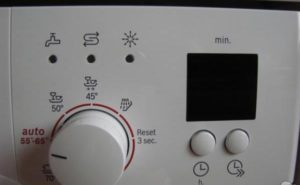
- The pumped water remains cold – error code E1.
- There are problems with the pressure switch - error code E2.
- There is too much water in the dishwasher – error code E5.
- The aqua sensor is out of order – error code E6.
- The heating element has failed – code E9.
- The Aquastop system has been activated or broken, a blockage has formed in the system – code E15.
- The Bosch dishwasher does not fill with water – code E17.
- The pump does not work at all or does not function normally – codes E21, E24.
- Low voltage in the electrical network – code E27.
In fact, in the dishwasher's memory Bosch has many more errors and, accordingly, codes for them; if we take the most modern models, they are capable of recognizing more than 200 different faults. But the above errors remain the most common. Electrolux keeps pace with its direct competitor, Bosch, by constantly improving the self-diagnostic system of its dishwashers. Here are the common error codes for Electrolux dishwashers.
- Problems with water supply to the dishwasher - the END indicator will blink once + code i
- The water drain into the sewer is difficult or does not work - the END indicator will blink twice + the code i
- The system preventing water from overflowing into the dishwasher has been activated - the END indicator will flash 3 times + the i code
- Water heating does not occur properly or does not occur at all - the END indicator flashes 6 times + code i
- There is a blockage somewhere in the system - the END indicator will blink twice + code E20.
Important! The letters preceding the digital error code will vary depending on your Electrolux dishwasher model; please refer to the instructions.
About decoding faults and their elimination
We've covered the self-diagnostic system of Bosch and Electrolux dishwashers in general terms. We've listed the most common error codes, and now we need to decipher these errors and outline troubleshooting steps. In this article, we'll provide an overview, but if you'd like more detailed information on a specific error, visit other pages on our website. Specifically, Error E24 in a Bosch dishwasher You can read about it in the article of the same name.
Errors E1, i60. These system errors indicate to the user and technician that the dishwasher's heating element or its electrical system is faulty. First, try running different wash programs.
If the heating element does not work on all programs, then you will have to disassemble the dishwasher and check the unit with a multimeter. A value within 1500 Ohm indicates that the unit is working; if it is much less, the heating element will have to be replaced.
E2 and i30. If your car displays these errors, it means there's a problem with the water level sensor. It's possible the sensor itself is working properly, but the contact that's cutting off its power supply is faulty. It's hard to say for sure until you see the component in person and verify. Sometimes simply blowing out the pressure switch will fix everything, but sometimes the sensor needs to be replaced.
Please note! Hard water has a destructive effect not only on filters, pumps, or circulation pumps, but also on the pressure switch, so don't be surprised if limescale deposits can remain on this sensor.
E21, E24, and i20. These errors occur when there are any problems with the water drainage. In this case, the dishwasher's operating mode is irrelevant. The pump may not be working, or it may be perfectly functional but unable to pump water, for example, due to a pinched hose, a clogged filter, or some other reason. Again, you'll need to perform a series of steps, as detailed in the article. My dishwasher won't drain – what should I do??
E15 and E20. These codes represent two categories of errors, different in nature but similar in their detection methods for dishwashers: a clogged drain and a triggered Aquastop. Why are these errors the same in terms of detection?
- In both cases, water cannot get into the dishwasher.
- In both the first and second cases, the control module correctly sends a command to fill the water, but receives the same response from the pressure switch.
- In both cases, the water line becomes clogged. Only with Aquastop does the line close automatically via a valve—this is a mechanical feature. If a blockage occurs, the line becomes clogged spontaneously by compacted dirt or limescale deposits.
The problem is solved quite simply. If the Aquastop hose has been activated, it must be replaced with a new one; the old one cannot be repaired. In case of a blockage, both chemical and traditional cleaning – done by hand – will help.
To summarize, initial diagnostics of a dishwasher's operation is the responsibility of the dishwasher itself. The manufacturer has ensured that the machine can automatically inform the user of the problem in the event of almost any malfunction, thereby making their life significantly easier!
Interesting:
Readers' comments
Headings
Washing machine repair




For buyers




For users


Dishwasher




Add a comment