
What is the purpose of a capacitor in a washing machine?
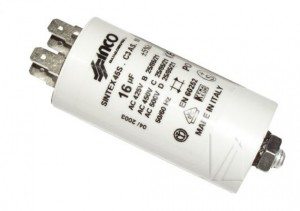 Washing machine manufacturers equip their machines with starting capacitors. These barrel-shaped components are installed inside the machine's housing. What is the purpose of a capacitor in a washing machine, and can the machine be operated without one?
Purpose of this part
A capacitor is installed in washing machines to start an asynchronous motor. This universal device can be used in any appliance with this type of motor. The capacitor is connected in series to the starting winding. It is needed to create and maintain a leading current during starting.
When the magnetization of the starting winding is delayed, a rotating magnetic field is created. Its function is to increase torque and facilitate starting the motor. As the rotor accelerates, the starting capacitor switches off. If the washing machine does not have a starting element for one reason or another, the operating winding is damaged and burns out. A capacitor is a self-healing component that functions normally after a breakdown.
What is the capacitance of the capacitor?
An important characteristic of a starting capacitor is its rated capacitance. The higher the capacitance, the better the device accumulates and retains charge. Over time, the capacitance of a washing machine capacitor decreases. To check this value and evaluate the device's performance, you'll need a multimeter.
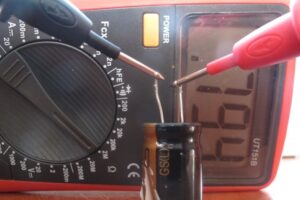
It's necessary to measure the capacitor's current capacitance and compare it with the value indicated on the casing. Experts warn that the measurement has its own peculiarities. Using a standard, inexpensive multimeter will only check whether the starting element is working properly. To do this, you need: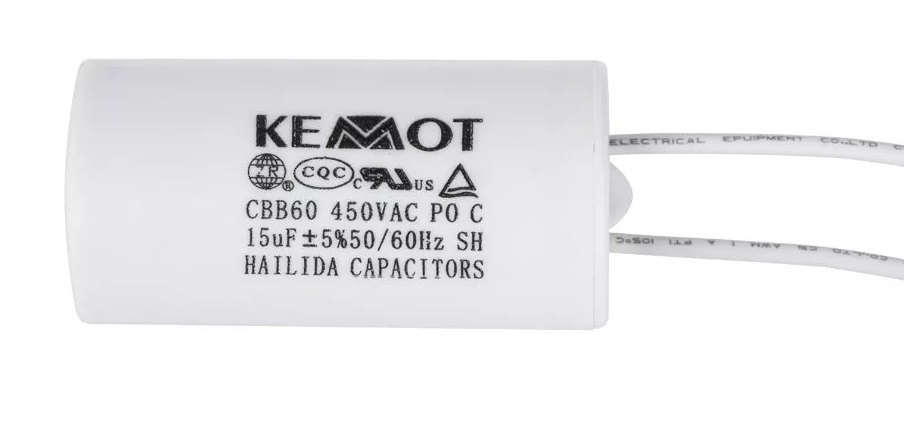
- move the tester to the continuity position;
- wait for a characteristic sound after touching the legs of the starting capacitor with the probes;
- Swap the measuring device leads and check again to see if the characteristic signal appears. This signal occurs if the capacitor's capacitance is greater than 0.1 μF;
Important! The higher the capacitance, the longer the multimeter's continuity test signal lasts.
To measure a capacitor's working capacitance more accurately, you need a professional multimeter. It's equipped with special connectors. The plug can be adjusted during measurement. Before starting, set the tester to the value indicated on the capacitor's body. Then proceed as follows: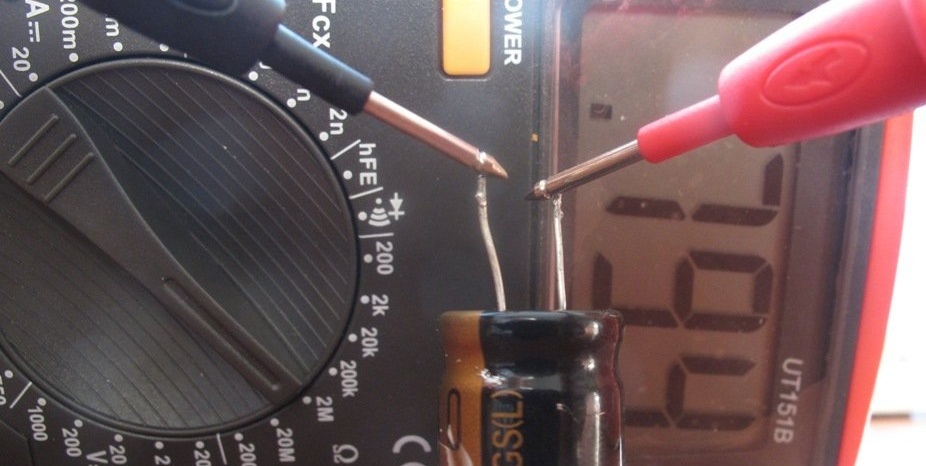
- discharge the capacitor with metal;
- the legs of the starting element are inserted into special “sockets” of the multimeter;
- When the tester screen shows the working capacity value, compare it with the nominal value.
If the deviation from the norm is significant, the capacitor is damaged and must be replaced. If the difference between the operating and rated capacitance is insignificant, the starting element is functional.
Let's measure the capacitor voltage
To check the operation of a capacitor, you can measure its voltage. To do this, you need a power source whose voltage is lower than that of the element. For example, if the capacitor voltage is 25 V, then a 9 V power source is sufficient. The testing principle is similar to the previous one: it is necessary to measure the voltage of the working capacitor and compare it with the standard one.
Using the tester's control knob, select the ohmmeter mode and connect the probes to the capacitor's terminals. Ensure polarity is correct. After a few seconds, the tester's display will show the measurement result. If the result is correct, the starting device is functioning properly. If the reading deviates significantly from the nominal value, the capacitor should be replaced.
Interesting:
Readers' comments
Headings
Washing machine repair




For buyers




For users


Dishwasher




Add a comment