
Why do you need a power filter in a washing machine?
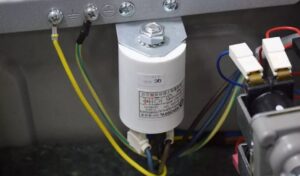 Modern washing machines are extremely sensitive to power surges. A sudden surge or drop in voltage within a second can damage the control board or motor, causing one or more microcomponents to burn out. A surge protector, or SPF, is designed to prevent this "chain reaction." A surge protector is designed to suppress pulsed and high-frequency interference occurring in the electrical network. Let's explore how this "fuse" works and how to test it for proper operation.
What purpose does it serve?
The surge protector acts as a protector for the washing machine – it dampens any frequencies except 50 Hz, preventing interference from damaging the machine.Upon detecting a critical voltage level, the FPS immediately shuts down the equipment, terminating the running cycle. If the observed failure was short and not severe, then the capacitors will be depleted; if the increase or decrease is too sharp, the element will burn out.
Running a washing machine without a surge protector is strongly discouraged. The slightest voltage fluctuation can damage the control board, motor, or other key components of the machine. The asynchronous motor is often damaged by interference: it stops rotating, but current continues to flow to the winding, which ultimately results in the motor burning out.
A surge protector can capture and smooth out power surges in the electrical network, protecting the washing machine from current leakage.
A surge protector is also used for external protection. Switching programs and starting and stopping the washing machine's motor alters the direct current in the electrical system, which can damage other appliances and devices connected to the line. The surge protector detects fluctuations, equalizes the current, and "discharges" excess current to ground. The filter is designed for a long service life and rarely fails. A surge protector will fail in the following situations: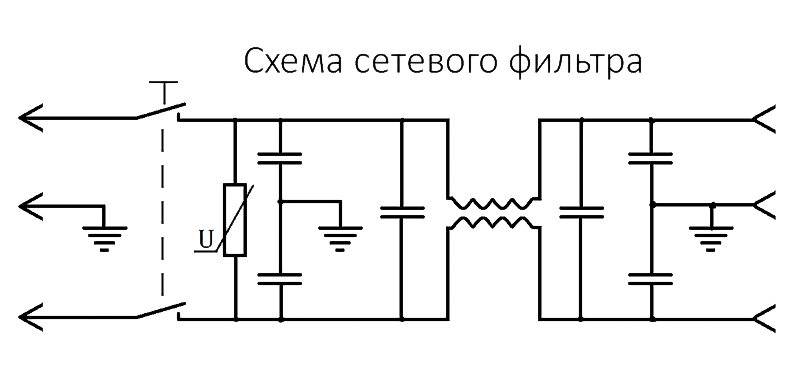
- the capacity of capacitors decreases;
- the element is "broken down" by a strong voltage surge;
- The FPS burns out due to a sudden power outage (when the user pulls the cord out of the socket).
The interference filter can't be repaired—it must be replaced entirely. But first, you need to check the FPS for functionality. You can do this yourself.
How to test FPS?
Modern washing machines are well protected from external interference, so most of them will not start without a working interference filter. As soon as the fuse burns out, the system urgently switches off the circuit breaker, not responding to further user commands. Until the part is replaced, the appliance will remain silent. If the washing machine doesn't turn on, the interference filter is often to blame. Therefore, after checking the power cord and plug, you should pay attention to the capacitor. A faulty interference filter is also often accompanied by the following symptoms:
- the machine body is electrocuted;
- there is a smell of burning, melted insulation;
- The washing machine is not working properly (it suddenly turns off or changes modes during washing).
If you suspect a problem with the interference filter, you need to begin diagnostics. To check, you'll need a multimeter, a flat-head screwdriver, and a Phillips-head screwdriver. First, you need to access the component: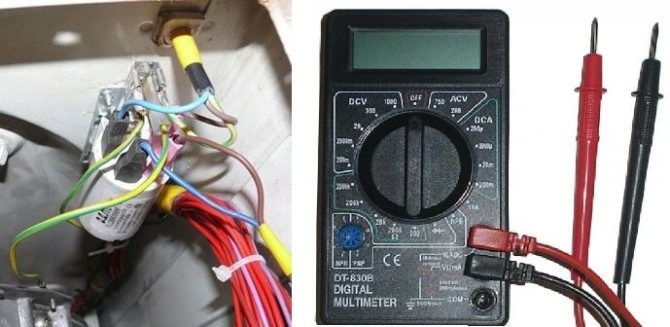
- de-energize the machine by turning off the power and removing the cord from the socket;
- disconnect the washing machine from the water supply by turning off the water supply tap;
- remove the top cover by loosening the retaining bolts on the back wall;
- find the place where the power cord is connected to the machine body;
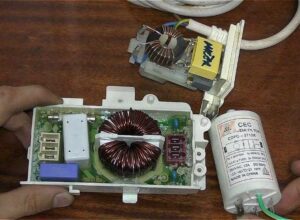
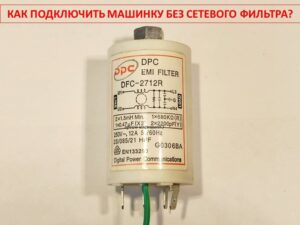
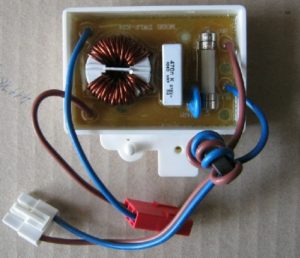
- Find a black or white bulb-shaped part on the cable – a noise filter.
The next step is a continuity test. Set the multimeter to ohmmeter mode and begin taking measurements. First, attach the probes to all contacts in pairs and compare the reading with the standard of 680 kOhm. Next, measure the input resistance on the plug; it should be within 680 kOhm. If the deviations are significant, the readings are too high, or approach zero, then there's no doubt the filter is burned out and needs to be replaced.
You also need to check the condition of the capacitors. This is difficult to do, as the compound on them will interfere with the measurements. But you can try: attach the multimeter probes to different inputs and evaluate the result. The norm is around 0.47 μF. Is the obtained value different? Then we begin repairs. Replacing the FPS is easy: disconnect the old one and connect the new one. The main thing is to photograph the wire locations beforehand and remember safety precautions.
Interesting:


Readers' comments
Headings
Washing machine repair




For buyers




For users


Dishwasher




Add a comment