
Drum filter for RAS from a washing machine
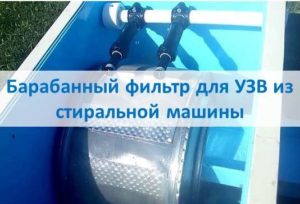 The development of filter elements is rapidly growing. This is due to the poor quality of water. Filters are used to purify drinking and wastewater in households, as well as in industry and the fisheries industry. Artificial ponds with closed-loop self-cleaning systems are used for fish breeding and farming. A similar filter device can be made from a washing machine drum. Let's discuss the operating principle of a closed-loop system and how to build a drum filter for a recirculating aquaculture system (RAS) from a washing machine.
How does a cylindrical filter work?
Let's take a closer look at the purpose of this type of filter. A metal cylinder, equipped with a filtering surface (which can be either external or internal), is driven by an electric motor. During external filtration, dirt and plaque settle on the surface, from where they are removed by a special knife after one rotation of the drum. The filtered liquid entering the cylinder is directed into the clean water tank.
In drums with an internal filter surface, untreated liquid is transferred to the filter, clean water is transferred to the tank, and dirt is collected inside the tray. The user must monitor the level of contamination in the vessel and clean it as needed. This is the basic operating principle of a RAS with external filtration.
- The drum is placed horizontally and placed in a container with incoming dirty water.
- Liquid poured onto the filter surface passes into the drum, being simultaneously cleaned, and is transferred to the clean water tank.
- The sediment is retained on the filter cloth.
- At the end of the revolution, the plaque is removed by a specially provided blade and transferred to the settling tank.
There are three types of drum filter elements, differing in their design features:
- filter element equipped with a reservoir;
- filter in a metal frame;
- frame filter element, supplemented with an inlet pipe.
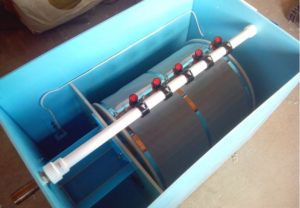 To construct a filter yourself, it's important to understand that the metal used to make the element will vary depending on the presence of salts in the liquid: to purify salt water, you need stainless steel, which is resistant to chlorine-containing substances. For fresh water, stainless steel with normal corrosion resistance is ideal. The cylindrical filter unit consists of the following elements:
- a frame used to mount the drum;
- washing machine drum;
- water tank;
- electromechanical drum drive;
- injectors and pipes for them;
- blade;
- liquid level sensor;
- control unit.
This type of filter is used when the fractions are uniform in size, the concentration of dirt, debris, and other particles in the water exceeds 5%, the sediment sink rate is no more than 12-18 mm/sec, the dirt layer thickness is at least 5 mm, and the drum rotation time is between 30 seconds and 10 minutes. Fine fractions, forming a sediment smaller than 5 mm, will only heavily contaminate the element and are difficult to clean.
What do you need for a homemade filter?
Homemade drum cleaning systems operate on the following basic principles: after passing through an internal cleaning system, the filtrate enters a special tank, after which the filter surface is rinsed externally with nozzles. To construct the device yourself, you'll need the following:
- stainless steel mesh (used to create the frame);
- filter material;
- fasteners, with their help the fabric will be attached to the frame (screws, clamps);
- a metal frame required to secure the drum and tank;
- clean water tank;
- a sensor that measures the liquid level in the system;
- pump;
- pipes made of stainless steel materials (for input and output);
- stainless steel container;
- injectors and plastic tubes that will supply liquid to the injectors;
- sediment tray.
The frame for the filter unit is based on a washing machine drum, minus one side. Once all the parts and components are prepared, you can begin the process of constructing the unit yourself.
We manufacture a filtering unit
Once the drum filter technology has been studied and the main parts and components for the filter have been prepared, you can begin constructing the device. To create the filter system, follow these steps:
- construct a frame from a stainless steel support mesh and a washing machine drum;
- cover the resulting structure with filter material;
- Install stainless steel pipes at the contaminated water inlet and filtrate outlet, and weld the pipes to the body using an autogenous welding torch. You can insulate the joints using a special sealant;
- Install nozzles above the drum; they will serve to wash the filter fabric inside the drum – the sediment present there will be washed away into a tray designed for this purpose;
- install the electric motor - it should be located outside, in the area where the drum pulley is located;
- Automate the operation of the electromechanical drive by installing a liquid volume sensor and a time counting relay.
The process starts and proceeds as follows:
- the liquid level sensor, upon detecting a low level of purified water, signals the start of the pump and engine;
- The nozzles wash the drum, thereby cleaning the filter surface;
- The time relay controls the speed of rotation of the drum.
Filters of this type have become widespread; they can be used to purify water in small private farms engaged in fish farming. The filtering system does an excellent job of removing feed waste, feces, and other fractions from the liquid. The service life of a homemade purifier is also quite long. The drum unit's capacity allows for high-quality filtration of small volumes of water for personal use.
Interesting:
Readers' comments
Headings
Washing machine repair




For buyers




For users


Dishwasher




Add a comment