
Washing machine dimensions: height, width, depth
 Modern home appliance stores offer a wide selection of washing machine models. Of course, the most popular machines are automatic. Semi-automatics and other models are becoming less common. They may soon disappear from shelves entirely. That's why in this article, we'll explore the various qualities of automatic washing machines.
If you're thinking about buying a washing machine, you're probably concerned about the functionality and dimensions of various models. City apartments built during the Soviet era are modest in size. And if you live in one of these apartments, you're likely concerned about saving space.
In this case, it's better to buy a smaller washing machine. Standard bathroom dimensions may not allow for a full-size washing machine. Or they may allow it, but the limited space may cause inconvenience. In theory, you can buy a larger washing machine, but in that case, you'll have to place it in the kitchen or hallway.
The most common sizes of washing machines
 Most washing machines are standard models. They have roughly the same dimensions. However, if you need a washing machine for your own laundry room or other similar purposes, it's best to look for a larger model. This is because a larger model can wash more laundry at once.
However, most people want to buy a washing machine specifically for home use. In this case, you need to consider the available space in your apartment and which washing functions are most relevant to your needs. Traditionally, washing machines are installed in the bathroom, and we recommend that you consider this option first.
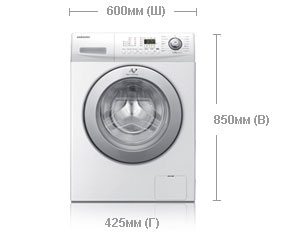
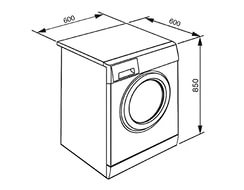
The dimensions of household appliances can be measured using fairly straightforward parameters, such as height, width, and depth. In most cases, the primary parameter for selecting a washing machine is its width. In some cases, height is also important, for example, when you want to place the washing machine under the sink or build a countertop above it.
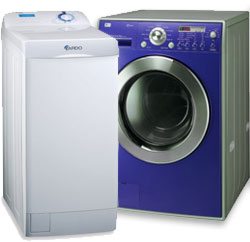
The dimensions and practicality of use in tight spaces may also depend on the type of machine:
- With front loading washing machines, you will need to ensure that there is some clearance at the front of the machine. Because it's on this side that the opening hatch is located. This is where you'll load and remove dirty laundry from the drum.
- With front-loading washing machines, you won't have to worry about space around the sides or front of your appliance. The door opens upward. However, keeping it under the sink or directly above the countertop isn't ideal. This will make it difficult to open the door and load and unload the machine.
Dimensions and weight in figures
The dimensions of a front-loading washing machine depend on the model:
- Width from 60 to 85 centimeters,
- height about 90 cm,
- and the depth can be from 32 to 60 centimeters.
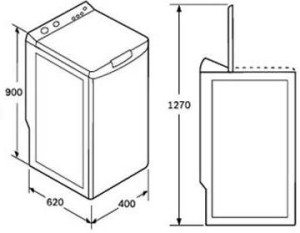
The dimensions of top-loading machines are as follows:
- The depth is usually about 60 centimeters,
- height - about 85 cm,
- and width: 40-45 centimeters.
Machine weights also vary. Some models can weigh up to 85 kilograms. The lightest ones weigh 50 kg. Most washing machines fall somewhere in between these two weight ranges.
Choosing a washing machine based on its size
 Choosing a washing machine isn't always easy. It's especially challenging for those who haven't purchased one before. When choosing, it's important to choose the right dimensions, especially if the space you've chosen for the machine is very limited. Be sure to measure the space you've prepared with a tape measure. To ensure that new household appliances fit without any problems, you need to leave at least a few centimeters of space between the size of the machine and the amount of free space.
You should also consider the size of your doorways. If you've decided to buy a large washing machine, you should ensure in advance that it will fit through all the doors that will be in your way, starting with the entrance and apartment doors and ending with the doors of the room you want to install it in. If the washing machine doesn't fit through the opening by just a few centimeters, you can temporarily remove the doorframes. This may help you get the machine through the door.
It is also important to consider the presence of pipes in the room. If you're planning to place your washing machine in a bathroom or kitchen, there are likely water pipes and other equipment there. If one of these pipes is located in a narrow space along the path of the movers carrying the washing machine, it could become an obstruction. It could also be an obstruction if it's located in the exact spot you've chosen to place the washing machine. Remember to measure the distance to account for these pipes.
If you've already purchased a washing machine and it doesn't fit into the space you've prepared, you have two options:
- Consider other possible locations. If the machine doesn't fit in the bathroom, you can install it in the kitchen or hallway. However, in the latter case, you'll likely need to run water and sewer pipes to it. In the kitchen, these pipes are within easy reach. This will save you the expense of extending and installing pipes.
- If for some reason you can't fit it anywhere, or you absolutely refuse to install it anywhere other than the designated space, where it won't fit, you'll need to return the washing machine to the store and exchange it for a smaller appliance. Or request a refund.
Important features of washing machines
In addition to size and weight, washing machines have other features that are important to consider when purchasing and using them. Generally, all existing washing machines can be divided into two types:
- Semi-automatic washing machines are a dying breed of household appliances. They are becoming increasingly rare in stores because they don't meet consumer demands, have limited functionality, and are unable to perform all necessary tasks independently. They require supervision. Furthermore, most of these machines don't even have a spin function.
- Automatic washing machines are the modern machines we're already accustomed to. Washing with them is a pure pleasure. You throw in your laundry, add detergent, set the program, press start—and that's it! Then you can relax. The washing machine will do everything itself. And you'll get fresh, clean laundry that all you have to do is hang it up. And even then, not always; some models also have a drying function. With these machines, you get both washed and dried items at once.
Clearly, the second option has many advantages. And you've probably already guessed why semi-automated cars are dying out like dinosaurs.
 But there are other parameters that matter to buyers, too. For example, the energy efficiency of a washing machine. Energy efficiency is an important criterion when choosing a household appliance. After all, some machines consume a lot of energy, while others use very little. Based on this quality, all household appliances are divided into groups designated by Latin letters.
The most energy-efficient option is a washing machine marked "A++," followed by "A+," then "A," then "B," "C," "D," and so on up to "G." The further the letter is from "A" in the alphabet, the more energy the machine consumes. As you might have guessed, washing machines marked "G" require the most energy.
Different washing machine models can wash different amounts of laundry at a time. If you live alone in an apartment, you won't need to wash a large amount of laundry at once. But if you want to wash for several people, you'll need a machine that can wash more than 6 kg.
There's also a classification system for washing and spinning performance. It's also designated by Latin letters and begins with "A." A model marked with this letter is considered the best in this area. Models listed alphabetically after this letter demonstrate lower performance in this area.
You can learn about other important criteria for choosing a washing machine by watching the following video:
Interesting:


Readers' comments
Headings
Washing machine repair




For buyers




For users


Dishwasher




Add a comment