
Where is the tachometer located in a washing machine?
 If you notice any symptoms of a faulty tachogenerator in your washing machine, it's essential to check the element immediately. To diagnose the sensor, you need to know where to look for it in the washing machine and what it looks like. Let's look at where the tachogenerator is located, how it works, and what this part actually is.
In a machine with a collector motor
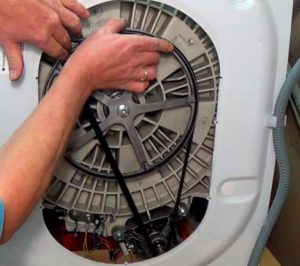
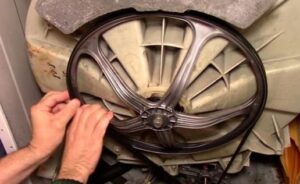
Determining what type of motor your washing machine has is easy. If, when removing the rear panel of the machine, you see a friction wheel (pulley) with a drive belt attached to it, then the machine has a commutator motor. If, when inspecting the rear of the machine, you don't see either a pulley or a drive belt, then your machine has an inverter motor. Owners of washing machines with a commutator motor should look for the Hall sensor directly on the electric motor shaft.
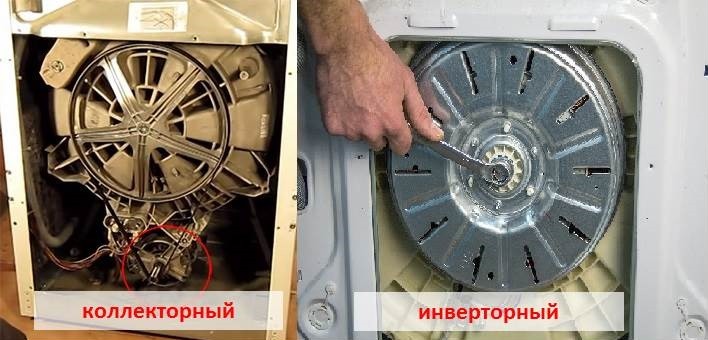
The tachogenerator is located either directly on the shaft or very close to it. Its location will depend on the washing machine model, sensor type, and overall design. Carefully inspect the shaft and the surrounding areas. The wires supplying the power must be connected to the element. Cables connected to the tachogenerator via a connector allow you to accurately identify the component.
In a machine with an inverter motor
Where is the Hall sensor located in this type of washing machine? It's located inside the electric motor. However, this location doesn't prevent easy access to the element. The procedure is as follows:
- Remove the rear panel of the washing machine by unscrewing the bolts holding it in place. On some washing machine models, the top cover may interfere with this process, in which case it will also need to be removed.
- Inspect the inverter motor cover. It is located on the crosspiece of the rear wall of the drum;
- Loosen the locking center nut and carefully remove the motor cover.
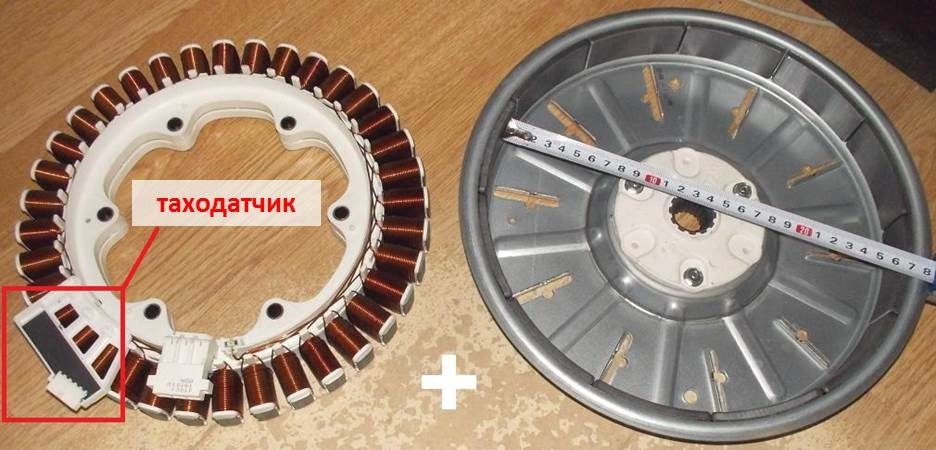
Once you remove the cover, you'll see the tachometer sensor. Once this part's location is determined, you can begin diagnostics.
How to check this part?
To diagnose the tachogenerator, it's not necessary to remove the element from its mounting location. However, the washing machine motor will need to be removed from the housing. First, disconnect the wiring leading to it, then remove the drive belt and unscrew all the bolts holding the motor in place. After this, the electric motor can be removed from the unit.
To test the Hall sensor, you'll need a special device—a multimeter. The tachogenerator wires must be disconnected from the connector, and then their resistance must be measured. Set the tester to resistance measurement mode and attach the probes to the sensor's contacts. A working tachogenerator will produce a resistance value of about 60 ohms.
To determine if the tachogenerator is conducting current when the electric motor is running, set the multimeter to voltage mode. Gently rotate the motor by hand while simultaneously measuring the voltage at the tachogenerator terminals; it should increase. When the motor is running, the voltage should be approximately 0.2 V.
If a multimeter test reveals no defects in the component's operation, check that the sensor mounting bolt is tightly tightened. If the mounting bolt is loose, the component may jam. If the bolt is not fully tightened, tighten it.
Sometimes the problem may be caused by loose contacts on the element. Carefully check all the wires supplying power to the Hall sensor and ensure they are connected correctly.
If the tachogenerator fails the test and is proven to be inoperative, it will need to be replaced. Hall sensor failure most often occurs due to overloading the washing machine. Therefore, to extend the life of the part, strictly control the weight of the laundry loaded into the drum.
How to install a new part?
To replace the washing machine's tachometer, you'll need to remove it from its mounting location. First, disconnect the connectors. They may be freely removable, or they may be loosely secured in a common socket. If the latter is the case, carefully pry the connectors out using a thin screwdriver.
Next, remove the tachogenerator cover, which usually simply snaps into place. In some washing machine models, the cover may be secured with several bolts that must be removed. Once the cover is removed, unscrew the bolts securing the Hall sensor itself and remove it.
The new tachogenerator is installed in its original location in the reverse order. It's important to connect the power supply wires correctly. To avoid confusion with the wiring diagram, it's a good idea to photograph the original contact connections before disassembling and then recreate the connection shown in the photo.
How does the sensor work?
It's important to understand the role of the tachogenerator in a washing machine's system. The sensor is a ring with wires attached. When the electric motor is running, voltage appears in the tachometer due to the magnetic field. The nominal value of the generated voltage is directly related to the motor rotation speed - the faster the engine rotates, the higher the voltage generated in the ring.
A tachogenerator allows you to accurately determine the rotation speed of a washing machine's electric motor.
The Hall sensor is designed specifically to monitor motor speed. It works like this: For example, the motor begins to spin faster to achieve the user-set spin cycle. The motor needs to reach 800 RPM. The control unit immediately signals the motor to increase speed, but at what point should it stop accelerating? The tachogenerator, which measures the motor's RPM, signals the control unit to stop accelerating the washing machine's electric motor when the set operating parameters are reached.
Interesting:
Readers' comments
Headings
Washing machine repair




For buyers




For users


Dishwasher




Add a comment