
How to place a refrigerator and washing machine in a small kitchen?
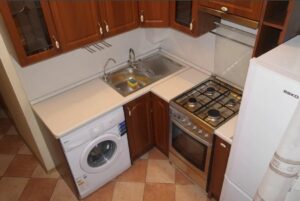 Owners of small apartments literally have to rack their brains when planning their furnishings. This is especially true when it comes to accommodating a refrigerator and washing machine in a small kitchen. Fitting all the necessary appliances into a limited space, while maintaining safety and convenience, is a real challenge. But with the right attitude, any challenge can be overcome with serious planning and forethought. We recommend taking your time and carefully considering the contents and design of your future kitchen.
The nuances of equipment placement
It's entirely possible to fit a wide variety of appliances and cabinets into a kitchen of 5 or 6 square meters. You just need to plan the space in advance and consider a few related details. Then, the close proximity of a refrigerator and a washing machine won't create any problems – they'll look harmonious, perform their functions, and not interfere with your everyday life.
Planning the layout begins with the most important element—the refrigerator. Typically, it's placed either at the entrance to the kitchen or in one of its corners. This way, the appliance is easily accessible, opens freely, and doesn't interfere with occupants' movement around the room. It's also important to consider the following recommendations when choosing a "refrigeration space":
- remember about the “work triangle” – there should be no more than 50 cm between the stove, refrigerator and sink;
- do not install the refrigerator under a window, next to a radiator, oven or sink (there is a risk of overheating or moisture getting in);
- When installing a refrigerator, leave an air gap of 2-5 cm;
- There must be a separate, grounded outlet of appropriate power nearby.
The arrangement begins with the refrigerator, as it is the most massive piece of equipment.
There are no restrictions on placing a refrigerator next to a washing machine. The only potential hazard is the increased humidity emanating from the machine, but with proper installation, this problem can be avoided. But that's not all—washing machines have their own installation rules:
- as close as possible to the sink, where the machine will be provided with the necessary rigidity and access to utilities;
- avoiding gaps and using shock-absorbing and vibration-damping devices;
- placing the washing machine in a cabinet, under the countertop, to save the work surface;
- hiding the technology behind a facade for aesthetic purposes.
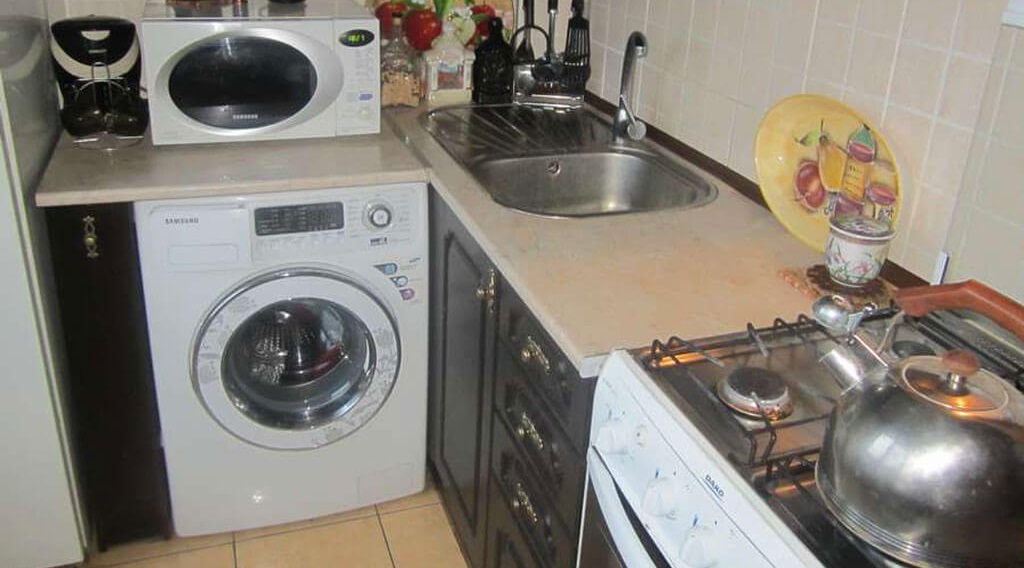
If you don't have any special requirements for your refrigerator, it's best to carefully consider your choice of washing machine. Firstly, it's recommended to choose a built-in front-loading washer, which is easier to conceal behind the front doors. Secondly, it's important to consider the noise level of the unit; otherwise, the noise will be disturbing. Thirdly, it's recommended to think about storing household chemicals and dirty laundry in advance.
Unlike a refrigerator, a washing machine is quite compact, so it's easier to move it around the unit when planning the final layout. The standard option – placing the machine in one of the lower drawers and hiding it behind the front – is not always suitable. This is especially true if all the available space below is taken up by other appliances or there aren't enough cabinets. In this case, it's best to consider more unusual style solutions.
A washing machine under a windowsill or table
If the lower tier of the kitchen cabinetry isn't enough, you can consider an alternative. Specifically, you can utilize the space under the windowsill if there's a niche of a suitable size. All you need to do is reconfigure the space and add utilities. Another option is to extend the countertop instead of a regular windowsill, adding a window area to the overall kitchen cabinetry. This way, you'll not only conveniently place a washing machine and utilize the empty space, but also add storage. However, this kind of remodeling isn't cheap.
In small kitchens, it is recommended to utilize the area around the window by extending the window sill and installing a washing machine underneath it.
A washing machine can be installed similarly under a table or breakfast bar. The latter is often found in kitchens of 5 square meters, offering a more compact alternative to conventional cabinetry. The only difficulty lies in the wiring – you'll have to move the dining area closer to the wall and run extra meters of wiring and pipes.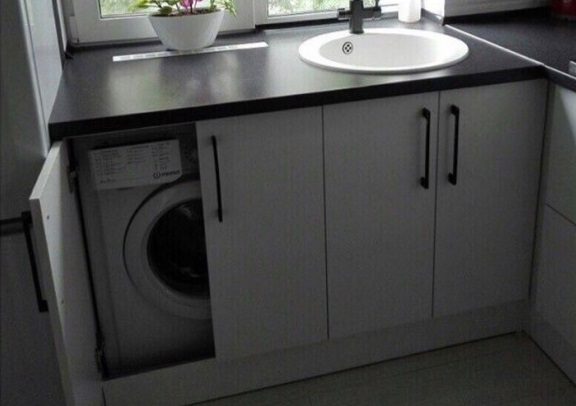
Washing machine in a column
A so-called column unit can help you fit a lot of appliances into a small kitchen. This is a tall frame consisting of several drawers designed for storing or installing electrical appliances. The units are stacked in several tiers, which solves the problem of limited space at the bottom of the kitchen unit. Another advantage is that a tall cabinet can be placed next to the refrigerator, and when integrated into the refrigerator, it creates a harmonious interior design. There are many options for arranging a washing machine in a column unit:
- machine plus cabinets;
- machine plus cabinets and oven;
- machine plus cabinets and microwave.
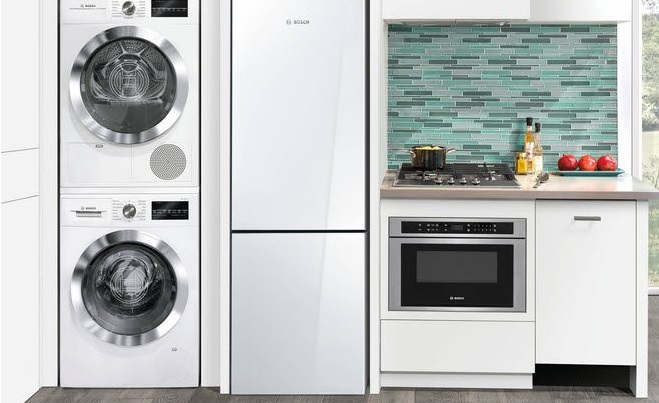
Thanks to the column, even "incompatible" appliances can be placed side by side. For example, using intermediate drawers and shelves, a single tall unit can accommodate both a washing machine and an oven. The former is located at the bottom, while the latter rises one level higher. Sometimes a third "level" is added for a microwave or coffee maker. As a result, the destructive effects of heat or humidity are reduced, allowing the appliances to be used conveniently and safely.
The optimal solution for a small apartment would be to install a washing machine in a column next to the refrigerator.
Installing a pencil case solves more than just the problem of the proximity of the washing machine and refrigerator. The design also allows the owner to rationally use the usually empty space, since the column “goes” practically to the ceiling. As a result, several cabinets are added at once for storing household utensils and food products.
If you bought a vertical one
Fitting a top-loading washing machine into the kitchen is more difficult – front-loading models are recommended. However, if there's no other choice, the user has two options: either install the machine freestanding in a free corner or try to conceal it in a creative way. In the latter case, proceed as follows: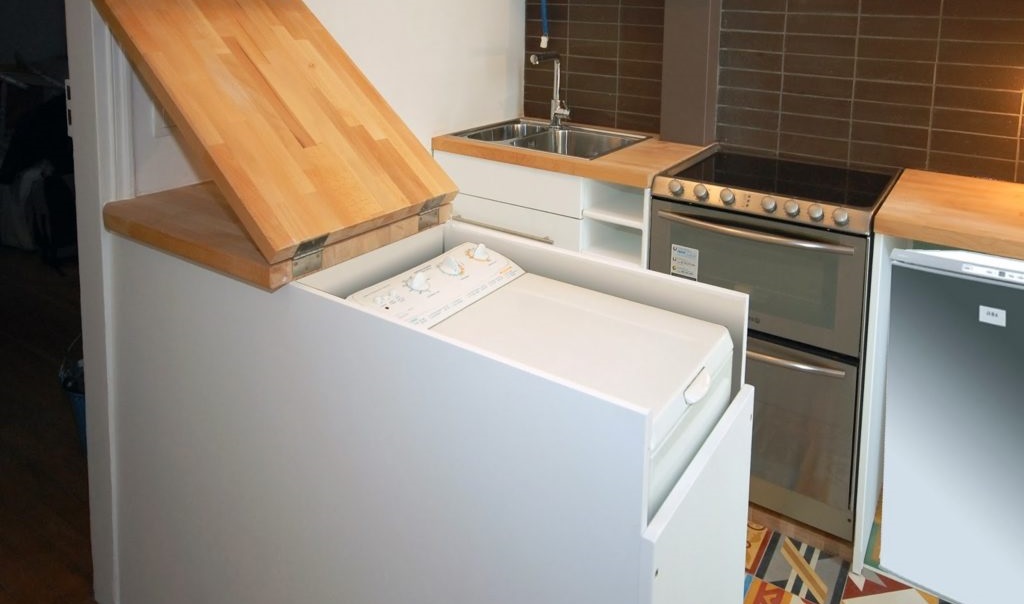
- we organize an “island” or a bar counter with a folding tabletop, under which we place the vertical table;
- We choose a corner of the kitchen unit where we “lower” the washing machine and hide it under the hinged lid.
Top-loading washing machines are more difficult to fit into a compact kitchen; it's better to buy built-in front-loading models.
Upright washing machines have the advantage of being compact. They're typically no more than 50 cm wide and 55-60 cm deep. This allows them to easily fit into awkward spaces in the kitchen, helping to make the most of the available space.
Expert recommendations
A small kitchen is not a death sentence. You just need to take the layout seriously, think through the available space in advance and try to find a “compromise”. Thus, experienced designers advise considering the following recommendations when placing a washing machine and refrigerator in a kitchen unit:
- pay attention to “inconvenient” places (the space under the ceiling and above the refrigerator);
- reduce the number of appliances and dishes, replace unused equipment with necessary ones (a full “revision” with an analysis of needs and future comfort is needed);
- consider the option of a "split" refrigerator, where the freezer and refrigerator compartments are purchased separately;
- combine the kitchen with the living room, which will allow you to add space for a refrigerator and washing machine;
- select furniture and appliances of reduced sizes (many brands offer narrow models with a small capacity);
- take into account the height of the washing machine when selecting the lower tier of the kitchen unit;
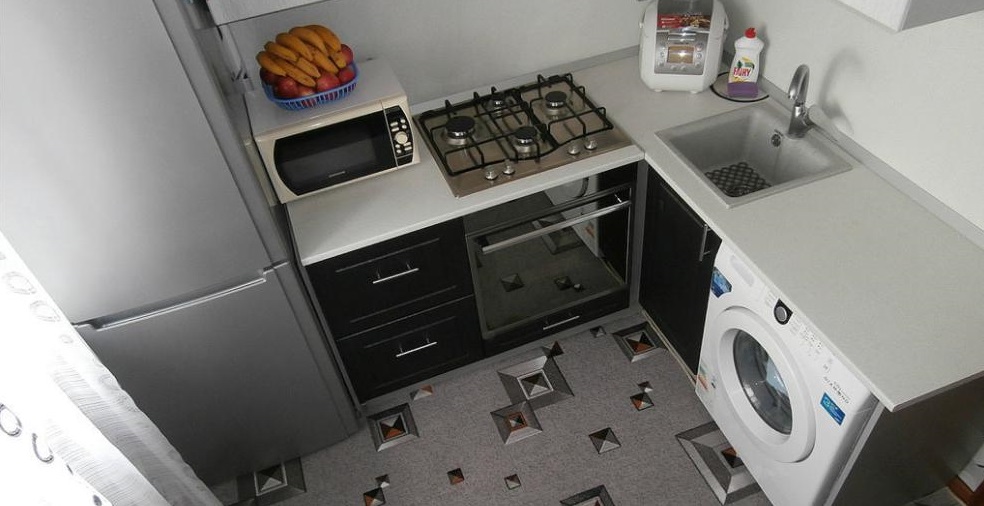
- Provide the kitchen with a number of sockets of suitable power to ensure uninterrupted and safe power supply to all installed appliances;
- Remember the secrets to visually expanding space - empty shelves and light-colored furniture and appliances.
Many household appliance manufacturers offer devices with reduced dimensions, which makes their installation convenient and simple.
Often, owners of a 5-6 square meter kitchen are saved by redevelopment – combining the “kitchen block” with a balcony, living room or hallway. There is just one “but”: renovating an apartment will require making appropriate changes to the technical passport. Moreover, any major adjustments must first be agreed upon with the management company to obtain special permission.
Modern appliance manufacturers are making things easier for owners of small spaces – it's now easy to find narrow and built-in models of any size. Furniture makers are also available to help, ready to craft the perfect, spacious custom-made set for spaces as small as 5 square meters or as large as 20 square meters. This allows for seamless placement of a refrigerator and washing machine in a confined space. The key is to think through the layout options in advance and, if financially feasible, consult with professional designers.
Interesting:
Readers' comments
Headings
Washing machine repair




For buyers




For users


Dishwasher




Add a comment