
Which washing machine motor is better: an inverter or a standard one?
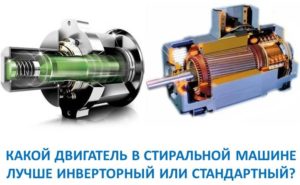 Automatic washing machines equipped with inverter motors have only recently come into production, but have already established themselves in the household appliance market. Compared to their brushed counterparts, this type of motor is more expensive and significantly outperforms standard motors, specifically in terms of operational reliability and greater wear resistance.
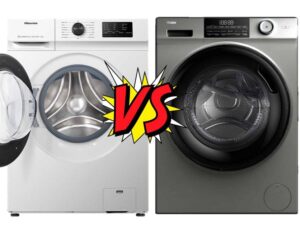
Today, competition between these types of motors is reaching its peak, and consumers should understand the advantages and disadvantages of each to determine whether to choose an inverter or a standard motor.
Why is an inverter considered better?
An inverter washing machine motor offers numerous advantages. Both experts and most users note the benefits of washing machines equipped with an inverter. Washing machines with this motor are characterized by:
- reduced consumption of electrical energy and increased efficiency (this result is achieved by reducing the number of working parts of the unit);
- durability – the inverter has no brushes, unlike a conventional motor, and therefore there is no need to replace this quickly wearing element;
- reduced noise level during operation (this is achieved by reducing the number of parts of the machine that come into contact with each other);
- By suppressing vibrations and shaking that occur during washing, this ensures and maintains uniform distribution of laundry over the surface of the drum;
- instantaneous automatic transmission reaching the required number of revolutions and constant maintenance of the required speed;
- softer and smoother start;
- the ability to spin at high speeds (up to 2000 rpm), which allows you to remove clean items from the drum practically dry.
You must agree that the listed advantages are quite significant. It can be concluded that inverter washing machines are much more economical than collector-type machines, are more reliable, and provide high-quality washing and spinning.
Let's compare engines
The inverter motor is a Korean development. It has been in use for a long time, originally intended for microwave ovens and air conditioners. However, since 2005, thanks to global brands Samsung and LG, these motors have been incorporated into washing machines to improve their resource efficiency and reliability.
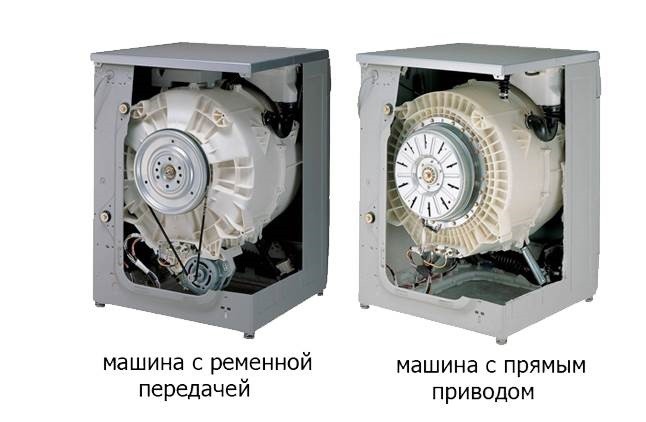
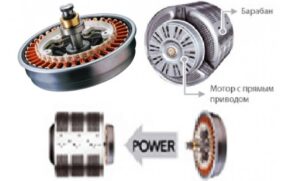
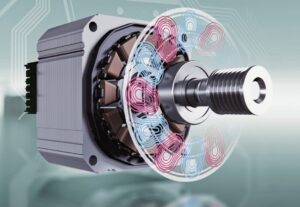
The operating principle of an inverter motor is as follows: when the motor rotates, a frequency converter, called an inverter, is created. This converts alternating current into direct current, producing an output current of the desired frequency. This process allows for precise regulation of the motor's rotation speed and maintaining an optimal RPM.
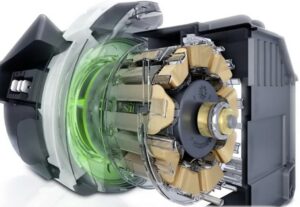
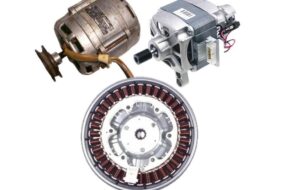
An inverter motor for an automatic washing machine differs from a commutator motor in its design: it does not have brushes that rub against each other, but maintains rotation using an electromagnetic field.
Car brands with similar motors
Modern automatic washing machines from the global brand Samsung are equipped with inverter motors. The washing machine series CrystalStandard In addition to this advantage, it can offer the user the "Eco Bubble" technology, otherwise known as the bubble wash method, which will ensure high-quality removal of the most difficult stains. The extensive functionality of Samsung models allows you to select washing parameters for any type of fabric, and a large number of interesting additions make using the device even more convenient and enjoyable.
The Yukon series of washing machines with inverter motors also features the "Eco Bubble" function. The machine can clean laundry using steam during the dry wash cycle. This feature is ideal for wool, hollow fiber, and suits.
The renowned LG brand offers customers its latest innovation: inverter washing machines operating on the direct drive principle. These models are part of the "DirectDrive" series. They operate virtually silently, creating no disturbance for family members, even at night.
It is worth highlighting the 6 Motion model, which has the ability to rotate the drum in six different modes:
- standard - most often used during the main wash;
- reversible - helps to dissolve washing powder well;
- rocking - it is recommended to turn it on at the stage of soaking the laundry;
- torsion;
- saturation - allows you to evenly distribute powder and other detergents over the fabric);
- Smoothing – allows for washing without excessive creasing and ensures easy ironing.
Washing machines equipped with inverter motors, which are currently available on the home appliance market, continue to prove their reliability and efficiency. European manufacturers such as Electrolux, Bosch, and Whirlpool have also been producing machines with similar motors in recent years. AEG offers a ten-year warranty on its inverter washing machines, as it is completely confident in their quality and reliability. If you prefer domestically produced appliances, consider Belarusian "Atlant" models.
Car with inverter: to buy or not to buy?
 Is it worth paying extra for an inverter motor in a washing machine? The undeniable advantage of an inverter is greater energy efficiency, increased reliability, and durability. Compared to conventional motors, technologically advanced machines consume 20% less electricity.
To make a final decision between an inverter or standard motor, it's best to analyze the pros and cons using a simple example. Let's say a user has a 2 kg load of laundry (with a maximum load of 6 kg). The converter motor will rotate the drum at the maximum speed possible for the machine, while the inverter will select the optimal number of revolutions based on the weight of the loaded items. Power consumption will be reduced as the device optimizes and stabilizes the drum rotation speed in each specific case.
Electricity is primarily used to heat water; an inverter will save between 2% and 6% of energy at this stage, provided the drum is not loaded to its maximum permissible weight.
Direct-drive inverter motors operate completely silently. So if this is important to you, we recommend considering LG's DirectDrive series models.
Another advantage of inverter washing machines is their high-speed spin cycle. Some models can spin up to 2,000 rpm. However, it's important to remember that such a high spin cycle can have a negative impact on the condition of your laundry.
As for durability, you need to consider how long you want to use your washing machine. If you're looking at 10, 13, or 15 years, a mid-priced inverter washing machine will easily last that long. Moreover, washing machines several levels higher than those currently available are sure to be released within that timeframe. However, if you're buying a machine for 20 to 30 years, it might be worth the extra cost for a longer-lasting inverter.
It's also worth understanding that inverter washing machines feature state-of-the-art motors. Manufacturers offer a long warranty on their units, but if a breakdown does occur after the warranty period, be prepared for a hefty motor repair bill.
Chooses the right equipment
When purchasing an inverter washing machine, be sure to carefully study its technical specifications. So, what features should you focus on?
- Energy efficiency class. It's best to purchase devices with energy efficiency ratings of "A," "A+," "A++," or "A+++." The more plus signs after the "A," the less electricity the washing machine will use.
- The drum speed during spinning. Most inverter machines spin at 1600 rpm. However, such high spin speeds can damage items, so chasing this speed is not necessary.
- Maximum load. This depends on the size of your family. For 1-2 people, a washing machine with a drum capacity of up to 5 kg of laundry is suitable; for families of 3 or more, it's better to look for a larger capacity washing machine.
- Noise level – for comfortable use of the device it should not exceed 75 dB.
- Intelligent functionality. The more features and washing modes available, the more convenient the machine is to use. A modern washing machine should have basic washing programs. It's advisable to choose a machine with Eco Bubble and AddWash technology, a steam wash function, an easy ironing function, the ability to save favorite settings, a delayed start, a child lock, etc.
Choose a washing machine that provides protection for the housing from emergency leaks!
When choosing a washing machine model, don't necessarily focus on a next-generation motor. "Induction motor" shouldn't be the primary criterion; it's much more important to consider the washing machine's key performance indicators, functionality, ease of use, and safety features. And consider the "inverter motor" option a nice bonus.
Interesting:
33 reader comments
Add a comment
Headings
Washing machine repair




For buyers




For users


Dishwasher




The author of this article is a real joker. Washing machines don't last 20-30 years. 12 at most, and then mold will eat away all the rubber seals, the electronics will start acting up, the drum dampers will leak, the concrete load will shatter, and you'll be left with nothing but your immortal inverter motor.
We bought our washing machine 21 years ago. It's still working, but we shouldn't move it. The metal has started to rust, and if we move it, the frame will likely fall apart. So, it's not guaranteed to last 12 years.
At that price they charged a decent amount of $250.
I have an Italian washing machine, it has been working for 25 years without any breakdowns!
I don't quite agree with your conclusion. My Indesit has been in operation for 24 years (unfortunately, its last) – the bearing is gone!
In 2018, we bought an Indesit ewsd51031. It rusted after three years, and today a bearing came loose. The quality of modern machines is dismal.
My Bosch machine has been in service for 20 years without any repairs. And it looks brand new.
I've had an Electrolux for 17 years. I replaced the heating element and the pump.
My Bosch has been serving me for 26 years without repairs.
Siemens 25 years old. No rust anywhere, only the motor brushes changed once.
Beko has been in service for 24 years without any breakdowns or rust on the body, in the village with my grandmother, daily washing in the summer, 1-2 times a week in the winter.
Candy is 27 years old, pump and heating element, and only because the contacts have become loose. Looks brand new.
They used to make machines like this! I bought an Ariston Dialogic in 1996, and it still works, I just changed the brushes!
The Samsung has been in business for 16 years and still going strong. I've only replaced the belt once.
Indesit. Italian. It's been around for 18 years, but it's starting to show its age. It's probably time for retirement. 🙂
Who will translate the operating principle of an inverter motor into technical language?
The brushless motor is controlled by a separate board, so it lasts a long time. But if the board fails, it's like replacing the matrix on a TV.
My first Italian car is 25 years old, our second one is 8 years old under an Italian license, and our third one, from Lipetsk (Ariston), lasted 1 hour 37 minutes and was returned to the store. The software crashed. Judge for yourself.
My Bosch washing machine works perfectly. And it's 30 years old.
Candy. 16 years of work.
LG 18 years without repair
Hotpoint Ariston. After 18 years, a belt change and that's it.
Siemens Siwamat 3301 has been in operation for 32 years. Motor brushes have been replaced twice – $15.
In October 2022, the drum shock absorbers and drive belt were replaced - $35.
Serious term of work.
LG without a single repair, for 20 years already, and no rust!
Ariston, 20 years without a single breakdown. Looks great. No sign of rust.
Bosch, 21 years old. The programs crashed once right at the start, and that was it! I haven't even changed the belt. I always used it on maximum heat, with vinegar or lemon juice, then bleach and bleach at the same maximum heat. That's quality for you 🙂
Veko served a family of three for 17 years.
Bosch has been operating for 26 years.
My Candy hasn't even lasted five years. The heating element burned out, and now it roars like a plane taking off. Everything inside is banging around, there's a leak somewhere... but it's still working. It cost about 15,000. I've already paid 10,000 for repairs.
Ardo is 27 years old, changed the belt in 2015, still washing it...
What can I say, your machines are good, but the quality is not what it used to be, and you are unlikely to find a native Bosch or LG, they are all Chinese or domestic.
I read all your reviews and concluded that while almost any brand of washing machine continues to work perfectly, the quality was completely different. Nowadays, they make washing machines that are specifically designed to make people buy new ones after just 3-4 years. Repairs are sometimes so expensive that it's cheaper to buy a new one.
Hotpoint WDG 862 with dryer. It's been 9 years and the control unit is on a bender. They're asking 12,000 rubles for a detox. 9 years of use and that's it. We're buying a new one.
Ariston, Italian, 17 years in operation. After 15 years, the pump was replaced, but now the bearings have started making noise. The rubber rim of the inlet has become deformed and is rubbing against the drum. It's making strange noises. The mechanic trimmed the rubber edge, the noise went away, and predicted another six months of operation.