
The history of the washing machine
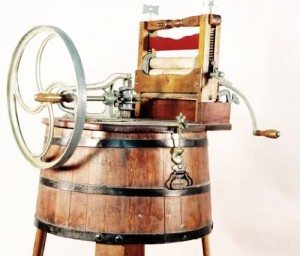 They say that many centuries ago, people who often sailed on ships devised an ingenious method of washing clothes. They tied clothes and dirty laundry to a rope with knots and tossed them into the water. The sea waves washed the laundry, flushing out the dirt as the ship moved. The force of the waves and the speed of the ship created a mechanical action. This was the first important factor in the modern washing machine.
A second, no less important factor, is chemical action. People have used various similar substances for washing and cleaning for quite some time. Archaeologists have discovered an object used as soap by ancient Romans. It was made from fat and ashes taken from sacrificial altars where animals were sacrificed to the gods.
Dates in the history of the washing machine
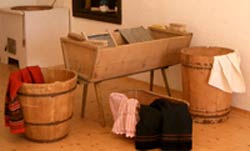 Much later, at the time when the patent office appeared, many inventors began to register inventions that were aimed at facilitating the process of washing clothes.
- The year 1797 blessed us with the gift of the washboard. This household item became a long-standing fixture in many homes and families.
- In 1851, J. King, an American, received a patent for the first washing machine with a rotating drum. It was hand-operated, meaning that to wash clothes, one had to turn the handle. This served as the prototype for the modern washing machine.
- By 1985, more than two thousand patents had been filed by various people who had invented various devices to make washing clothes easier. Not every idea proved viable or developed into something useful in the future.
Of note is the original machine, which was invented and brought to life by a Californian gold prospector in 1851. It could wash a dozen or more shirts in a single wash. To keep it running, it required human labor, which consisted of about a dozen mules. The enterprising inventor began making money from his washing machine by washing his colleagues' clothes for gold.
It's generally accepted that the first laundry arose out of the need for laundry among a large number of bachelors. Who knows, perhaps this happened in one of the gold-mining settlements.
After washing, washing clothes requires spinning. How can this process be made easier? 1861 brought us the first washing rollers. A wet item was placed between them, and a handle was turned to create a rotating roller. The item passed through the tightly pressed rollers, and the water was extracted. You can find exactly the same rollers on semi-automatic washing machines, which were used for washing until recently.
Until the end of the nineteenth century, the majority of washing machines were powered solely by manpower. That is, with the help of various livestock or human power. William Blackstone's invention worked in the same way. An adult man living in Indiana delighted his wife by giving her a hand-made machine for her birthday.
This device is considered the first example of a domestic washing machine. It was also the first to be mass-produced and widely sold. William demonstrated the qualities of an excellent businessman. He founded a manufacturing plant for his invention, selling it for two and a half dollars apiece. The company he founded continues to operate and manufacture washing machines to this day.
In the small town of Eaton, Colorado, there's a washing machine museum. Its founder, Lee Maxwell, has amassed a large collection of various washing machines dating back to the early 20th century. At the time of writing, the museum houses over six hundred exhibits. Remarkably, all of them are in working order.
Washing machines with a motor
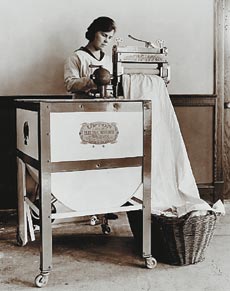 The turning point in laundry was the use of motors. Some motors ran on gasoline. Others on electricity. The pioneer (or one of them) in the mass production of electric-powered machines was the Thor machine. It was created in Chicago in 1908. Its creator, American Alva Fisher, became the inventor of a new type of household appliance.
In 1920, there were over 1,300 companies producing typewriters in America. Most of them have not survived to this day. However, there are some that still exist. Then the company Whirlpool CorporationYou can also see this company's products in modern home appliance stores.
Washing machines continued to be improved. While the first models had exposed components and posed a danger to careless users, newer machines were safe and attractive.
The advent and development of washing machines and other household appliances had a significant impact on American life. The number of people working as domestic servants decreased, and the need for laundry services diminished. By 1953, the number of washing machines sold was approximately 1,400,000 units. And one car cost about sixty American dollars.
The evolution of washing machines
- 1920s – wooden and copper tanks are replaced by enameled ones.
- In the 1930s, electrically powered drain pumps came into use, as did timers.
- 1949. The first software device. And the automatic washing machine was born.
- 1950s – Automatic push-up mode appears.
- 1978 – a machine using a microprocessor was made.
- The beginning of our century – cars are integrated into the “smart home” system.
Washing machine manufacturers continue to improve their machines, introducing new wash cycles, additional features, and other innovations.
Modern cars
In modern washing machines, discrete logic with strictly defined parameters has been replaced by Fuzzy Logic. It utilizes a variety of configurable parameters and information read by various sensors and transmitted to the control module.
The UseLogic system is used in the most modern washing machines. It analyzes and influences the washing process, bringing it to an optimal level. Various processes are monitored and adjusted during the wash cycle. This improves washing quality and keeps laundry in excellent condition.
The Clear Water sensor monitors water pollution levels and, if necessary, adjusts the program by adding an extra rinse.
Safety of modern household appliances
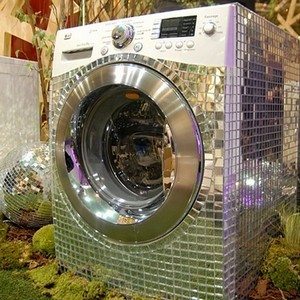 Nowadays, one of the most developing trends in the development of various technologies is the safety of its use.
Many washing machines have operating features that are unknown to most users. For example, Electrolux equips its machines with systems that lower the drain water temperature. This precaution reduces the temperature impact on the sewer pipes, which in turn prolongs their life.
One of the most frustrating washing machine problems is a leaking inlet hose. It's frustrating not because a new hose is difficult to replace or expensive. On the contrary, it's easy to replace, and a new hose is quite inexpensive. The problem is that if this malfunction occurs, you risk flooding both your apartment and the neighbors below.
To prevent the consequences of this type of failure, many washing machine manufacturers use special systems. For example, Electrolux uses Anti-Flood. It measures the machine's pressure and takes appropriate measures in the event of a leak.
Siemens and Bosch use the Aqua-Stop system, which also serves as a leak prevention system. If a leak is detected, it immediately shuts off the water supply.
There are also separate devices that serve the same purpose. One such device is the Water-block safety valve. It is installed before the inlet hose. If a leak occurs, it stops the water flow. Once the problem is corrected, the valve is released and ready for use again.
Top and front loading of laundry
Front-loading washing machines are more popular in European countries. In some parts of Europe, such as France, top-loading machines are more common.
Front-loading machines are loaded through a transparent door located on the front. You can also monitor the progress of the wash through it. When positioning the machine, keep in mind that the door opens forward. For comfortable use, leave enough space in front of the door. You can use the top of the machine as a table (as long as there is no vibration during operation). If the model and location of the machine allow, you can install a sink above it.
In top-loading machines, laundry is placed into the drum through an opening top lid. This eliminates the need to worry about space in front of the machine. However, using it as a tabletop can be difficult. Since the top lid acts as a loading hatch, it must be able to open freely.
Interesting:

Readers' comments
Headings
Washing machine repair




For buyers




For users


Dishwasher




Add a comment