
How often should I add salt to my dishwasher?
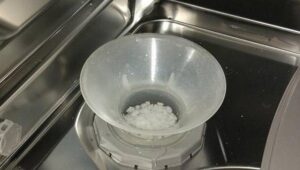 Most housewives believe that the most important step is adding salt to the dishwasher for the first time, filling the salt compartment to the brim. This can lead to forgetting about it for a long time. In reality, a kilogram packet of salt is usually only enough for a few months of active dishwasher use. Therefore, the salt compartment should be regularly checked and granules added to maintain the integrity of the ion exchanger, which softens tap water and improves dishwashing results. Today, we'll discuss how much salt to use for dishwashers and how often it should be added.
How long does one load of salt last?
There is no absolute definitive data on when to add salt again, because there are as many people as there are people using a dishwasher. It often happens that after the first load, only 5-10 work cycles have passed, and the machine already requires refilling the salt reservoir. This can happen if the dishwasher owner added salt "by eye" the first time, adding too little and failing to achieve the desired salt solution concentration. Furthermore, future salt granule replacement intervals may also vary, influenced by a number of factors.
- Water hardness and dishwasher settings. If your tap water is hard, set the dishwasher's hardness settings to the maximum to protect the ion exchanger, which must constantly replenish its spent resin. Therefore, salt consumption varies depending on whether you have hard or soft tap water—the better the water, the less salt granules you'll need. For example, in conditions of moderate water hardness, salt can be added only once every 4-6 months.
To properly adjust the water hardness on your machine, visit the official website of your local water utility to find out accurate information about water quality and adjust salt consumption.
- Frequency of use. It's logical that if you use your dishwasher every day, it will use much more salt than if you use it once a week. Every cycle uses up the salt solution, so you need to refill the dishwasher from time to time. With daily use, the salt crystals may last only a quarter, and if you use them infrequently, you can forget about refilling the salt for six months or even a year.

- Salt quality. A special salt has been created for dishwashers. Not only does it have regenerative properties and is better purified from impurities, but its crystals are also significantly larger than those of regular table salt. To minimize consumption, purchase only brands with large crystal sizes, such as Finish, EONIT, and Mister DEZ.
Each of the three factors listed above is important for salt consumption, so it's advisable to monitor all of them. Ultimately, salt should be added when the previous supply begins to run low.
The machine will tell you when to add salt.
It's very convenient that modern dishwashers are equipped with a separate salt indicator located on the dishwasher's control panel. The indicator is marked with an icon with two curved arrows, and it lights up only when salt needs to be added. In some dishwashers, the indicator will glow bright red, while in others, it'll be a dim yellow, so you'll have to pay close attention to the signal to refill the salt.
This signal is generated by a special sensor built into the ion exchanger. It monitors the saturation of the saline solution and is activated when the salt concentration drops below the normal level. Keep a close eye on the salt indicator on the panel, as it will always tell you exactly when to add salt to the dishwasher.
What if the indicator does not light?
If you're using an older appliance, there may not be a dedicated indicator on the control panel. In this case, you'll need to watch for the following signs on freshly washed dishes to indicate when the salt needs replacing:
- the glass became cloudy;
- whitish drops remained;
- a milky coating appeared.
If any of these problems disappear after hand washing the dishes, then the culprit is the salt solution, which is not concentrated enough to fully restore the resin in the ion exchanger.
Also, in very hard water conditions (with readings exceeding 21°dH), using multilayer 3-in-1 tablets is not recommended. They simply don't contain enough salt to effectively soften hard tap water. If used in such conditions, you'll still need to add additional salt granules to the tank.
Therefore, if you have a salt indicator on the control panel, use it as a guide. If your dishwasher doesn't have this feature, the quality of the dishes washed will tell you. If they don't shine after washing, it's time to check the salt reservoir for salt.
Interesting:




2 reader comments
Add a comment
Headings
Washing machine repair




For buyers




For users


Dishwasher




Thank you.
Thank you!