
How to fix the E23 error on a Bosch dishwasher
 An unexpected activation of the self-diagnosis system in a Bosch dishwasher usually results in the machine stopping completely, until the "irritant" is eliminated and the unit is restarted. The "irritant" in this case is a breakdown or system failure, to which the self-diagnosis program responds. In this article, we'll examine the E23 error in a Bosch dishwasher. We'll focus on the causes of this error and how to quickly fix it, preferably yourself, to avoid overpaying.
Why does it arise?
Error E23, like any other, occurs suddenly. The machine stops, which can cause some users to panic. The only solution that comes to mind is a universal one: turning the dishwasher on and off. This actually helps, and the error disappears, only to reappear a few minutes later. So why does error E23 occur? Experienced technicians identify three main causes.
- The machine's inability to drain wastewater. This is the primary cause and should be addressed first.
- Water entering the tray and, as a result, triggering the Aquastop system. This is an additional cause, which, on most models, is identified by the self-diagnostic system as Bosch dishwasher error E14.
Sometimes, a Bosch washing machine displays errors E14, E18, and E23 in sequence after each reboot. This clearly indicates water in the water pan.
- A faulty dishwasher control board. This is a universal cause, as a faulty board will also cause the diagnostic system to malfunction and may display any error contained in the database.
It is very difficult to diagnose electronic faults at home. We will not describe these faults, but we advise you to immediately contact an authorized Bosch service center if you discover them.
Water in the tray
Determining whether there's water in the tray of a Bosch dishwasher is easy. Disconnect the appliance from all power sources, then move it to a clear area, placing something on the floor underneath it, and then tilt it onto its right side. A significant tilt will cause water to leak from the tray, if there is any.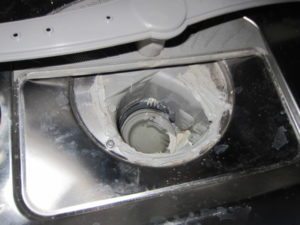
If you've managed to drain a significant amount of water from the pan, it means one of the hoses or pipes has become leaky. How can this be fixed? You'll need to remove the pan, exposing the dishwasher's interior, and inspect all the parts that could be damaged. First, carefully inspect the barely visible seams inside the wash chamber. Sometimes, due to a manufacturing defect, a poorly made seam can leak water from the chamber directly into the pan.
Next, check to see if the debris filter is installed correctly. It's not uncommon for users to replace it without securing it properly after cleaning. This causes water to bypass the seal and flow into the tray. You should also inspect the rubber seal around the door, especially the lower part. A worn seal can cause a small amount of water to either spill onto the floor or drain into the tray, depending on the Bosch dishwasher model. If no leak is detected after inspecting the external components, the problem is internal and the tray must be removed.
- First, we remove the front door panel and the decorative panel from under the door.
- We close the door, remove the closers along with the hinge protection and open the door all the way.
- Remove the soundproofing. Underneath, on the outside of the tray, you'll find screws connecting the tray to the main body of the machine. Remove them.
- We remove the debris filter together with the mesh, cleaning out all the dirt from there at the same time.
The lower sprinkler may also interfere with disassembly, so we remove it as well.
- In the recess of the trash filter we find 4 screws that also need to be removed.
- We place the machine on the back wall.
- We remove all the parts connecting the pallet to the main body: wires, hoses, pipes, anything that could interfere with pulling out the pallet.
- We pull the pallet gradually, separating it from the main body.
Exposed pipes, hoses, and connections between pipes and hoses and other components should be carefully inspected. Any damaged pipe should be replaced. Experts do not recommend wrapping it with electrical tape or filling it with sealant.
Problems with water drainage
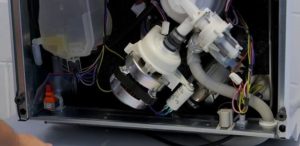 Faults that prevent water from draining can be caused by a burnt-out pump, damaged wiring or contacts powering the drain pump, or a damaged control board bus. How can these problems be fixed?
We disassemble the Bosch dishwasher as described above. The drain pump is located on the side of the circulation unit. Turn it half a turn counterclockwise and remove it, remembering to disconnect the wires. Test the pump with a multimeter and replace it with a new one if necessary. If the problem is in the power supply wire, you can also find it with a multimeter.
In conclusion, the E23 error code can cause many problems, but the malfunctions it causes aren't all that difficult to fix. The key is desire, determination, and a willingness to strictly follow the instructions the technicians kindly provided. Good luck!
Interesting:

1 reader comment
Add a comment
Headings
Washing machine repair




For buyers




For users


Dishwasher




Thanks for your help! It worked. Everything worked.