
How to install a belt on a washing machine
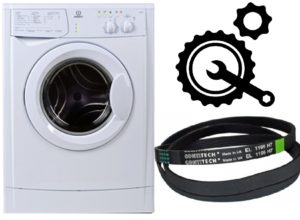 If you own a modern automatic washing machine with a direct drive, you don't need to worry about a slipped drive belt, as your machine doesn't have one. However, if your washing machine has a commutator or asynchronous motor and the drum pulley is driven by a belt, this article is for you. Here you'll find information on troubleshooting belt problems.
How to identify a breakdown?
It's often difficult for the average person to determine what's wrong with a washing machine, because if the drive belt slips, the machine can't continue washing. The drive belt is located inside the washing machine body, and there's no way to see if it's slipped, but there are some signs that can help you figure out what's wrong.
Most often, the washing machine itself notifies the user about the breakdown and its nature through a built-in self-diagnostic system. Thanks to this system, the machine can instantly react to a breakdown, stop all systems, and display an error code on the display.
Error codes vary depending on the make and model of the washing machine, so when an error occurs, the user should consult the error code table for their specific washing machine. With this table in hand, you can easily decipher the error code displayed on your washing machine's display. This information can be found, for example, on our website. In a number of publications, we've deciphered virtually all error codes for most washing machine models, so finding the information shouldn't be a problem.
Sometimes a washing machine doesn't display an error code, but the problem still exists. In this case, a number of indirect signs confirm that the belt has come off and needs to be replaced.
- The washing program starts, the motor runs, but the drum does not rotate;
- The washing machine motor hums evenly and then “falls silent” at equal time intervals;
- The program starts, the engine starts to run continuously, after which the electronics freeze.
- The washing machine drum rotates manually very easily, and this rotation does not cause even the slightest noise from the motor.
If any of the above signs are present, this is a good reason to turn off the washing machine, remove the back panel and take a closer look at the drive belt.
We fix the breakdown
The problem is that often a slipped belt is just a consequence of some more serious problem. If the belt on your washing machine has come off for the first time and this is an isolated incident, then you just need to put it back on. This isn't always easy, not because it's a complex repair, but because it requires skill and sometimes even considerable physical strength. Generally speaking, the procedure is as follows.
- Unplug the washing machine and turn off the water. Then disconnect the drain and inlet hoses.
- We move the washing machine to the middle of the room to make it easier to work with, and turn it so that the back wall is facing us.
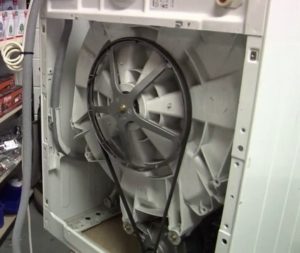
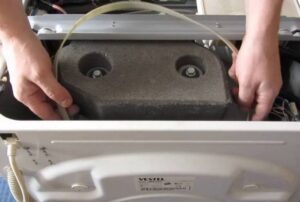
- The belt is located just behind the back wall, stretched between the large drum pulley and the motor pulley, so we unscrew the screws holding the back wall and then move it aside.

In some cases, the top cover of the washing machine prevents the rear panel from being removed. In these cases, you must first remove the top cover and then remove the rear panel.
- Behind the back wall, you will either see a belt placed on pulleys, in which case the information about it coming off will not be confirmed, or the belt will be lying somewhere at the bottom of the washing machine body, and you will need to put it back in place.
- If the belt has come off, remove it from the car body and then try to read the set of numbers and letters imprinted on its surface. We'll be interested in the first four digits—the original belt length in mm. We'll need to measure the belt, comparing its actual length with the manufacturer's stated length. If a difference of 20 mm or more is detected, the belt is good for nothing but scrap. If the length is correct, you can pull the old belt back on.
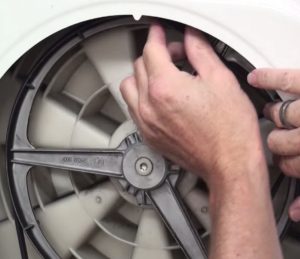
- Next, tighten the belt onto the engine pulley, then try to fit it onto the large drum pulley while turning the pulley counterclockwise with one hand. You can ask someone to help you turn the pulley while you try to tighten the belt with both hands. On some models, the belt is very difficult to tighten, and the manufacturer does not provide any adjustment.
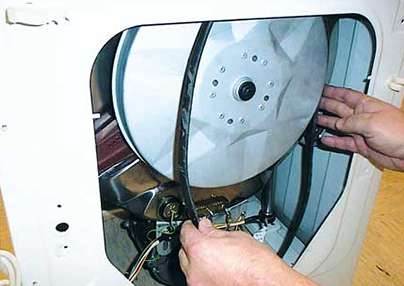
- As a result, the belt should fit properly into all the grooves; turn the drum pulley and make sure that this is the case. The pulley should turn quite stiffly by hand.
- We replace the back panel, slide the washing machine into the niche, and connect it to the utilities. Now all that's left to do is run a test wash and make sure everything is working properly.
If the breakdown recurs
Repeated slipping of the drive belt can lead to much more serious problems. If the belt has slipped off at least a couple of times in six months, this should already alert you, because it is almost certainly the result of a more serious breakdown. What are the reasons for the belt frequently slipping off the engine and drum pulleys?
- The belt has reached the end of its service life. This is a fairly common cause of belt slippage. If the belt shows signs of wear, the gussets are partially worn, and the belt itself is partially stretched, it must be replaced with a similar one.
- There are signs of wear on one of the pulleys, or it has become loose. If play has developed on the pulley, the belt will not adhere to it as it rotates. This can be resolved by tightening the pulley fastener or replacing it entirely.
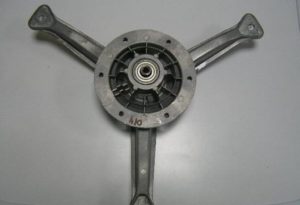
- Motor mount issues. Most washing machines have very secure motor mounts, but constant vibration can cause them to become loose, and the bolts to come loose. This can cause the belt to slip on the pulleys. Solution: Strengthen the engine and tighten all fasteners.
- The pulley and shaft are misshapen. Our specialists have encountered situations where, as a result of a previous botched repair, a user or some incompetent mechanic bent the pulley, causing problems with the drive belt. The problem can be solved by replacing the pulley or carefully straightening it. In the latter case, a solution is not guaranteed.
- Universal joint problems. Although uncommon, it can happen that the shaft and universal joint become damaged. This could be due to vibration, a manufacturing defect, or both. In any case, the universal joint will need to be replaced, as a damaged part causes imbalance and can lead to even more serious damage.
- The belt was installed incorrectly during the previous repair. This happens often. If, for example, you installed it incorrectly last time and missed the grooves, the belt will sooner or later slip off the pulleys again and you'll have to redo it.
- The belt was replaced with the wrong one. If, again, some "poor mechanic" replaced your drive belt last time but managed to install the wrong one, there's a good chance the new belt will constantly fall off. Solution: find and install a drive belt that's compatible with your washing machine model.
- The bearings are completely destroyed. It's rare for people to let their "home helper" get to this point, but it does happen that the bearings are completely destroyed, causing the machine to grind loudly and become unbalanced. This unbalanced movement can cause the belt to slip, and the machine to stop working. Solution: replacement of bearings and seals.
When your washing machine's bearings fail, a slipped belt is the least of the troubles that await you and your appliance.
We buy a new part
A worn belt needs to be replaced—there's no arguing with that. But that raises another question: how do you buy the right part? The best option is to take the old belt to the store, show them the damaged part, and ask them to bring you a similar new one.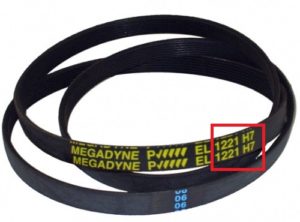
Unfortunately, this option isn't always available to everyone. For example, if you live in a remote village where the only store is the local general store, your best option would be to order the part online and have it delivered by mail to the district center or directly to your village. But that's easier said than done. How do you order the right belt in this case?
There are two main types of drive belts: V-belts and poly V-belts. If your washing machine has an asynchronous motor, you'll likely be using a V-belt. If your motor has a commutator motor, you'll likely be using a poly V-belt. Now that we've covered the general theory of drive belts, let's begin by carefully reading the markings on the old belt. The first digits (usually 4) indicate the length of the part in millimeters. These are followed by a letter indicating the shape of the wedges. The letter is followed by a number indicating the number of wedges.
All numbers and letters must be written down and this information must be taken into account when ordering the part.
When ordering a new belt for your washing machine, consider the following: your washing machine model, the information on the belt, and the material it's made of. By taking all this into account, you'll never make a mistake when ordering.
To summarize, if the problem is simply a slipped drive belt on your washing machine, you can easily fix it yourself, and in some cases, even without difficulty. However, if a constantly slipping belt is the result of a more serious problem, you'll need the help of an experienced technician. Happy repair!
Interesting:

1 reader comment
Add a comment
Headings
Washing machine repair




For buyers




For users


Dishwasher




Hello, what will happen if I install two belts?