
How to bleach linen and tulle in the washing machine at home
 White tulle, bedding, and other white items can take on a gray or yellow tint over time. Our grandmothers knew excellent recipes for making bed linens sparkle white, but it requires manual labor and hours of time. So, the modern housewife wonders how to bleach items in an automatic washing machine at home. What's the best product for this, and where should it be placed? Let's take a closer look.
Whitening products
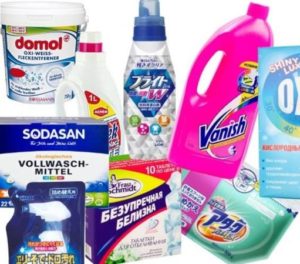
The household chemical market offers a wide variety of bleaches. Depending on their composition and effect on fabric, bleaches can be divided into three groups:
- Chlorine-containing bleaches are aggressive bleaches, mostly available in liquid form. This product is effective even when washed in 40-degree water.0WITH.
Important! Chlorine bleach, such as Belina, should not be used in the washing machine.
- Oxygen-containing – universal bleaches that are suitable for most types
 fabrics, including colored ones (Persol, Swan, Parus, Vanish, Velvet, Synergetic, Belle). They can be either liquid or dry. Most bleaches only work effectively at temperatures above 90°C.0WITH, but there are also those that can be used at temperatures of 400C, they are more expensive. Both are suitable for use in a washing machine.
 - Optical brighteners. They contain fluorescent dyes that create a whitening effect but do not bleach. They are available for different fabric types (Bos Plus, Dr. Beckmann, Ace).
When choosing between dry and liquid bleach, consider how often you'll be using it. Liquid bleaches have a short shelf life of 3-4 months, while dry ones can be stored for up to 5 years. You can also select a bleach based on the type of fabric. There are bleaches for tulle, lingerie, silk items, and bleaches for cotton or linen.
They have whitening properties soda ash and salt, which can also be used in the washing machine. For example, to whiten tulle, you can add two tablespoons of table salt along with the laundry detergent.
Machine Bleaching: Instructions
So, for effective bleaching in an automatic washing machine, you can use oxygen-based bleach, which contains hydrogen peroxide. The bleaching process in a washing machine is much simpler than manual bleaching, but it's important to follow the instructions carefully. This is the only way to achieve positive results.
Some modern washing machines have a separate bleach compartment in the detergent drawer. Therefore, bleaching shouldn't be an issue. In this case, follow these steps:
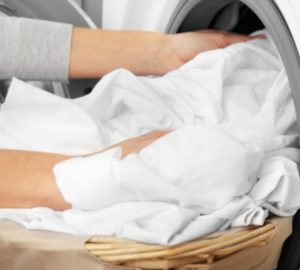
- Place the laundry in the drum, sorting it by fabric type. This means bleaching underwear separately from other fabrics, as well as tulle, bedding, and towels. Cotton T-shirts and white socks can be bleached together. Be careful, put only white items in the drum of the machine, one colored item can ruin all the white ones.
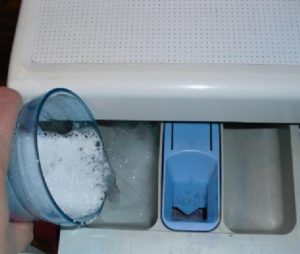
- Then, pour the detergent and bleach into the appropriate compartments of the tray. The detergent compartment is usually labeled II, and a triangle is drawn on the bleach compartment.
- Next, select a cycle depending on the fabric type. Tulle, white blouses, and silk items can only be washed on a delicate cycle. Bedding, cotton T-shirts and socks, and towels can be washed on a cotton cycle at temperatures between 60 and 90°C.0C, the washing temperature is indicated on the label of the products, so be sure to read the information.
Some washing machine models have a "Bleaching" program. So, select it, but be sure to first read the machine's instructions, specifically all about this program.
- We start the wash and wait for the result.
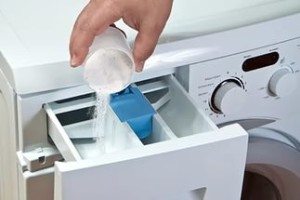
It seems simple, but what if your washing machine doesn't have a special bleach compartment? Where do you put it? In this case, you need to bleach after the wash cycle. This is because the powder is effective at 40°C.0C, and bleach at 60-900C. If the bleach is high-quality and effective even in warm water, you can pre-wash the laundry with regular detergent in compartment I and dry bleach in the main compartment II. Select a wash cycle based on the fabric and start the process.
It is not recommended to add bleach to detergent containing enzymes, as this will reduce the detergent's effectiveness.
Liquid bleach is convenient because it can be added after the machine has filled with water and the powder has reacted. Simply add a little water to the bleach and pour it into the main compartment, where it will automatically drain into the drum containing the laundry.
Machine bleaching is convenient for bleaching bulky items like tulle and bedding. Machine bleaching at 90°C is also convenient.0C, there is no risk of getting burned.
Machine-free methods
It's not always possible to effectively bleach items in the washing machine. In this case, you have to resort to folk remedies, as well as boiling and soaking. Hand bleaching is also appropriate when you only need to bleach a few small items, such as underwear, a blouse, or 2-3 towels. Here are some effective recipes for bleaching items:
- Bleach effectively whitens bed linens. Add 3 tablespoons of bleach to 9 liters of water. Soak the linens in the resulting solution for half an hour and then rinse thoroughly.
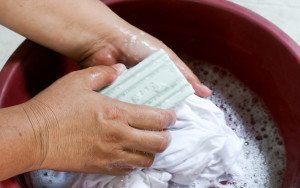
- You can whiten bed linens, towels, and net curtains with potassium permanganate, and it truly does make them snow-white. To do this, lather the items thoroughly with laundry soap or use 250 g of powder per 10-12 liters of water. Dissolve 10 crystals of potassium permanganate in the hot water (the water should be red) and soak the items for 3 hours, then rinse thoroughly.
- You can bleach items made from delicate fabrics, such as blouses and shirts, using a solution of one spoon of 3% hydrogen peroxide, 1 tbsp of soda ash and 2 liters of water, the temperature of which is no more than 500C. Soak items in this solution for 2-3 hours, stirring them periodically.
- Cotton items (T-shirts, socks, towels) can be bleached in hot water with the addition of boric acid;
- Boiling helps bleach cotton and linen items. To do this, place the laundry in an enamel tank, add powder and any bleach, and boil for 20 minutes, stirring with a wooden stick. After boiling, you need to rinse the laundry with the addition of fabric softener; it will help remove the unpleasant odor.
Some useful tips
Bleaching whites at home isn't always effective. It's all about following all the rules; there are a number of nuances that can not only affect the quality of the bleaching but can even permanently ruin the item. So, here are some tips for bleaching laundry.
- Don't bleach an item with a rust stain, as this will only cause it to turn yellow. First, remove the stain.
- Items with buttons, locks and other fittings should be bleached only in water no more than 400C. In this case, soak for no more than 30 minutes.
- For manual bleaching, it is advisable to use plastic or enamel bowls.
- Before bleaching in the washing machine, you need to check the pockets of your clothes and shake out dust from the seams of your bed linen.
- When purchasing bleach, be sure to look at the production date and expiration date. The fresher the product, the higher the effectiveness.
- For effective bleaching, you can pre-soak the laundry in a basin and then wash it in the machine.
Therefore, when bleaching towels, tulle, and other items in the washing machine, pay special attention not only to choosing a high-quality bleach but also to the temperature setting. Most importantly, wash white items more often, and you'll need to bleach less often.
Interesting:


2 reader comments
Add a comment
Headings
Washing machine repair




For buyers




For users


Dishwasher




I'm not sure about potassium permanganate... Is this a joke? Potassium permanganate stains, not bleaches.
When you add potassium permanganate to water, then baby powder, the water becomes white, not pink.