
How to clean a dishwasher with citric acid
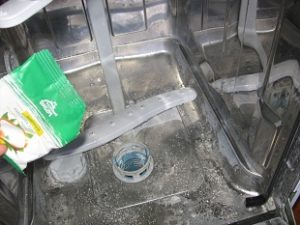 Cleaning a dishwasher is a sore subject for many housewives, especially when it comes to descaling. This is a fairly common need, especially considering that many cities in our vast country have hard water. You can buy special products for this purpose, but the problem is that many of these products are based on ordinary citric acid. This naturally raises the question: why overpay when you can clean your dishwasher with citric acid? Especially since this household chemical costs mere pennies. Let's figure out how to do it and whether it's even possible.
Manual care
Some housewives ask: can citric acid be used when hand-washing a dishwasher? We believe it's not only possible, but also necessary, instead of detergents containing abrasive particles and other harsh chemicals. Use a soft cloth and sponge, as well as a small basin of water.
- We open the washing chamber of the dishwasher and take out the baskets with the tray.
- Sprinkle some lemon juice onto a sponge soaked in water and wash the trays and baskets.
It's better to wash the tray and baskets in the bathroom, it's more convenient.
- Generously sprinkle the bottom of the washing chamber with lemon juice and use a sponge to clean the surface of dirt and scale.
- Using a sponge and a citric acid paste, we clean the sprinklers: upper and lower.
- Wipe the inside of the washing chamber completely. You don't have to be stingy with the lemon juice, and you don't have to rinse it off thoroughly; it will be flushed back into the system during the next dishwashing cycle.
Cleaning your dishwasher with citric acid removes limescale and dirt from the interior of the washing chamber. Citric acid is also incredibly gentle on microorganisms and is harmless to humans and animals—a real plus. This cleaning should be repeated every 1.5 to 2 months.
Cleaning the system
Citric acid, while used externally, is safe for dishwashers and their owners. However, it can also be used to descale the inside of the dishwasher system. If you have hard water, we can assure you that the lion's share of scale—97%—will be concentrated in the heating element, hoses, and pipes. It's impossible to remove it manually, unless you plan to disassemble the dishwasher. The only option left is to automatically clean the system at home, which can be done with ordinary citric acid.
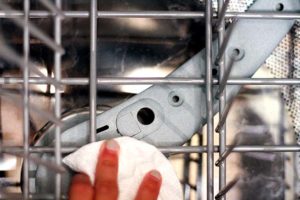
Take the citric acid and pour it into the detergent drawer. Do not load dishes into the baskets. Close the dishwasher door, select the intensive wash program, and start the machine. Once the program completes, the dishwasher system will be thoroughly descaled. This procedure should be performed approximately once every two months.
It's clear where to add citric acid, but how much should you add to the detergent compartment? Through experience, we've found that you need to rely not so much on the dishwasher's size, but on the volume of water it pumps into the system. Consult your dishwasher's instructions.
- If it uses less than 10 liters of water per cycle, then add no more than 40 g of citric acid.
- If the car consumes about 12 liters, you need to add 50 g of citric acid.
- Uses 14 liters or more? Add 60 g.
Why is it so important to monitor the dosage so precisely? We'll discuss this in the next section.
When you shouldn't use lemon juice
Using citric acid and other cleaning agents can cause real damage to your dishwasher. Imagine you have hard water, but haven't taken any measures to clean your dishwasher for several years. Naturally, large limescale deposits have built up inside the machine. And then, several years too late, you finally decide to clean it with citric acid. Citric acid will break down the fragile limescale deposits, all at once.
Overnight, a huge amount of large debris will accumulate in the dishwasher's system, which will likely cause a serious blockage. If such a blockage occurs, clearing it will be difficult. But a blockage is only half the problem. Scale deposits from the internal surfaces of the tankless heater can dislodge, damaging the heating element itself. Cleaning with citric acid can lead to costly repairs. The bottom line is simple: if you haven't descaled your dishwasher before, don't start—it could have serious consequences!
So,How to clean the inside of a dishwasher yourself Using regular lemon juice? We think we've answered that question. If you need clarification or disagree with our point of view, please leave a comment or join the discussion on our forum. Good luck!
Interesting:
Readers' comments
Headings
Washing machine repair




For buyers




For users


Dishwasher




Add a comment