
Cleaning your washing machine yourself
 The sooner you think about caring for your washing machine and how to clean it, the longer it will look like new, sparkling clean and pleasing to the eye. However, many people neglect proper and timely maintenance, often leaving their machine in such a state that it literally needs to be scrubbed of dirt, limescale, and scale. So, once again, we've decided to share how to properly clean a washing machine at home and what products you can use.
Cleaning products: their purpose
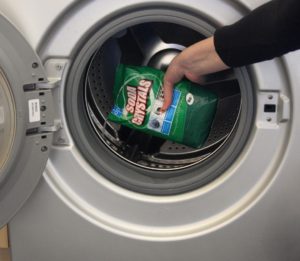
There are a wide variety of cleaning products for both the inside and outside of a washing machine. These range from home remedies to professional store-bought ones. The effectiveness of any of them depends on proper use. Many of us try to use products for other than their intended purpose, later claiming that the product doesn't work. For example, many people try to remove limescale with the much-hyped Calgon, even though it's only intended to soften water.
Therefore, we'll list the possible remedies women use at home and describe their purposes. We'll start with improvised remedies, or as some call them, folk remedies. Although they're not exactly folk remedies, they're just like store-bought ones, only very inexpensive and readily available:
- Baking soda is a good remedy for removing mold and dirt that appears on the rubber seal of the washing machine drum or powder container, and soda also softens water.
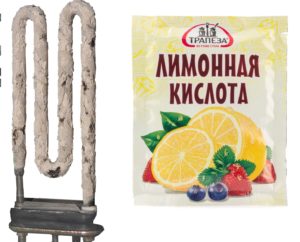
- Citric acid will help clean the inside of the machine from scale, that is, parts such as the heating element, tank, and drum.
- Table vinegar is similar in application and effect to the previous remedy, and it effectively eliminates foreign odors, but it itself doesn't smell very pleasant.
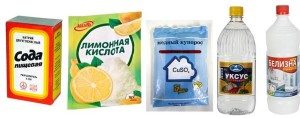
Vinegar should only be used in extreme cases, as it leaves a strong odor, and in general, you need to be very careful with it. - Copper sulfate is a remedy that will help in the fight against severe mold.
- Bleach is a product that housewives use to disinfect and eliminate unpleasant odors. But be careful, you can’t use chlorine-based bleach, it will damage the washing machine. If disinfection is necessary, it is better to consider special products that do not contain chlorine.
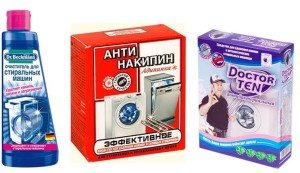
Of the special chemicals intended for cleaning automatic machines, the following can be used:
- Frisch activ is a product for cleaning the drum from scale and dirt.
- Miele – a product for cleaning machines from odors and bacteria.
- Beckmann – used to clean the washing machine drum, remove dirt, limescale, scale and odor, and has disinfectant properties.
- Magic Power is a German product used for cleaning scale.
- Topperr 3004 is another German product suitable for removing limescale from the heating element of a washing machine, recommended by Bosch.
- Luxus Professional is a special lemon-scented, domestically produced cleaning solution for washing machines and dishwashers. It's also suitable for kettles. It effectively removes limescale.
- Bork K8P is a Korean powder-based descaling product.
- Top House is a German-made limescale remover for kettles, coffee machines, washing machines, etc.
- Antinakipin is a domestic product for combating scale.
- Dr. Ten Antibacterial – a product for cleaning the washing machine and its internal disinfection.
- Disinfectant from the Korean company SANDOKKAEBI.
- Multidez-Teflex for washing is a powder that can be used to disinfect the washing machine, cleaning it from bacteria and viruses.
This isn't a complete list of chemicals; there are many available. When choosing, remember to read their ingredients and purposes. If you need an odor-fighting product, look for one, but don't buy an anti-scale product for this purpose—you'll just waste your money.
We wash out scale from the machine
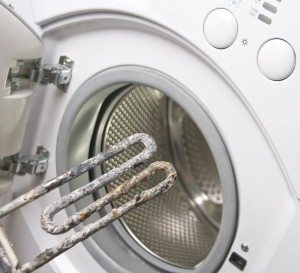
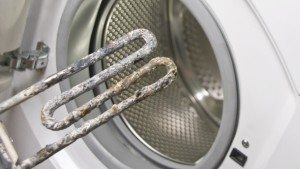 Tap water in most regions of our country is unsuitable not only for drinking but also for washing in a washing machine, as it is very hard and contains impurities. Therefore, it is usually filtered, and while almost everyone filters their drinking water, only a few do so for washing. As a result, when heated, impurities settle on the heating element and the washing machine, forming a "crust" called scale.
If your washing machine isn't cleaned regularly, the limescale layer will quickly build up and the heating element will fail. Service center technicians recommend installing a cleaning filterOtherwise, regularly rinse the machine with citric acid. How to clean an automatic washing machine? It's quite simple: just pour 150-200 grams of citric acid into the tray and set the cycle to a long cycle of at least 60 minutes.0WITH.
Important! After using citric acid, rinse the filter and the drum seal to remove any scale deposits.
The heating element can be cleaned mechanically or using special means. This process is described in detail in the article about How to descale an automatic washing machine.
We remove dirt, mold and odor from the inside
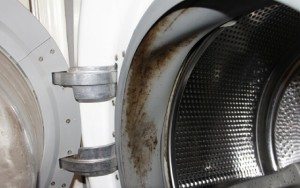
Fighting mold and odors will require some effort. If the mold is extensive and has spread throughout the rubber seal, it's best to use a copper sulfate solution. Soak the seal in it and leave it for 24 hours, then wipe the seal with a cloth, trying to remove any mold. Then run a test wash with detergent to thoroughly rinse everything.
To clean mold, you can use a 1:1 solution of baking soda and water. Apply the baking soda paste to the cuff and drum for several hours, then run the wash cycle, and then thoroughly wipe the cuff with a cloth.
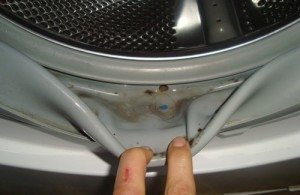 Mold often accumulates on the detergent drawer. This is because fabric softener and detergent particles can remain on the drawer as slime. Slime and water are a perfect breeding ground for mold and germs. The tray must be dried after each wash. If mold does develop, soak the tray in water and detergent for several hours, then scrub with an old toothbrush and wipe dry. Don't forget to rinse the tray compartment with a baking soda solution and wipe everything thoroughly with a dry cloth. If there's a limescale deposit on the tray, In this case, you need to soak the tray in water with a packet of citric acid added, and after 2-3 hours, clean it with a soft sponge or toothbrush.
The drain hose and drain filter also need to be cleaned of slime and dirt, which can cause an unpleasant odor. In one of our articles, we described this in detail. How to clean a drain hoseAs for the filter, everything is very simple:
- Open the door at the bottom of the machine, on the right or left, depending on the model.
- Place a large cloth under the body.
- Unscrew the filter counterclockwise and pull it out towards you.
- Remove the debris, rinse the filter with water and put it back in place.
The more often you clean the filter and drain the water, the less water will stagnate, thereby emitting an unpleasant odor.
Cleaning your washing machine from dirt using special cleaning products should be done strictly according to the instructions on the label. In addition to cleaning, some special cleaning products kill viruses and bacteria, thereby disinfecting the inside of the machine. disinfection procedure at home is described in the article of the same name.
Adding shine to the outside
Once you've finished cleaning your washing machine, you can move on to cleaning the outside. If you're careful and regularly wipe down the surface with a cloth to remove dust, the process won't take long. However, those who aren't particularly meticulous will have to work hard to get it looking its best. After all, the machine can be coated not only with dirt and dust, but also with greasy oils and food, if the appliance is installed in a kitchen.
Before washing your washing machine, remember to disconnect it from the power supply!
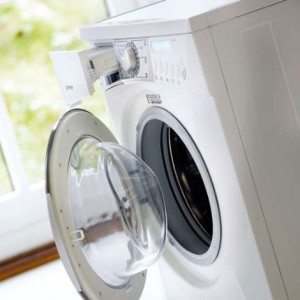 How do you clean the outside of a washing machine? To do this, you'll need dishwashing liquid. Dissolve a small amount in water and wipe the exterior of the machine with a damp sponge. Then, wipe the machine again with a clean sponge and finally, with a dry microfiber cloth—it won't leave streaks on the surface. If dust has become embedded in the plastic of the top lid, apply a paste of baking soda to the lid and leave for 2-3 hours, then rub with a soft sponge and rinse.
To give your hatch door a shine, take any glass cleaner and a dry microfiber cloth. Spray the cleaner onto the hatch glass and then wipe it thoroughly. After this thorough cleaning, your washing machine will look like new.
To summarize, to avoid having to clean your washing machine and worry about how to clean it, you need to regularly maintain and care for it. We hope the tips in this article will help you clean your machine and restore its attractive appearance.
Interesting:

Readers' comments
Headings
Washing machine repair




For buyers




For users


Dishwasher




Add a comment