
How to use a dishwasher correctly
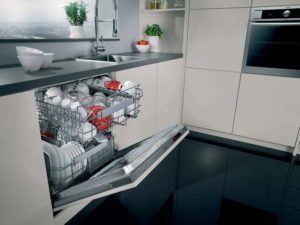 A dishwasher is a complex appliance, and it's not easy to operate if you're unfamiliar with it and seeing it for the first time. The manual comes in handy, but it's not always written in a way that's accessible to the average person. Furthermore, the manual doesn't cover many operating details. Therefore, we decided to cover the proper use of a dishwasher in detail.
How to turn on the machine and set up the program
After the technician installs the dishwasher in its designated location and connects the water supply and drain, you'll be faced with the task of turning it on. Don't rush into loading the dishwasher with dishes; you'll first need to rinse it by running it empty. To do this, you'll need salt and dishwasher powder. You can also use dishwasher starter kit, if you purchased one along with the car.
You need to do the following:
- open the machine door and pull out the lower basket, under which you will see the lid that covers the salt reservoir;
- unscrew the lid and pour water into the reservoir (this is done only once, before the first start);
- then add salt into the water using a funnel;
- wipe away any water that has spilled into the chamber;
- close the lid of the salt container;
- Set the salt consumption on the control panel (for Bosch dishwashers) in accordance with water hardness, which must first be measured.
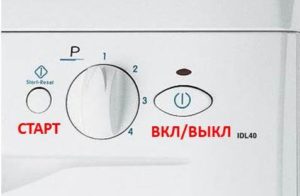
From then on, add salt as needed. When the salt runs low, the salt indicator on the control panel lights up. After adding salt, add detergent. The powder drawer in almost all brands of dishwashers is located on the inside of the door. Using a measuring spoon, pour the powder (approximately 15-20 g) into the compartment and close the lid.
Now the dishwasher needs to be turned on. To do this, make sure the water supply to the dishwasher is open and the machine is plugged in. Next, find the power button on the control panel, marked with a circle with a vertical bar, as in the photo (on/off).
Please note! In fully built-in appliances, the control panel is located on the top edge of the door, while in freestanding models, it is located on the front.
Next, you need to select a high-temperature wash cycle, such as intensive wash. All cycles have symbols, which we described in detail in the article "Dishwasher Symbols." The process varies across Bosch, Electrolux, and Ariston dishwashers. In dishwashers with mechanical controls, you turn the knob to the appropriate cycle; these machines are rare. In machines with electronic and touch controls, the cycle is selected by pressing buttons. Each program and function can have a separate button, which is often found in Bosch dishwashers.
It's also possible to have a single button for cycling through all programs, such as in Electrolux touch-screen dishwashers. After selecting a program, press the Start button, which begins the wash cycle. This will initiate a wash cycle.
Starting the machine is similar. In addition to detergent, you'll also need to add rinse aid, which is located next to the detergent compartment. Just like with salt, you need to set the rinse aid flow rate. You can start with a medium setting, then increase or decrease it as you use the machine, depending on the wash results. If streaks and drips remain, increase the flow rate; if a rainbow film appears or the rinse aid doesn't rinse out well, decrease it.
Loading the dishes
Once you understand how to set up and activate dishwashing programs, you need to figure out how to arrange the dishes in the baskets. There are various ways to do this, but the results may be disappointing: the dishes won't be washed properly, and you'll be disappointed with your dishwasher. The manual for your Electrolux, Ariston, or other dishwasher will likely include instructions on how to arrange the dishes, complete with pictures.
With standard cookware that manufacturers use as a reference, everything is more or less clear. But more often than not, the cookware used by most users doesn't meet these standards.
Don't forget! Before loading the dishes into the machine, remove any food debris. Rinsing isn't necessary, but be sure to brush off any food particles, napkins, bones, etc.
Let's list the basic rules for loading a dishwasher:
- First, load the lower basket with large items (large plates, pots, pans), then the upper one;
- Place plates in holders, leaving a small gap between the plates, otherwise they will not be washed, especially deep soup bowls;
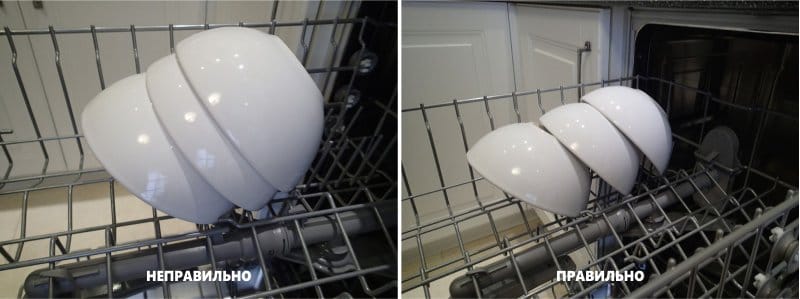
- the dishes are placed with the inside facing the center, large plates should be placed in the outer sections of the basket, and small ones in the center;
- pans and baking trays are placed on their sides so as not to block the water supply to the upper basket, and it is better to wash pots by turning them upside down;
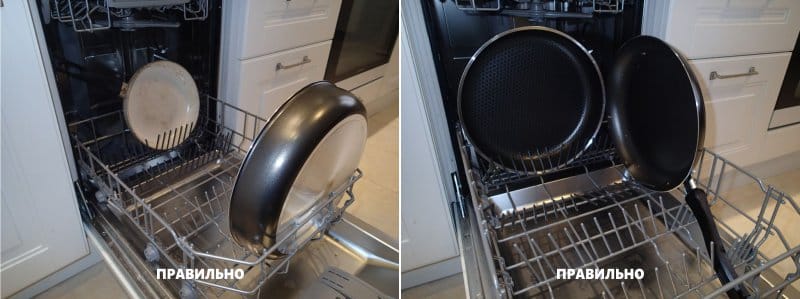
- It is best to wash pans and pots separately from plates and glasses;
- You can't overload the dishwasher with dishes, otherwise nothing will get washed;
- glasses, wine glasses, cups, plastic containers and other small items are placed upside down in the top basket;
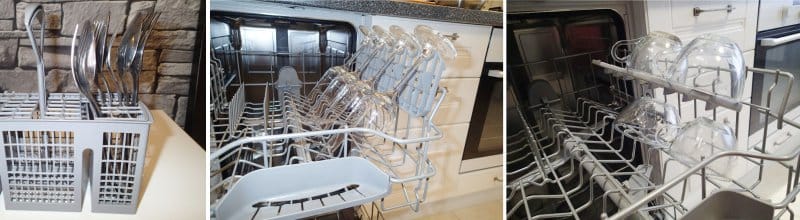
- There is a separate basket or pull-out tray at the top of the dishwasher for cutlery; ladles, skimmers, and spatulas are placed horizontally in the top basket;
- The dishes should not interfere with the free rotation of the spray arms and the opening of the powder drawer on the door.
When arranging dishes, you need to take into account that not all items can be washed in the dishwasher.
A complete list of what you shouldn't load into your car is in the article. What dishes should not be washed in the dishwasher??
Choosing a detergent
Choosing a detergent is a challenging task for users, as with such a wide range on the market, it's difficult to choose just one brand. It's truly difficult to advise whether gel, powder, or tablets are best. Everything will depend on your budget. Each of these products has its own pros and cons.
For example, easy-to-use combination tablets are very expensive. Powder is cheaper, but it's difficult to pour. In our opinion, and we're not pushing it, it's better to use all the products separately: powder or gel, salt, and rinse. We'll explain why:
- Firstly, it will be cheaper this way, calculate it yourself;

- Secondly, you'll be dosing the detergent yourself, depending on how dirty the dishes are and how much they're in the dishwasher. Over time, you'll automatically dispense the correct amount of detergent. Tablets, however, have a fixed dosage, so sometimes you'll have to halve the dosage (for compact dishwashers). The same applies to rinse aid dosage.
- thirdly, Powder and gel dissolve significantly faster, for this reason tablets are not recommended for use in short cycles;
- Fourth, your ion exchanger won't suffer from a lack of salt. A salt tablet contains a specific amount, which isn't enough for very hard water, so you'll have to add salt separately, which is an additional expense. Not adding salt is a bad idea, as it could completely damage the dishwasher.
Decide for yourself which brand to choose: Finish, Amway, Somat, we only recommend reading the review safe dishwashing detergents.
Choosing the right mode
After loading the dishes and preparing the dishwasher, we move on to selecting a program and starting it. This is also an important step in the efficient operation of the dishwasher. The washing mode should be selected based on the degree of soiling and the material the dishes are made of. Let's look at the basic modes found in most dishwashers.
- Standard (basic) program – suitable for washing various dishes of medium soiling, carried out by heating the water to 50-600WITH.
- Economy program (Eco) – also works with heating up to 500C, but it saves water and energy. It can wash lightly soiled dishes of various types.
- The intensive program is designed for washing very dirty dishes, such as frying pans, pots, and plates with dried-on food. The water is heated to 700WITH.
- The delicate program is designed for washing crystal, glass, plastic and other fragile dishes.
Please note! Washing times may vary from dishwasher to dishwasher. Washing times can range from 45 minutes to 3.5 hours.
- An automatic program that selects the temperature and other washing parameters depending on the contamination of the dishes.
Besides modes, don't forget about useful functions. The half load feature allows you to wash dishes without piling them up, while the pre-rinse function helps clean dishes that have been sitting in the machine for a long time, as well as those with burnt-on food. The "Hygiene Plus" function is useful for disinfecting baby bottles, jars, and cutting boards.
What to do after washing
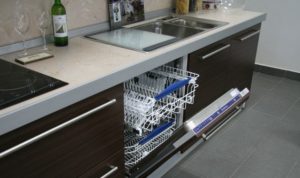 After washing and drying the dishes, it's time to clean your dishwasher. Don't neglect this, especially since it only takes 10 minutes. Otherwise, it could lead to lengthy repairs.
After turning off the dishwasher and emptying the racks, remove the racks and the mesh filters from the bottom of the chamber. Rinse them under the tap and replace them. Next, wipe the walls of the dishwasher with a dry cloth. Remove any food particles stuck under the door or door seal. You can leave the machine door open for a while to dry out the moisture, so that an unpleasant smell does not develop.
These simple steps will keep your dishwasher always clean. Once or twice every six months, clean the dishwasher with a degreaser and scale remover. This will remove scale and other buildup not only from the dishwasher chamber but also from the hoses and pipes.
Safety tips
In conclusion, I would like to say a few words about safety and precautions:
- It is not recommended to touch the dishwasher with your hands while it is running;
- the machine must be connected to a grounded outlet;
- To protect your machine from unexpected power surges, connect it to the outlet through voltage stabilizer;
- After the wash cycle is complete, do not rush to remove the dishes, they are very hot;
- When adding dishes while the machine is running, wait until the rocker arms stop;
If something breaks, don't panic. Unplug the appliance and inspect it carefully. If you're unsure of your abilities, don't attempt any repairs yourself. Contact a qualified technician.
- Do not allow children to operate the dishwasher or press any buttons.
We hope you now know how to use your dishwasher, whether it's Electrolux or Bosch. You can also watch a video on how to properly use your dishwasher. Remember: consistent adherence to the operating instructions will extend its lifespan, delighting you with clean dishes.
Interesting:

1 reader comment
Add a comment
Headings
Washing machine repair




For buyers




For users


Dishwasher




A very useful article. True, I made some mistakes at first, and then I read it all.