
How to use a tumble dryer?
 Washer-dryers have long since replaced conventional washing machines, offering users a 2-in-1 solution: washing and drying. The machine washes, rinses, spins, and then dries the items. All you have to do is wait for the program to finish, open the door, remove the clean, dry laundry, and immediately put it away.
These machines eliminate the need for floor dryers or clotheslines—they're more convenient and easier. You just need to know how to use a washing machine dryer, its limitations, and its capabilities.
Read the instructions carefully
The biggest mistake people make with a washing machine is failing to read the manufacturer's instructions first. Many housewives ignore the manual and operate their appliances by trial and error. This approach is fundamentally flawed: you could end up over-drying or under-drying your clothes, breaking the machine, or missing out on useful features.
Before turning on the washer-dryer, please read the instructions included with it!
The manufacturer's instructions detail installation and assembly details, a list of basic programs, and operating instructions. Without this knowledge, users often make mistakes. For example, homeowners often load their washer-dryers incorrectly. The manual specifies a loading limit, which in most cases is limited to half a drum. However, people are unaware of this limit and leave their entire load—a full drum—out to dry. The consequences can be disastrous: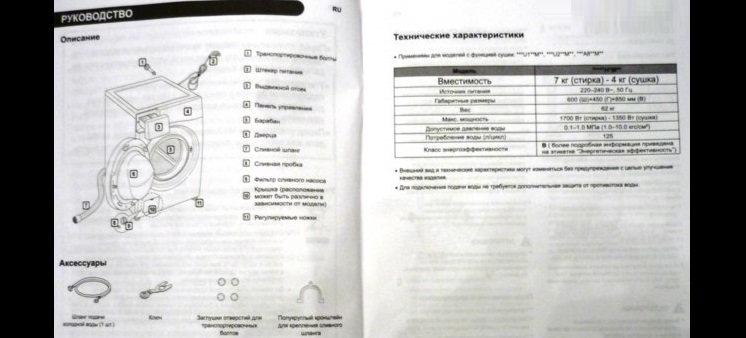
- the laundry dries unevenly due to excessive volume, the cycle has to be repeated;
- the fabric of things deteriorates, they quickly lose their marketable appearance and get torn.
Manufacturers recommend dividing large loads of laundry into two batches. For example, with a 7-8 kg washing machine, you can dry a maximum of 3.5-4 kg. However, it's best to check the load capacity for your specific model in the instructions.
The second point concerns the type of fabric. Modern machines offer several modes designed for specific materials and colors. This will ensure more efficient and safe drying of your items.
How to set up a clothes dryer?
Setting up the machine is easy: just read the instructions carefully and check the control panel. Typically, to start the drying cycle, you press a button or turn the selector to the appropriate position. The drying time and degree depend on the drying mode selected. Typically, you'll find one of two options: timer or Fuzzy Logic technology.
- Timer drying. This feature is only adjustable by time—the user sets the cycle duration. Drying quality will depend entirely on the timer setting—you'll need to experiment with the drying time for each fabric type.
- Fuzzy Logic Technology. In modern machines, the system automatically calculates drying time based on residual moisture. This approach ensures laundry dries better and more safely, minimizing the risk of over- or under-drying items. When calculating the cycle time, the machine uses a special thermometer located at the bottom of the condensation compartment. This sensor continuously measures the moisture content and temperature. As soon as the values match the set value, the machine stops.
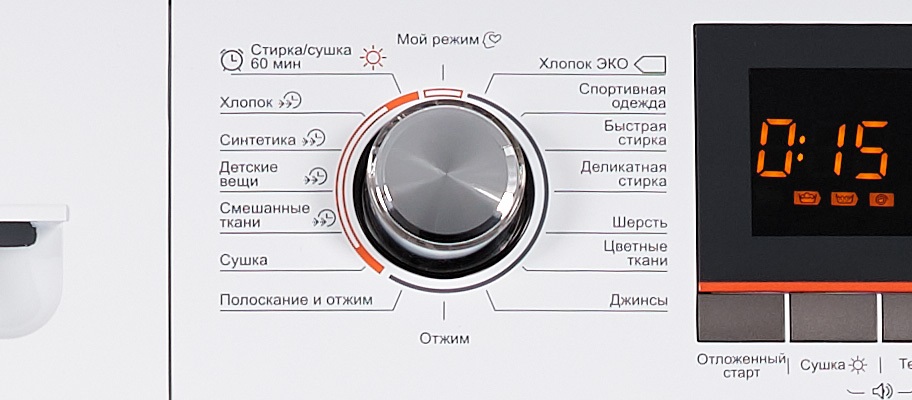
Many modern machines offer the user the option of choosing drying either by timer or by residual moisture. For convenience, several drying stages are provided, and the boundaries are set not in percentages, but in terms understandable to housewives. For example, there are settings such as "Iron Dry," "Cupboard Dry," "Very Dry," and "Hang Dry." These settings allow you to choose the most optimal option.
Modern combination machines allow you to vary the dryness level of your clothes from 70% to 90%.
The latest washer-dryers feature a special non-stop program. When this mode is activated, the drying process automatically begins after washing, eliminating the need for the user to press any additional buttons. However, there's an important caveat: the machine should only be half full.
Also, improved models of washer-dryers offer users:
- a special gentle mode for delicate fabrics, where drying operates at low temperatures;
- quick drying lasting 30-40 minutes;
- "Softness" function, which prevents fabric from wrinkling;
- the “Cooling” option, which sharply lowers the temperature in the drum to prevent creases and wrinkles in the fabric;
- "Hot Dry" function for rough, dense items and "Cold Dry" function for synthetic and delicate materials.
Modern, expensive washing machines boast advanced functionality, offering users multiple drying modes and additional options. The key is to be aware of all your washing machine's capabilities and set the cycle correctly.
What's good about a washer-dryer?
Washing machines with dryers have proven themselves to be excellent household appliances. Besides their convenience, these machines offer several advantages over conventional washers and dryers. These include the following.
- Reliability. The idea that 2-in-1 machines break down more quickly due to their complex design is a misconception. On the contrary, thanks to sophisticated technology and higher-quality components, washer-dryers last longer than conventional ones. The key is to follow the operating instructions.
- Compactness. Fitting one combination washer in the average apartment is easier than fitting a separate dryer and washing machine. A 2-in-1 washer will also be more energy-efficient: two units use twice as much electricity.
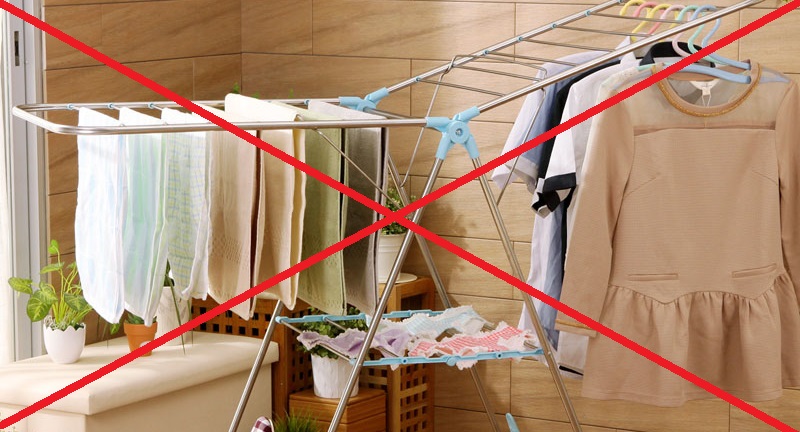
- Speed. While laundry can take several hours to dry on a balcony or floor drying rack, a washing machine can produce dry items in just 40 minutes. Even better, the machine works quickly regardless of the season—in both winter and summer. This is important if you have small children or live in a home with high humidity due to proximity to the sea or lake.
Thanks to the quick mode, the washer-dryer is able to produce dry clothes within 30-40 minutes after starting the cycle.
- Safety. In an attempt to dry clothes faster, housewives often hang them in direct sunlight or on a radiator. Unlike these options, automatic drying is much safer: clothes don't get overdried and the fabric isn't damaged.
- Versatility. The drying function allows you to wash pillows, down jackets, blankets, and other bulky items, even in winter. Automatic drying is safe for the filler: the down does not clump, keeps its shape, and retains its original properties.
- Reduced humidity in the apartment. If you have a tumble dryer at home, there's no need to dry clothes in the apartment—the amount of moisture evaporating in the rooms is reduced.
The main advantage of a washer-dryer is the freedom from hanging wet clothes and then waiting for them to dry. This saves time and energy.
Disadvantages of washer-dryers
Combination machines have both advantages and disadvantages. The most significant of these is the drum load limitation when switching to drying mode. Typically, only half the machine's capacity can be dried at a time. This means you either have to wash less clothes or divide the washed items into two batches, wasting extra time restarting the machine. Machines capable of drying a full drum at once haven't yet been released – a maximum of 70% of the capacity.
Washer-dryers are less energy efficient than standard washing machines – models are only available with energy efficiency classes “B”, “C” or “D”.
Also, the owner of a washing machine with a drying function should remember at least one more serious drawback - high energy consumption. Due to its complex design and long operating time, this type of equipment is less economical than standard equipment. So, most dryers are rated "B," with "C" and "D" also available on the market. Class "A," let alone "A+++," is nonexistent among dryers.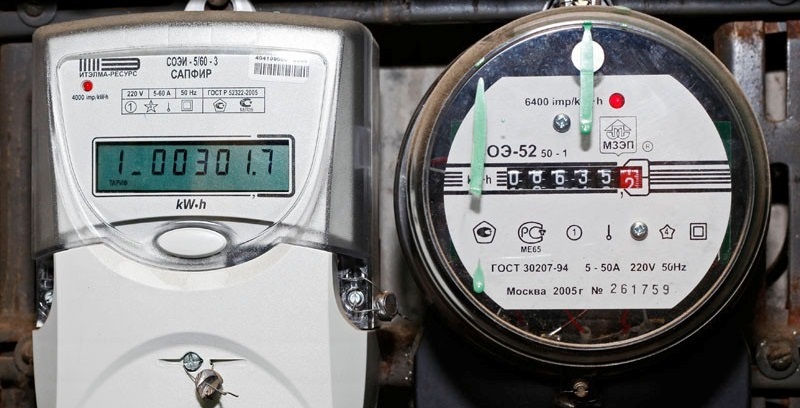
The disadvantages of 2-in-1 machines also include:
- high cost (combined technology costs 20-30% more than standard technology, and we are talking about the most budget models);
- rapid wear of the laundry (incorrect selection of the mode or incorrect setting of the cycle duration negatively affects the fabric - it dries out, becomes rougher, discolored and thinner);
- lack of an anti-dust filter (while individual dryers are equipped with this device, combination dryers are not).
When deciding to purchase a washer-dryer, it's worth weighing all its pros and cons. If you can afford to pay extra for more features, a compact combination unit can make your daily routine easier. Before using the washer-dryer, carefully read the instructions, adhere to the load capacity guidelines, and select the correct drying program.
Interesting:


Readers' comments
Headings
Washing machine repair




For buyers




For users


Dishwasher




Add a comment