
How a washing machine pressure switch works
 When problems arise with their washing machine, many homeowners can't even guess what the problem might be, as they have a vague idea of what's inside their washing machine. Meanwhile, it's important to at least have a basic understanding of the structure and function of the main components without which the machine cannot function. For example, do you know how a pressure switch works and what it even is?
What is it for and how does it work?
As you might have guessed from the name of the component, its function is related to pressure. Have you ever wondered how the main module (which commands all the components) "understands" what exactly needs to be done? For example, what signals it that there's enough water in the tank and it should either stop filling or drain the used water? That's what the pressure switch is for. It's involved in the entire washing process from start to finish, and without it, the whole process would be indispensable.
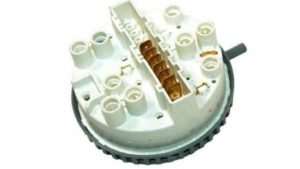 The thing is that each program requires a different amount of water. The pressure switch is programmed for these values and as soon as the required volume appears in the drum, it gives the control module a signal to stop the supply.Even during the spin cycle, the pressure switch accurately monitors the amount of water released from the wrung-out items and signals the pump to pump it out. Thus, after opening the drum, the items are still wrung out, but the water is already drained.
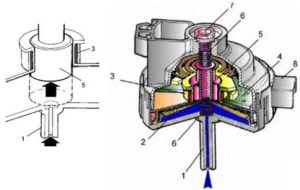
The device itself is a rounded piece with a plastic housing, attached to a hose and wiring. What does this piece do? Inside is a membrane and a switch. It works like this: The pressure in the drum is determined by the volume of water. Air flows through the hose to the pressure switch and presses on the membrane. Since the membrane is flexible, it bends under pressure and presses the switch. The switch, in turn, sends a signal to the module via the wiring.
To locate the pressure switch, simply open the top cover of the washing machine. The device will be located near one of the side panels (left or right, depending on the manufacturer).
What parts does it consist of?
First, let's look at what the part consists of. This is necessary for a better understanding of how it works.
- The compression chamber is the base of the connecting hose that connects it to the pressure switch. It tends to clog, causing errors and eventually problems with water pumping.
- Sensors. This is where the membrane is located. The sensor converts the pressure created by the liquid column into kilohertz (which measures frequency oscillations).
- Magnet or ferrite core.
- Spring.
- The diaphragm. Otherwise known as the membrane that bends under air pressure and presses the switch.
- The coil, capacitors, and printed circuit board are auxiliary components that don't directly contribute to signal transmission but support the operation of other components and contacts.
- The adjusting screw and the housing itself, inside or next to which the main elements of the device are located.
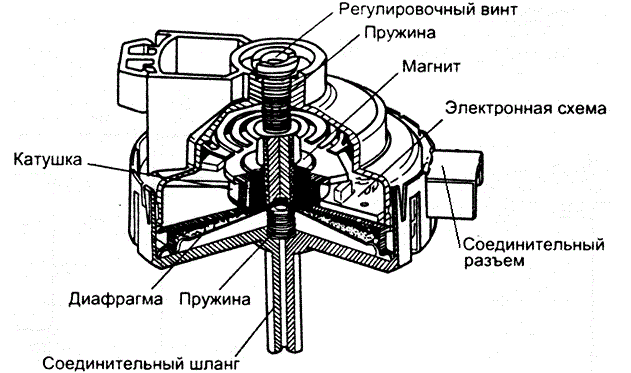
The pressure switch works as follows: when air moves through the hose, the membrane presses on the magnet (core) of the oscillating circuit. This causes the generator's oscillation frequency to change. The height of the core position changes under pressure, and these changes are read by the adjusting screw.
Important! The water volume in the pressure switch is programmed using the oscillation frequency values.
For example, when the tank is empty, the value is highest, and when it's full, it's lowest. There's also an inlet fitting, which is the main repository of programmed data. It's located at the very edge of the housing and intersects with the connecting hose. The inlet fitting reads the oscillation frequency and, based on the stored data, determines the volume of water entering the tank. The higher the volume, the lower the frequency. As soon as it reaches the minimum permissible value, the pressure switch generator is triggered and sends a signal through the wiring to the main module.
This is how this important washing machine sensor works. Incidentally, the washing machine's water level sensor is preset at the factory, but sometimes these settings get lost and need to be reset.
Interesting:


1 reader comment
Add a comment
Headings
Washing machine repair




For buyers




For users


Dishwasher




Simple and clear.
Thank you very much!