
Disassembling a Bosch washing machine
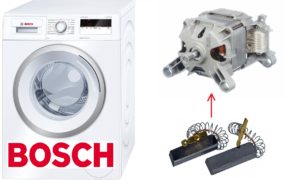 In our country, as always, prices are rising, while household incomes either remain the same or even decline. In such a situation, we are forced to resort to saving, and if the washing machine suddenly breaks down, it truly becomes a major problem.
Buying new appliances during a crisis isn't an option, and having old ones repaired by a professional is also expensive. The only option left is to fix it yourself, but to fix a washing machine, you first need to disassemble it. We'll discuss how to do this quickly and correctly.
Preparation
Before disassembling the washing machine, it is necessary to at least briefly study its design and disassemble it. Bosch washing machine design And note which components and assemblies will need to be removed to achieve the desired result. To completely disassemble a Bosch washing machine, you will need to remove:
- the rear metal wall of the machine and the top cover, as well as the front panels;
- powder collector with cuvette;
- control Panel;
- electric motor, pump, heating element;
- pulleys and drive belt;
- counterweights and shock absorbers;
- inlet valve, pressure switch and tubes;
- trash filter and pipes;
- hatch and UBL device;
- finally, the tank and drum.
But all of this is still a long way off. First, you need to properly prepare for disassembly, so that, firstly, the work is convenient, and secondly, parts don’t get lost. After all, disassembling a car is easy, but reassembling it later is not so much! First, let's gather a small set of tools. We'll need: a large and a small hammer, wrenches and sockets with 6.8, 10.12, 14, and 18 mm heads, a star-head screwdriver or bit, and Phillips and flat-head screwdrivers. You'll also need wire cutters, an awl, pliers, and colored markers to mark the wires.
Once you've gathered everything you need, disconnect the washing machine from all power, sewer, and water lines, then move it to a location where it'll be easier to work and where there's plenty of space. If you don't have anywhere to move it, you can simply drag it out to the entryway or leave it right in the apartment, after laying some rags on the floor underneath it.
Now we need to remove all the walls and panels from the washing machine that could interfere with disassembly. Use a Phillips-head or star-head screwdriver (depending on the Bosch model) and unscrew the two small screws holding the top panel (lid) of the washing machine. Next, slide the panel back relative to the machine body and remove it. Unscrew several screws holding the rear metal panel and remove it.
We take out the powder tray and unscrew the screws that hold the control panel (three screws near the niche for the cuvette and two on the top end of the housing). We remove the control panel and dismantle all the wires.
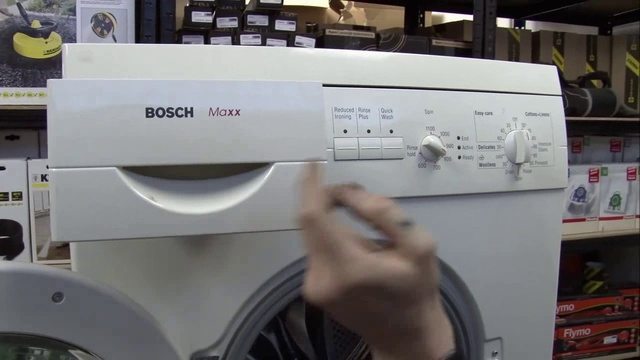
Caution! Remove the control panel with extreme care, as it has several short bundles of wires attached to it. Pull too hard and it will rip off!
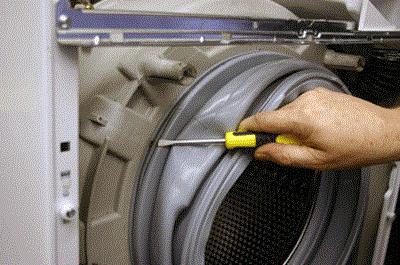
Remove the narrow lower front panel. It is secured with latches and covers the debris filter and fasteners for the central front panel. Unscrew the screws on the central front panel of the Bosch washing machine. Next, use a thin flat-head screwdriver to locate the clamp securing the door seal and remove it, detaching the fasteners. Tuck the seal inward, and then pull off the central front panel.
Removing the main components
So, what do we have at this stage of disassembling the Bosch washing machine? We see that after removing the walls and panels, all the parts and components we need to know are exposed. All that remains is to properly disassemble them. How do we do this, and where do we begin? Let's start at the top.
- Just under the top cover, you'll see a metal bar connecting the left and right sides of the Bosch washing machine. Unscrew the screws and remove this bar.
- Using a 14 mm wrench, unscrew the two bolts of the upper counterweight. Remove the counterweight.
- A little earlier we took out the powder tray and unscrewed the dispenser body; now it hangs loose, held in place only by the pipes. Our task is to move the dispenser slightly, “crawl” under it and remove the clamp with which the pipe is attached to the dispenser. It's disconnected using pliers. We remove the hose leading to the fill valve in the same manner and remove the dispenser.
- In the top half of the Bosch washing machine's housing, we can find the pressure switch and the tube and wires leading to it. The power cable with the interference filter also enters there. Disconnect the wires from these parts and carefully remove them. That's all from above for now!
Now, unscrew the waste filter and drain the water. Ideally, you should do this right at the beginning, but if you follow our instructions, nothing serious will happen. Quite a bit of water may leak out, so place a container underneath or throw plenty of rags underneath. Next, unscrew the screws holding the hatch door hinge and remove the door. Remove the two screws located to the right of the hatch to access the locking mechanism.
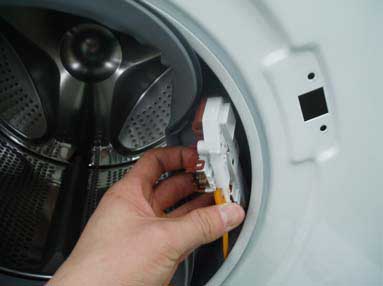
Important! The hatch locking device has wires that cannot be disconnected, so remove the locking device carefully.
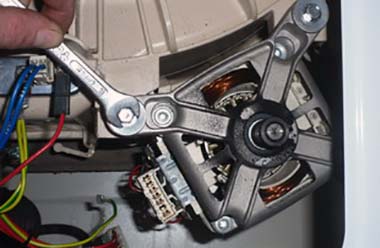
We go from behind. Remove the narrow drive belt from the pulleys and pull the wires off the motor. The motor needs to be removed. Take a 12mm wrench and unscrew the motor screws. Push the motor forward and down, while holding it from underneath with your hand. The motor should slide off smoothly.
Now we will be interested in the lower part of the Bosch washing machine body. If your model does not have a tray, then you can immediately begin dismantling the pump and pipes. If there is a tray, then you need to unscrew it.
- We lay the Bosch washing machine on its left side.
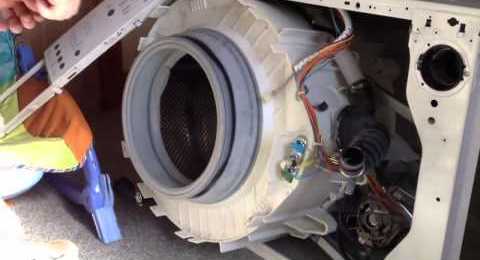
- We unscrew the screws holding the tray.
- We pull the pan off the plastic fasteners, but do it carefully so as not to tear off the leak sensor wires.
- We disconnect the leak sensor wires and move the pan to the side.
- We remove the clamps from the drain pipe and pull it off the pump.
- We pull the wires off the pump, and then unscrew and remove the pump itself.
- We unscrew the fasteners connecting the posts to the body of our semi-disassembled washing machine.
We're just a little bit away from removing the drum. Unscrew the front counterweight; it will prevent us from removing the tub and drum from the washing machine. Disconnect the wires from the heating element.
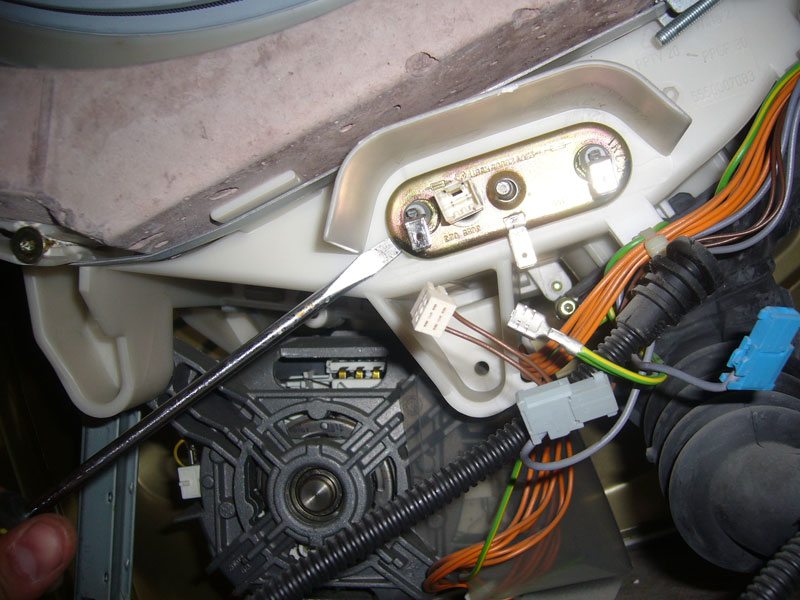
We won't touch it for now. Now all we have to do is remove the springs that hold the tub and drum together, and we can finish this stage of disassembling the Bosch washing machine.
New Bosch washing machine models have the heating element located at the front of the machine, not at the back of the tank, as in many other automatic washing machines.
Let's remove the tank
After we've removed all the essential and non-essential parts from the washing machine body, we can begin removing the drum. Now, removing the drum is quite easy, as we've pulled it free of the springs, meaning it's lowered about 30 cm. We grab the edges of the hatch and pull the tank together with the drum towards ourselves. The knot should just fall out through the front.
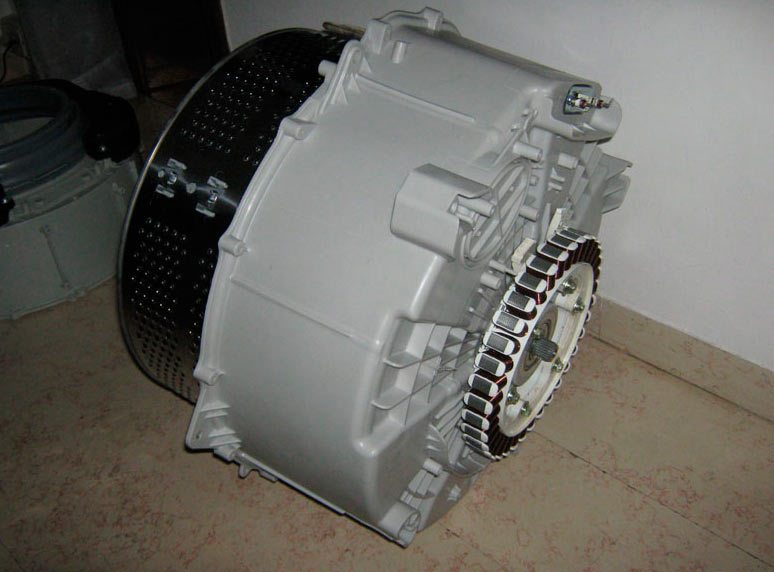
Next, we need to disassemble the washing machine's drum to check and replace the seals and bearings. Bosch washing machines have disassemblable drums, so no sawing is required. Simply unscrew a few dozen screws and separate the drum into two halves. Further disassembly and repair of the drum is carried out in the same way as on all other washing machines. For more details, read the publication. How to disassemble a Zanussi washing machineOn Bosch everything is done the same way, I don’t want to repeat myself.
In conclusion, if you've decided to disassemble your Bosch washing machine, don't panic ahead of time. Be determined, and you'll definitely succeed. Good luck!
Interesting:
1 reader comment
Add a comment
Headings
Washing machine repair




For buyers




For users


Dishwasher




Hello, I have a Bosch Maxx 4 WFC 2060 washing machine. I removed the control unit and forgot to label the connectors, so I took them out. Now I can't remember where to connect them correctly. Please help!