
How to sterilize jars in the dishwasher
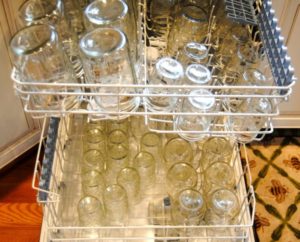 In summer and fall, housewives spend their time preparing food at home. Needless to say, this process is tedious, so many are interested in simplifying it somehow. Recently, there have been suggestions online to sterilize jars in the dishwasher. When we first heard about this, we thought it was nothing short of silly, but after researching the matter thoroughly, we reconsidered our position.
Description of the process
After considering various points of view, we decided to try this method ourselves. There's nothing complicated about it; the main thing is to kill any microorganisms that live in the glass jars during washing. And, of course, you can't use detergents, as even the slightest trace of them can ruin all your hard work. What do we do?
- Prepare the jars for sterilization. If the jars are very dirty, they need to be washed. If there's just a little dust on them, don't bother—the dishwasher will wash it off. Also, check the jars for chips.
- We clean the tray from any remaining detergents so that they do not get on the sterilized dishes.
- We place the jars tightly in the baskets with the necks down.
If your dishwasher contains salt, there's no need to remove it. Salt water kills microorganisms faster and at a lower temperature.
- We close the dishwasher door, select the program that provides washing at the highest temperature, and start the process.
- Once the program is complete, we take out the sterilized jars and begin preparing the food.
What dishwashers are suitable?
It all sounds simple. However, it's important to understand that the success of the sterilization process will depend on the capabilities of the dishwasher. SomeBosch dishwashers capable of washing dishes at a temperature of 70-800S. This type of equipment is quite suitable not only for washing dishes but also for sterilizing jars. However, not all machines have these capabilities. Machines from Electrolux, Leran, Flavia, Indesit and others are mostly capable of heating water to a temperature of 600C, and this is clearly not enough for sterilization.
Check your dishwasher's manual to see if it can be sterilized. If it washes at least 70°C on intensive or any other setting,0Feel free to place the jars in the baskets. If your sink temperature is 10 degrees or more lower, use the tried-and-true methods to sterilize the jars.
There are also dishwashers with a sterilization function. Their instructions explicitly state that this appliance can sterilize jars, glass baby bottles, and allergy-safe dishes. However, it's worth noting that such dishwashers are rare on the Russian market, so you'll have to make do with regular ones.
The pros and cons of this method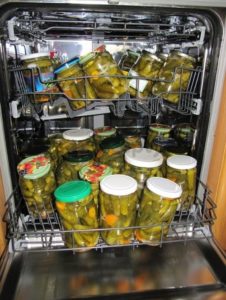
We've already mentioned that we've tried this method of sterilizing jars, and we found it to be quite good. It may not be perfect, of course, but it's not bad. This innovative sterilization method has a number of advantages.
- The sterilization effect was amazing. The jars were completely disinfected, so the preserves inside survived the winter quite well. Of the 40 jars of cucumbers, only 3 turned cloudy for unknown reasons.
- The sterilization process is automatic, requiring no manual labor. While the jars are sterilizing, you can do other things.
- High performance. The dishwasher can hold a whole mountain of jars and jars, all of which are sterilized simultaneously.
- Careful handling of dishes. When you sterilize at least one jar by hand, you break it while juggling it over a boiling pot. A dishwasher sterilizes without breaking, and that's a saving, at least.
This method also has its downsides, and we'll certainly mention them. First, it's time-consuming. If you need to sterilize 7-10 jars, it's better to do it manually. It will save you time.But if you need to sterilize large volumes of glass containers, then it's better to give the "palm of victory" to the dishwasher.
Secondly, this method isn't applicable to every dishwasher. We've already discussed this, and it's a definite drawback. And thirdly, how do you sterilize in a dishwasher if you're making preserves at your dacha? Sure, you can bring the appliance to your dacha, but without running water, connecting it will be problematic.
So, what's the takeaway from this story? Sterilization in the dishwasher, while not universally applicable, is possible, and it can truly make a homemaker's life easier. It takes no more than 10 minutes to master the process, and in the best-case scenario, you can save between 40 minutes and an hour. So, give it a try and share your impressions in the comments. Good luck!
Interesting:



1 reader comment
Add a comment
Headings
Washing machine repair




For buyers




For users


Dishwasher




Any dishwasher dries dishes with steam, this is true sterilization, so any machine will do, and not just one with a 70-80 degree setting.