
How to properly wash pillows
 Of all the household items, pillows require the most careful and delicate care. Skin particles, dust, and sweat accumulate inside the pillow, creating a favorable environment for germs and mites, which can cause allergic reactions in humans. Therefore, they need to be cleaned regularly. In this article, we'll share our experience and explain how to machine wash pillows.
The process of washing synthetic pillows
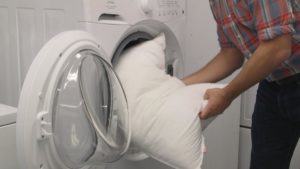
Pillows with synthetic filling are the easiest to wash because they retain their shape. The most common synthetic fillings are hollow fiber and synthetic padding, but pillows filled with polyester, fiberlon, and polyester beads are also common.
Before placing your pillow in the washing machine, check the filling's ability to withstand this treatment. Simply place a heavy object on the pillow for a few minutes and then remove it. If the pillow has regained its original shape, you can safely wash it.
You can wash synthetic padding pillows using one of the following washing modes:
- Delicate wash
- Hand wash
- "Down Blanket"
All these modes are gentle on fabrics, as the drum speed is reduced during washing. As for the water temperature, it should not exceed 40°C.0C. When choosing a laundry detergent, choose gels over powders. This is because soapy water is easily absorbed into the filler, making rinsing difficult. Gel-based detergents are easier to rinse out than powder particles.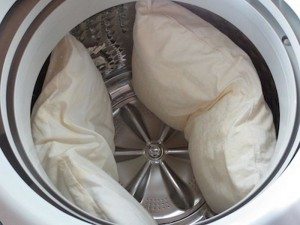
Please note: To effectively rinse out detergent, you need to set the extra rinse cycle.
Pillows with synthetic fillings can be spun at high speeds, but not exceeding 1000 rpm. However, this does not apply to anti-stress pillows filled with polyester balls. It's best not to spin these pillows, or to spin them at low speeds.
Features of washing down and feathers
The most common question people ask is whether they can machine wash a pillow filled with down or feathers. Washing these pillows isn't easy because the filling must be separated into several pieces. Pillows with synthetic fillings are placed whole in the machine. Feather and down pillows, however, must first be carefully ripped open along one seam, then the down or feather filling must be divided into two or three pillowcases and sewn tightly. A special washable pillowcase can be used instead of a pillowcase.
Important! The less fluff in a single cover, the better it will wash and rinse.
Now let's move on to washing:
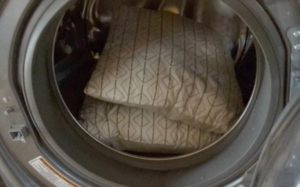
- Place the covers with the filling in the drum. Two covers are placed in a standard-sized drum to create an even load and prevent imbalance. Machines with a larger drum can wash 3-4 down or feather-filled covers at once.
- Along with the pillows, we put a couple of tennis balls in the drum to prevent the down from clumping.
- Pour gel laundry detergent into the powder compartment. You can use loose powder, but use half the amount you'd use for regular laundry.
It is not recommended to use fabric softener, as its strong and persistent odor can cause dizziness. - Select the "Down" ("Down Blanket") or "Delicate Wash" cycle. The water temperature should be 300WITH.
- We set an additional rinse.
- We set the lowest spin speed to prevent the down filling from clumping.
- Let's start the process.
Feather pillows should be washed this way at least once a year, ideally 2-3 times a year. This will prevent the proliferation of germs and dust mites.
Other materials
In addition to the above-mentioned pillow fillings, there are pillows with filling made from:
- bamboo;
- sheep's wool;
- camel wool;
- organic materials (eg buckwheat husks).
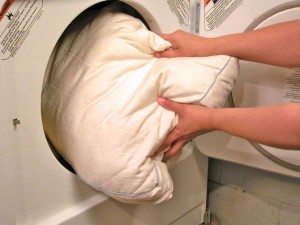 Pillows filled with buckwheat husk cannot be washed at all. Care for these pillows involves emptying the filling and drying or baking it. The cover should be machine washed on a delicate cycle or by hand. In general, orthopedic pillows cannot be machine washed., as this can lead to loss of shape and its beneficial properties. Such pillows should be cleaned by hand.
Bamboo pillows are washed in the same way as pillows with synthetic filling. The water temperature during washing should not exceed 30°C.0S. Bamboo is a natural material that retains its shape perfectly and does not lose its amazing properties after repeated washings.
Please note: Bamboo pillows are hypoallergenic and suitable even for asthmatics.
When washing pillows made of sheep's wool or camel wool, use a special liquid detergent for wool containing lanolin. This substance protects the wool fibers from dirt, making them supple. Machine washing of these pillows is permitted on the "Wool" or "Hand Wash" cycle. Rinse the pillows multiple times and spin at low speed.
Drying rules
It's crucial not only to wash your pillows, but also to dry them thoroughly afterward. Improper drying can lead to a musty odor and bacteria growth in the warm, humid environment.
Synthetic and bamboo pillows should be dried in a well-ventilated area, laid flat. Avoid overdrying them to avoid developing an unpleasant odor.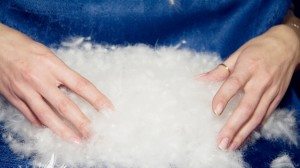
Washed feather and down pillowcases should be dried quickly. This is best done on a sunny, hot day. This is essential to prevent the filling from rotting. After washing, it's recommended to lay down the down pillows on towels or a terry sheet to absorb excess moisture. Then, as the pillows dry, fluff and smooth out the down. Once the filling is dry (this process can take a couple of days), place it in a clean pillowcase and sew it tightly shut.
Wool-filled pillows can be dried naturally on the balcony by laying them out flat. Alternatively, you can use a tumble dryer or drying function in the washing machine. In this case, the drying mode should be gentle, the temperature should not exceed 300WITH.
Alternative cleaning methods
If you're against washing your pillows in the washing machine, you'll have to wash and clean them by hand. This should be done in a large container, such as a bathtub. The basic washing principles are the same:
- water temperature no more than 400WITH;
- You need to use a gel-like product or thoroughly dissolve the powder in water.
Feather pillows are hand-washed without covers, meaning you'll have to wash the feathers themselves. First, soak them in soapy water for two hours. Then, change the soap solution and wash the feathers, swirling them around in the bathtub. After washing, rinse all the feathers in a colander and lay them out on a towel to dry.
In some cases, washing a pillow isn't necessary to refresh it. Steaming it will suffice. Here's how:
- the pillow is suspended in a vertical position;
- the product is steamed twice on both sides using a vertical steamer;
- Dry the product in a horizontal position and put on a clean pillowcase.
Please note! A similar "Refresh" mode is programmed into some modern washing machine models with a drying function.
Another alternative to washing pillows in the washing machine is dry cleaning. Dry cleaning not only launders the item but also treats it for pests and germs. If you don't want to waste time doing this at home, consider hiring a professional.
So, we hope you now understand how to wash bamboo, down, and other pillows in a washing machine. The most important thing is to be patient and follow the instructions.
Interesting:
3 reader comments
Add a comment
Headings
Washing machine repair




For buyers




For users


Dishwasher




I washed down pillows much more easily. I used UniPuh. Of course, the first time I washed them, I was worried the down would bunch up, but my worries were unfounded. I didn't separate the down and didn't use any down balls. The pillows washed perfectly, and once they were dry, the down straightened out on its own.
Could you please tell me what kind of cover you used to wash your clothes? And where can I buy these covers?
I simply removed the pillowcase and washed it with UniPukh, right in the pillowcases. The fluff didn't clump, and that's the main thing.