
How to install a dishwasher in an IKEA kitchen
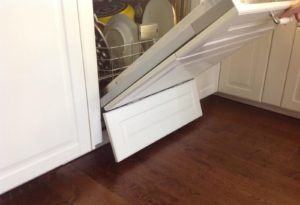 Installing a dishwasher in a kitchen, specifically building one, usually doesn't pose any problems. Even a novice DIYer can get the job done to a reasonable standard in a relatively short time. But that's only if the kitchen is designed with the built-in dishwasher in mind. What if it isn't? In this article, we'll explore the situations where installing a third-party dishwasher in an IKEA kitchen is necessary. We'll also explore potential issues that may arise during the installation and how to resolve them.
What's the problem?
To install a built-in dishwasher in a kitchen cabinet niche, you need to: connect the water supply and drain hoses to the dishwasher, slide the cabinet all the way into the niche, and hang the cabinet door. If the kitchen was custom-made to your measurements, this won't be a problem. However, if you bought a ready-made kitchen from IKEA and are trying to install a dishwasher from, say, Bosch, Electrolux, Kandy, Smeg, Hansa, or another brand, you'll encounter a problem when hanging the cabinet door.
The fact is that the dishwasher front in a standard IKEA kitchen is taller, which is due to the dishwasher's design. Apparently, the manufacturer designed their dishwasher this way, so that only their appliances could be seamlessly integrated into their kitchens, or perhaps they simply didn't think it through. Even if the IKEA front panel can be hung on the door of a third-party dishwasher, the door simply won't open because the bottom of the front panel rests against the niche frame.
Most often, it is impossible to hang the IKEA front on the door of a third-party dishwasher due to incompatible fasteners.
Here you have a problem out of nowhere. Doorsdishwashers from IKEA Some dishwashers have a retractable design that allows for hanging such fronts, something other dishwashers can't boast. Adapting such a front requires at least some effort, but there's a more sophisticated solution. For an additional fee, cabinetmakers can redesign the front or make a new one to fit the door. This is an additional expense, and there's no guarantee of a perfect fit. You can try to solve the problem yourself; let's discuss how.
Fitting the facade
Some experts recommend using the good old-fashioned method of fitting. It involves simply cutting the front panel with a jigsaw. You need to cut off the part that's blocking the dishwasher door. If necessary, you need to adjust the fasteners to ensure a perfect fit. You'll need to cut off a piece of about 8 cm, then the front panel will fit perfectly and the dishwasher door will open and close freely. This method has its drawbacks.
- Cutting off part of the front panel will expose the bottom of the niche and the dishwasher legs, creating an unsightly gap that, according to many, spoils the kitchen's furniture composition.
- The facade must be sawed off carefully to avoid chips along the edges, otherwise it will be hopelessly damaged.
If you manage to make a high-quality cut, you must definitely process its edges with sandpaper.
- If the front panel isn't a solid color and has a pattern or design on it, this method won't work at all. After all, cutting off part of the front panel will disrupt the design, which will completely ruin the furniture's appearance.
The first drawback can be overcome by hanging the carefully cut piece of cabinet door on special IKEA hinges instead of throwing it away. This way, it will hang freely, attached to the bottom of the fitted cabinet door, and cover the bottom edge of the niche. This solution kills two birds with one stone: first, it preserves the kitchen's appearance, and second, it ensures that the door opens and closes freely. This method is also advantageous because it doesn't require significant material costs; it only requires your time and patience.
Rising facade
If the door front has a texture or pattern, it's definitely not cut. But what can you do? It won't hang like that, either. There is a solution, though it's not exactly simple. If you follow the instructions, it'll work.
- Unscrew the original fasteners from the dishwasher door. Leave the fasteners in place; we'll need them later.
- We purchase ball-bearing telescopic guides for furniture.
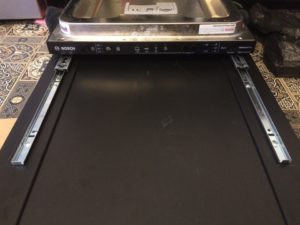
- We install one part of the guide on the dishwasher door, and the other on the back of the facade so that they match exactly.
- We connect the guide parts, simultaneously hanging the front panel on the dishwasher door.
Now, when we open the dishwasher door, the front will slide up along the guides and will not interfere with opening. This design has only one drawback: it requires a lot of space in front of the dishwasher, since when the door is opened, the front will move forward by 30-50 cm, but this is not such a big problem.
So, we're once again convinced that there are virtually no unsolvable problems, especially when it comes to installing a dishwasher in an IKEA kitchen. Be careful and meticulous, and you're sure to succeed.
Interesting:
2 reader comments
Add a comment
Headings
Washing machine repair




For buyers




For users


Dishwasher




Everything is much simpler!
1. Lower the Bosch washing machine as far down as possible.
2. At the bottom of the machine, unscrew the metal casing with two bolts and throw it away.
And a Miracle!!!
We place the door level with the other facades and it opens and closes!!!
There is only about 6 centimeters of empty space between the top of the machine and the tabletop; you can cover it with a piece of wood if it bothers you.
Verified by me.
How do you close the dishwasher's legs?
They will stick out...
And here is an option for the dishwasher to be inside the frame and covered by the facade.