
How to integrate a dishwasher into a kitchen
 Not everyone has the luxury of frequently renovating their kitchen: replacing cabinets, redoing wiring, plumbing, piping, and so on. But what if the kitchen is already finished and you don't particularly want to redo anything, but you need a dishwasher? Even if the kitchen is quite large, it's impossible to find room for new appliances right out of the box, especially ones that require a power connection. How to integrate a dishwasher into a finished kitchen is the topic of this article.
We look for a place and calculate the dimensions
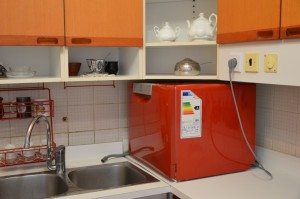 When we're just starting to plan a kitchen interior, and the space is empty except for shabby walls, it's much easier to figure out where the dishwasher will go. In our case, we already have a functioning kitchen, everything in its place and nothing out of place. How to integrate a new appliance, especially a rather large one, into such a space is a crucial question that requires immediate resolution.
First, you should have an idea in your head where you could place this kitchen unit. As you can imagine, you'll have to think carefully, as there aren't many acceptable options. When considering the installation location, you should keep in mind the dishwasher's connection. Simply installing it isn't enough; you need to ensure its proper operation, without any technical complications. Experts offer several ideas.
- Place the dishwasher in the sink under the sink. The idea itself is not bad; the sink's width and depth are exactly the same as many dishwasher models. And the height can be increased by modifying the bottom of the sink. You'll also need to buy a special siphon, but it's close to the water and sewer lines.
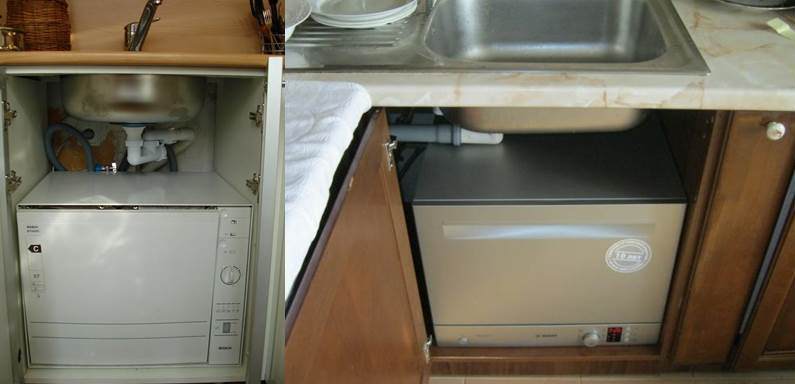
- Install a dishwasher in one of the large base cabinets that was previously used for storing larger dishes. This cabinet, of course, will require some remodeling, which we'll discuss later.
- Install a dishwasher instead of an electric stove. Many people are now abandoning electric stoves, replacing them with smaller cooktops. If you don't need an oven and were planning to "retire" your old electric stove anyway, this option might be worth considering.
- Remove the least needed piece of kitchen cabinetry and install a dishwasher there. It's unlikely you'll have such a piece of kitchen cabinetry, but don't discount this option.
- You can stack a dishwasher on top of a freestanding appliance. For example, if you have a washing machine in a corner of the kitchen, away from the kitchen cabinets, it's perfectly acceptable to stack a dishwasher on top, although aesthetics are still an issue.
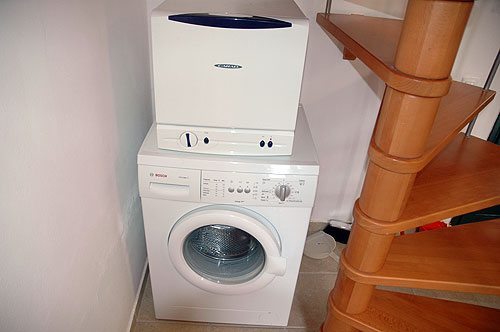
Please note! Dishwashers don't necessarily have to be placed on the floor; many design solutions include installing them in cabinets suspended 60-90 cm from the floor, or even higher.
Before calculating whether a dishwasher will fit in a particular space, you need to decide what type of dishwasher you want. The following types of dishwashers are available:
- non-built-in – they are not intended for installation in furniture;
- partially built-in – can be placed in furniture, but not in every one;
- Fully built-in – special equipment designed for integration into a kitchen unit.
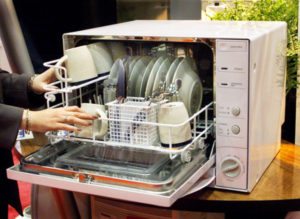
- Compact – they take up so little space that they will fit into any finished kitchen.
Fully integrated, small or partially integrated dishwashers fit best into a finished kitchen. You can read about how to perform calculations and successfully fit a built-in machine into the right place in the article Installing a built-in dishwasherBy the way, if you buy a compact dishwasher, you won't have to search for a long time for a place for it, since the dimensions of a small "dishwasher" are comparable to the size of a microwave oven.
How to convert a cabinet into a dishwasher?
If you have a cabinet in your kitchen that can accommodate a dishwasher (it's the right size), you'll need to properly adapt it. Incidentally, standard base cabinets with shelves aren't the only options. You can even build a dishwasher into a cabinet with drawers. What do we do?
- Remove the cabinet's front panel. If the cabinet has drawers, pull them out.
- We take out all the contents from inside, including the shelves.
- We unscrew the hinges that hold the doors in place – they may interfere with installing the dishwasher.
- We unscrew the back wall – it will only get in our way.
- We estimate the size to see if our dishwasher will fit, and if so, we order a cabinet front.
Important! If you don't want to spend money on the front panel or have trouble making it, you can return the doors after remaking the hinges.
What might be required for installation?
What tools and materials will be needed to install a dishwasher in a finished kitchen? We can only guess, as there are thousands of options. Basically, you need a standard set of tools that every owner has in his pantry., but with the components, not everything is clear.
- If the dishwasher is located 1.5-2 meters away from the drain trap or outlet, the standard drain hose included with the dishwasher may not be sufficient. We don't recommend trying to splice the hose; it's better to buy a one-piece, longer hose.
- An extended inlet hose may also be required. If the dishwasher is also intended to be connected to hot water, two hoses are required.
- You will need a brass water supply tee with a shut-off valve.
- You will also need fum tape and rubber gaskets.
- If the dishwasher is to be installed in a sink, you will need to purchase a special siphon.
The above list of materials covers the basic components, but you may also need a whole bunch of other small items: screws, concealed door hinges, clamps, compression fittings, and more. Basically, Be prepared to match your ideas with the materials you have on hand or that can be easily purchased.
Please note: If you're installing a separate outlet for your dishwasher, be sure to use a well-insulated, two-wire copper cable and a moisture-resistant outlet.
Where and how to connect a dishwasher?
The location has been chosen, the materials have been gathered, the ideas have surfaced, and now we're starting to connect the dishwasher. But where should we connect it? The electrical and water lines weren't specifically designed for a dishwasher. Let's start with the electrical system. The problem is that a finished kitchen is unlikely to have a dedicated outlet for a high-power appliance, and plugging the power cord into an existing outlet that already contains a refrigerator, microwave, or other appliance is highly discouraged. You can install a new socket from the electric stove's communications.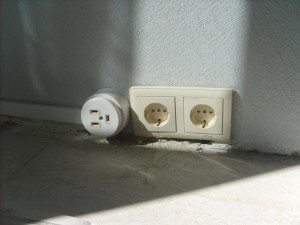
- We de-energize the socket by turning off the switch in the electrical panel.
- We unscrew the 380 V socket.
- We take a screwdriver-indicator and find the phase and neutral wires.
- We bring these wires out to the side through the terminal connection.
- We drill holes in the wall and install the “guts” of the new socket.
- We connect, tighten everything carefully, and then install the housing of the waterproof socket.
This outlet layout isn't quite right, but we don't have any other options. We can't cut grooves in the walls for new wiring or install cable ducts, since the kitchen is already finished. Now we'll solve the water and sewer issues, and we'll try to do that as quickly as possible.
- We turn off the cold water.
- We disconnect the hose going from the metal-plastic pipe to the mixer.
- We install a tee with a tap on the hose and connect it back to the mixer.
- We connect a flow-through filter to the tee, and then the dishwasher inlet hose to it.
As you can see, no major modifications were required; everything was done meticulously, yet very effectively. Now let's connect the dishwasher to the sewer system. Nothing special here—we installed a pre-purchased trap with a drain hose outlet. We connected to this outlet, making sure to make an elbow at the trap and at the base of the dishwasher. Now all that's left to do is put the dishwasher back in place and test it—the job is done.
In conclusion, if you're unsure where to install a dishwasher in your existing kitchen, don't despair. Use your brain, consult the experts, and take action. We have good reason to hope you succeed!
Interesting:
1 reader comment
Add a comment
Headings
Washing machine repair




For buyers




For users


Dishwasher




Totally unprofessional. I watched the video for 10 seconds and couldn't continue (disgust at the work being done, like a perversion). I'll say this: total crap. He taped on two tees from a flexible water supply. He's worried about leaks and short circuits from the electrical system, and he's using an extension cord to install a temporary connection. No, guys, that's not right, and don't learn from his example. I did the renovation myself, and everything I have is wired in the wall through a comb, and each outlet on the comb is shut off individually. Each consumer has its own wire (dishwasher, water heater, stoves, washing machine, lighting, room wiring, and all of this is fed through a residual-current circuit breaker. Plus, there's a funny little thing at the input that can withstand a 7,000-amp lightning strike and protects against a broken wire (neutral). Electricians will understand—then the network will switch from 220V to 380V. That's how it should be done, folks, not the hunchbacked kind in the video!