
How to replace a dishwasher circulation pump
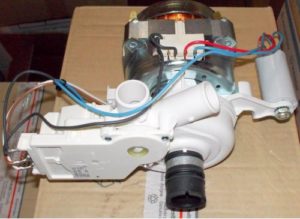 The circulation pump is a vital component of a dishwasher. Without it, it's impossible to create the necessary pressure in the system and wash dishes. If this part fails, the machine stops functioning completely. Replacing a dishwasher's circulation pump is quite expensive. First, you'll need to purchase the part itself, and second, pay a technician to replace it. You can cut costs a bit by doing the repair yourself. Let's give it a try.
Symptoms and causes of failure of this part
If you notice that your dishwasher is filling with water but not washing dishes, don't rush to replace the circulation pump. This part is relatively reliable and rarely breaks down. More often, the debris filter or the spray nozzles become clogged, which causes problems.
Turn off the dishwasher, open the door wide, and look at the very bottom of the wash chamber. There you'll see a plastic cup-like object and a metal mesh strainer. If the strainer or "glass" is clogged with food debris, clean it before running the dishwasher again. If you encounter problems at this stage, read the article. Replacing and cleaning the dishwasher filterIt contains many useful details that will help you.
On a Bosch machine, the filter can be unscrewed by hand without much effort, and the mesh can be lifted and pulled out.
The sprinkler impeller should also be thoroughly inspected. Remove the impeller and then use a toothpick or needle to clean out each hole. Once you've ensured that water flows freely, the problem should resolve.
To make sure that it is the circulation pump that is broken, listen to how the machine behaves after filling with water. If the machine stops after filling with water without making any more sounds, there is a 98% chance that the central pump is broken. If there's a humming noise but the dishwasher isn't washing, you should first clean the circuits of dirt before addressing the component. Why does the circulation pump break? According to repairmen, the main causes are:
- manufacturing defect;
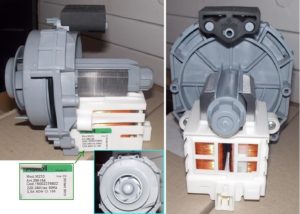
- improper use of the dishwasher;
- power surge;
- damage during transportation;
- handicraft repair.
This last point deserves special attention from DIY enthusiasts. It's important to remember that before tinkering with any device, you should examine it thoroughly before attempting any repairs. If possible, it's best not to attempt to repair a recirculation pump yourself, but rather entrust the job to a professional. You'll have to pay a technician, but they'll do the job quickly and professionally.
Preparing the dishwasher
Some repairs are best left to a professional, but we also understand that a good homeowner is always itching to fix their dishwasher themselves. We'll try to help. Let's start with properly preparing your dishwasher—it's essential.
- We de-energize the machine, remove all the hoses and move the housing to a place where it will be convenient to work with and begin disassembling the unit.
- We unscrew the screws that hold the side walls, and then remove the walls.
- We turn the dishwasher upside down and remove the sound insulation from the side walls.
- The door's soft-opening mechanism is mounted on the side walls. It consists of a cable, plastic blocks, and springs. These springs must be released, while the door must be held to prevent it from falling.
- The entire tray is held in place by several hooks located at the corners of the housing; these need to be unlocked using a screwdriver.
- At the base of the tray, where the dishwasher hoses enter, there are more hooks that need to be released. The plugs with wires also enter there. These should be disconnected.
- After removing the hooks, you need to carefully lift the tray up, then disconnect the inlet pipe, remove it and put it aside.
The inlet pipe is quite difficult to disconnect; you will have to apply force and carefully pull it out.
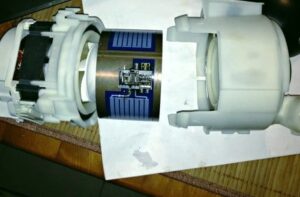
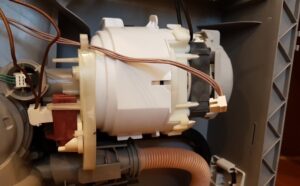
Once the tray is removed, all the dishwasher's vital components will be visible, with the non-functioning circulation pump right in the center. You won't confuse this component with any other, as it's the largest and has several bundles of wires running to it.
Bosch or Ariston dishwashers also have flow-through heating elements inside their circulation pumps, but they can't be replaced individually. So if a heating element burns out or something goes wrong with the motor, the entire unit—that is, the circulation pump—will have to be replaced. At this point, the preparation is complete. Let's begin replacing the part.
We are changing the part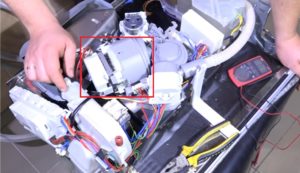
Where can I buy a new circulation pump, and how can I test the old one? It's best to leave testing the old pump to the professionals; it's difficult to do on your own. You can purchase a new pump from branded stores or from specialized websites. When ordering a part, be sure to tell the seller the model of your dishwasher. So, without further delay, let's remove the old circulation pump.
- Disconnect all the connectors and wires. There are many connectors and wires connected to the pump, so it's best to take photos of everything as it was before you installed it, so you don't mix anything up when you install the new part.
- There's a small metal clamp at the very base of the pump that needs to be removed. Use a flat-head screwdriver to pry the clamp's hook apart and separate the two halves.
- Where the clamp was, the circulation pump is connected to a rubber hose. Disconnect the pump from the hose.
- Now we disconnect the circulation pump from the distribution block, which is located nearby.
- Now the pump is left hanging by one hanger. Let's remove it and set it aside.
We take the new circulation pump out of the packaging. We hang it on the hanger, connect all the pipes, and install the clamp. Lastly, we connect all the connectors and wires. It's important not to mix up the order. We reassemble our dishwasher in reverse order, connect it, and perform a test run.
So, if your circulation pump isn't turning on, it may be faulty and need replacing. Don't worry, it's not that difficult. If you put in the effort and read our instructions, you can do the replacement yourself. Be careful, take your time, and you're sure to succeed!
Interesting:
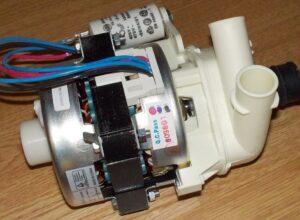



2 reader comments
Add a comment
Headings
Washing machine repair




For buyers




For users


Dishwasher




We called a repairman today. At first, he said the pump was broken and could be repaired for 5,000. But when I pulled it out of the dishwasher, he said it couldn't be repaired and a replacement would cost 10,000. Is that normal?
Certainly.
Masters, that's what they are.