
Which dishwasher is better: 45 cm or 60 cm wide?
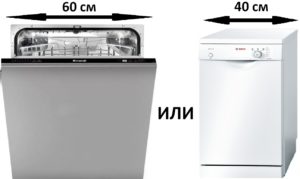 When considering purchasing a dishwasher, homemakers immediately imagine themselves lounging on the couch while the appliance washes their dishes and pots. The benefits are endless: a perfect manicure, healthy skin on your hands, and no need to stand for half an hour at the sink fiddling with a sponge and towel. All well and good, but when the time comes to choose a dishwasher, the question arises: which dishwasher is best? First and foremost, we're interested in size: 45 cm or 60 cm? Let's find out what experts and experienced homemakers think.
Let's think about the selection criteria
Experienced housewives who've been using a dishwasher for years recommend carefully considering the size of your future "home helper." Let's assume you haven't taken any steps yet, but are just considering buying a dishwasher. What should you consider first? Of course, where you'll install your new appliance and how you'll connect it.
Many people have small kitchens in their apartments and houses, and they have to save space. Quite often, there's simply no room for a full-size 60 cm dishwasher. In this case, the dilemma is self-resolving, as a 45 cm dishwasher is narrower and easier to find space for. If there's potential for space for a 45 or 60 cm dishwasher, you'll have to consider other criteria.
- How many people are in your family and how often do you host guests? This is a very important criterion that determines the intensity of your visits.
 dishwasher load. It's simple. If you frequently wash a huge amount of dishes, then you need a dishwasher with the maximum possible load, and these are 60 cm machines.
 - Dishwasher load. Quite often, you have to wash more than just plates, glasses, and spoons and forks. Dirty dishes also include large salad bowls, baking sheets, and large pots and pans. A full-size dishwasher is better for larger dishes.
- Water and energy consumption. I want to buy a dishwasher that's functional yet as energy-efficient as possible. To do this, I'll need to look at the datasheets for specific dishwasher models and find information on energy and water consumption.
Water and energy consumption depend not so much on the size of the dishwasher, but on the programs and functions built into it.
- Rack arrangement. The quality of the wash depends on how you arrange the dishes in the racks. Therefore, the more convenient the racks are, the easier it is to use the dishwasher. Manufacturers carefully design dishwasher racks, and many models now feature adjustable racks. Now, users can adjust them to ensure the dishes fit comfortably.
- Program and function selection. Any modern dishwasher should have an impressive array of useful programs and functions. In particular, a half-load mode, which allows the dishwasher to use half as much water and energy for a smaller load of dishes.

- Noise. If a dishwasher produces more than 55 dB of noise during operation, it's best not to buy it. The normal noise range is 45-52 dB.
- Manufacturer. For many, the dishwasher brand and country of assembly are very important. In this regard, German brands and dishwashers assembled in Germany are at the top of the list, while Russian-assembled dishwashers are at the bottom. China currently ranks somewhere in the middle. If you're seriously considering the question, Which brand of dishwasher should I buy?, read the article of the same name.
- Protection. Good dishwashers are protected from leaks and child tampering. They are equipped with filters that protect the machine if the water supply is contaminated with poor quality water. In our opinion, such nice features are worth considering; they're very useful.
So, here's a basic list of criteria to consider when choosing a dishwasher. Of course, not all criteria are relevant to the question of whether a 45 cm or 60 cm dishwasher is worth choosing, but if you look at these criteria together, you'll come up with a picture of the ideal machine you'll be searching for on store shelves.
Advantages and disadvantages of a 45 cm machine
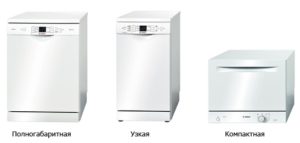
Now we'll briefly outline the advantages and disadvantages of each of the presented dishwasher size ranges, so you can get an even more complete idea of which type of appliance to choose. We'll start with the pros and cons of a 45 cm wide dishwasher.
Don't be surprised if some of the ideas outlined earlier are repeated in the remaining points. This is done intentionally to emphasize the points and present the material more clearly for easier digestion by the reader. So, here are the advantages of the 45 cm machine.
- Compact and ergonomic design. This isn't so much about saving space, although that's important, but about ergonomically arranging the appliance within the kitchen space. A 45 cm dishwasher with a narrow design looks much more natural in a small kitchen, and it's also somewhat easier to integrate into cabinetry than a full-size one.
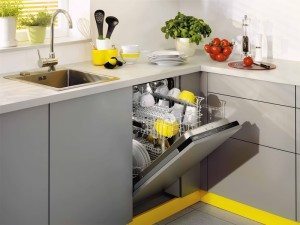
This narrow dishwasher fits easily into a standard-sized cabinet. No special design required.
- A more diverse model range. Marketers have long noticed that narrow dishwashers sell better, so the manufacturer, in response to this fact, is constantly expanding its range of machines with a 45 cm wide body. The conclusion is that narrow dishwashers have a wider range of models and a greater choice, which means it will be easier to find the “ideal assistant” for yourself.
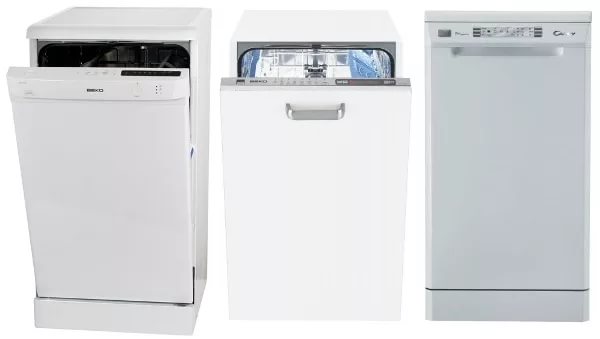
- It's easier to choose a ready-made front panel. Since built-in dishwashers with a 45 cm wide cabinet are much more popular, ready-made front panels are available in almost any color and texture. For a 60 cm wide dishwasher, a custom-made front panel is required, which is an added headache.
Add to the above advantages the opportunity to save an extra 15 cm of space in your kitchen, and you'll see that there's a lot to like about buying a 45 cm model. However, before jumping to conclusions, let's discuss the downsides of narrow machines.
- Some dishes literally don't fit. Try squeezing a standard-width baking sheet or a huge pot into the narrow bin. Even if you manage to do so, you won't be able to fit anything else in there. And large, greasy baking sheets, pots, and pans are very difficult to wash by hand. The conclusion is obvious.
- Service life and technical solutions. Narrow dishwashers accommodate components more compactly. Technical solutions are used that are more aimed at cramming more components into a small frame than at extending the machine's lifespan. Statistics are grim: narrow dishwashers last, on average, 2-2.5 years less than full-size ones.
- Not suitable for a large family. A narrow dishwasher can hold significantly fewer dishes than a full-size machine—that's a fact. If you have more than four people living in your home, a narrow dishwasher won't be suitable.
Pros and cons of 60 cm dishwashers
The situation with narrow models is clear. Although manufacturers and marketers never tire of praising them, these dishwashers also have obvious drawbacks that should be considered. But what about standard dishwashers? In our opinion, the fact that 60 cm wide dishwashers are considered standard and traditionally used worldwide speaks volumes. They have a number of undeniable advantages.
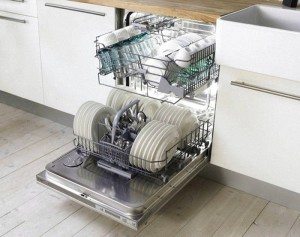
- Plenty of capacity. If you need to cram a whole mountain of plates and glasses in, that's fine. A couple of pots and a baking sheet are no problem either. And you won't even have to worry about where to place them for best cleaning results.
A full-size dishwasher holds 16 or more place settings.
- High-quality dishwashing. The more space the dishes have, the better the cleaning results. It's difficult to clean in a narrow bin.
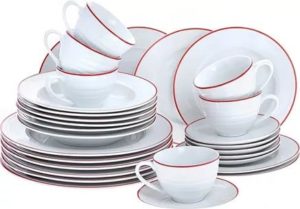 To achieve this, in a 60-centimeter model it is elementary.
 - The presence of modes that help save water and electricity. Previously, large dishwashers were uneconomical. Now, with the advent of electronic control systems, there are programs that allow you to load the machine halfway and set a half-load program, and this is pure savings.
Large dishwashers also have their downsides, and they're related to the size of the appliance. Fitting one into a small kitchen is problematic, let alone a built-in one. A 60 cm built-in dishwasher will take up a lot of space. But if you have a larger kitchen, these drawbacks automatically become irrelevant.
Interesting:



2 reader comments
Add a comment
Headings
Washing machine repair




For buyers




For users


Dishwasher




Well, it depends on the person, I guess. Personally, I don't need 60 cm; a 45 cm Hotpoint is perfectly adequate. Yes, a wider one is easier to fit baking sheets into, for example. But I don't use the oven that often.
I have an Indesit, and a bigger one, it’s perfect for washing bulky dishes, otherwise everything around the sink was covered in water 🙂