
Which washing machine to buy – advice from the pros
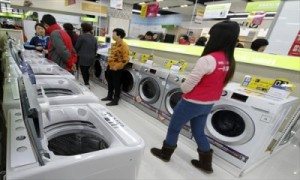 Today, no normal home can be imagined without an automatic washing machine. Demand creates supply, and the choice is now so vast that it can be overwhelming. People are increasingly asking which washing machine is best to buy. Experts offer a specific selection process, as a washing machine is not a cheap purchase, and money should be spent wisely.
First, you need to clearly define your budget. Then, create a list of your machine requirements, including its exact dimensions and loading method, listing and recording all the necessary features, and finally, reading reviews and choosing your preferred brand and manufacturer. Only then can you decide where to buy a washing machine that meets all your requirements.
What's so interesting about narrow washing machines?
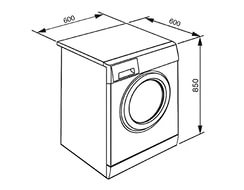
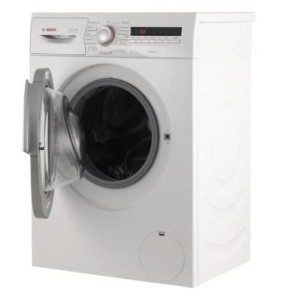 Narrow washing machines have a width of up to 40 cm, most often 32 cm, which, compared to the standard width of 60 cm, is much preferable for small apartments. Most of our residents live in small apartments, and not everyone has the space to install a washing machine in the bathroom or kitchen. A narrow washing machine can be installed even in a hallway without compromising usable space. However, it's important to understand that narrow machines have a much smaller load capacity than standard machines. While a standard machine can hold up to 7 kg of laundry, a narrow one can only hold 3-4 kg.
One of the disadvantages of narrow machines is that their model range is significantly shorter than that of standard models. However, an undeniable advantage is the space savings, as many are top-loading and require no additional space to open the door. Front-loading models are so compact that they can be installed directly under the sink.
Another important plus is Some narrow washing machines often use a direct drive (no belt), which significantly reduces noise, vibration, and energy consumption. This means, in addition to saving space, a narrow machine also saves money, which is important for single people and young families without children.
The vast majority of narrow washing machines have a sufficient number of wash programs (7-9). Many models feature a ceramic-coated heating element, which prevents scale buildup and premature failure, and eliminates the need for frequent use of descalers.
Water consumption for the entire wash cycle in such machines is standard and ranges from 48 (42 to 60) liters. Therefore, the wash quality in narrow machines is no different from that in standard machines, and the spinning is even better due to the small drum radius and smaller load.
Which loading type should I choose – top loading or front loading (side loading)?
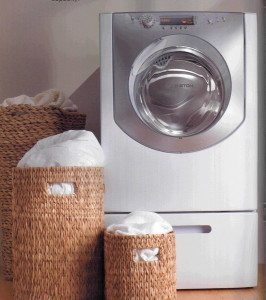 A priori, top-loading was designed for machines that don't need to take up much space. Everyone knows that the machine door needs to be left slightly open between washes, which is inconvenient in high-traffic areas, especially narrow aisles.
But top-loading has other significant advantages. For example, the lid can be opened while the machine is running and additional laundry can be added. It's also a great solution for families with small children, as the control panel is located on top, making it difficult for a small child to reach the controls.
When purchasing a top-loading machine, pay attention to the lid opening angle. Ideally, it should be 180 degrees, meaning the lid opens completely. This is especially important if the machine is planned for installation under a countertop. Also, consider the drum material. Models with stainless steel drums are preferred, as they are more reliable and durable, although composite models (plastic or metal) may be less expensive.
Which washing class should I choose?
Washing class refers to the ratio of washing quality to energy consumption. Automatic washing machines are designated by letters, from G to A. Class A machines provide minimal energy consumption with a fairly gentle wash, they are considered the best. However, class G is the lowest level of vehicle efficiency.
Spin classes are also designated separately, but in exactly the same way. Although most modern washing machines have manually adjustable spin speeds, the range is from 400 to 2000 rpm (compared to 1200 in conventional machines). The lowest spin speeds are recommended for delicate and fine items, while the highest are for thick and heavy items. Higher spin speeds also remove more water, but also increase the machine's cost and energy consumption. It's up to the owner to decide which is more important.
Which washing programs are preferable?
Let's look at the most popular and frequently used washing modes.
- Quick wash – designed to refresh laundry, nothing more.
- Soaking and stain removal – for heavily soiled and baby laundry.
- Economy wash with half load – for thrifty housewives, it consumes significantly less water and energy.
- Extra rinse – for those who don’t like the smell of powder on their clothes.
Choosing your preferred washing programs is closely tied to your water connection method. Depending on your typical washing temperature, you should choose a water connection method—cold, hot, or a combination of both.
When connected to a cold water supply, water heating occurs smoothly, but regular use of water softeners and periodic descaling will be required. Using hot water allows for significant energy savings, but is unacceptable when washing delicate fabrics, both due to the high initial temperature and the poor quality of the hot water, which is essentially industrial.
Additional functions of automatic washing machines
Drying clothes. Many modern washing machines come with a built-in drying function. The obvious convenience of this feature comes with a serious drawback. Machine drying only allows you to dry half of your laundry, meaning you have to remove half after each wash. Furthermore, laundry often ends up overdried and impossible to iron. Machine drying is also not recommended for delicate fabrics. Therefore, you should carefully consider whether the extra cost of this additional drying feature is worth it.
Soundproofing. It varies, so it's important to know that the quietest machines are those with three-phase asynchronous motors (commutator motors in conventional machines). A special insulating layer of material inside the housing also reduces noise. However, bright stickers on the housing indicating the noise level are completely unimportant.
Additional leak protection. Not all machines have this feature and it's installed exclusively at the factory, meaning you can't buy it at a parts store and install it on your existing machine. Leak protection can be complete or partial. If your machine is equipped with the Aqua Stop control system, if water gets into any unauthorized area inside the machine, the water supply is automatically shut off.
Water monitoring system. Some machines automatically monitor parameters such as load weight, water consumption, and energy consumption. For example, the Aqua Sensor system monitors water clarity—the dirtier the laundry, the cloudier the water—and automatically increases the rinse duration and intensity.
A detergent dissolution quality control system. Booble-soaking is an additional system that creates numerous air bubbles in the water, ensuring that any detergent dissolves quickly and completely.
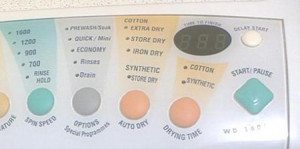 Automatic selection of washing mode. This function is provided by the Fuzzi Control system, which analyzes the volume of laundry loaded and its type, after which it determines the optimal washing mode and subsequent rinsing with spinning.
This system also monitors the level of foaming and, if it becomes excessive, takes appropriate action, such as activating an additional rinse and adjusting the drum speed during the spin cycle. Some other systems operate similarly, such as the Smart and S systems for foaming control, and the Fuzzi Logic system for automatic wash cycle selection.
The water cooling system before draining allows to extend the service life of drainage units and plastic sewerage systems.
The door protection system locks the door for 1-3 minutes after washing, during which time the laundry has time to cool down and prevent burning your hands.
The anti-crease feature slows the drum rotation to 30 rpm at the end of each wash cycle. This is also achieved by the interval spin function and the rinse hold function. During this time, unspinned laundry can be removed and hung to drain on hangers, resulting in virtually crease-free results. Alternatively, you can add more laundry to the machine.
The start timer allows you to set the washing start time from 1 to 24 hours in advance. This is a useful feature for those whose nighttime electricity bills are significantly cheaper than their daytime ones.
Washing systems in automatic washing machines
- Traditional. The machine fills with water without any tricks, and the laundry and detergent come into contact at the bottom of the drum.
- AquaSpar and Aqua-Tronic. The drum of this machine has asymmetrical arms that direct water upward, so laundry comes into contact with the detergent both from below and above the drum.
- 3-DAquaSpar and 3-DAqua-Tronic. The machine is designed so that water is supplied from below, above, and from the side.
- Activa and Jetsystem. Machines with this system deliver a powerful jet of water into the drum, filling the tank quickly and pre-treating the laundry.
- Direct Spray. During the wash cycle, the detergent solution is continuously sprayed onto the laundry like a shower.
- Combiwash. A combined washing system where delicate items are washed "under the shower," while normal items are washed as usual in the water. And the shower isn't ordinary—it's filled with air bubbles that gently lift dirt out of the fabric.
Which brand of washing machine and which manufacturer should I choose?
It's important to understand that products assembled at affiliated factories of a well-known brand whose headquarters are located in another country will in any case be of inferior quality to the original. The very location of assembly plants closer to consumers is evidence of the manufacturer's desire to reduce production costs. This policy manifests itself in everything, including the use of cheaper and lower-quality components. Consequently, the service life of such machines is steadily reduced.
But this has its advantages: the closer the assembly line, the more readily available the parts. The only question is how often you're willing to make repairs. Most low-end cars last no more than five years, and many don't even make it that far, after which they're faced with endless repairs. This is especially true for Chinese cars and Russian clones of European brands.
Mid-priced machines feature a wide range of washing programs, a 1200-rpm spin cycle, additional features, and lower noise and vibration levels. These machines typically last at least 8 years without breakdowns. The most expensive and advanced machines last at least 15 years and feature a full suite of additional features. And when you consider the savings from gentle washing of the most expensive items, savings on detergents and energy, and the avoidance of repairs, the extra cost quickly pays for itself.
Interesting:

20 reader comments
Add a comment
Headings
Washing machine repair




For buyers




For users


Dishwasher




I liked the article, it was clear and understandable.
Thank you! Very useful information, accessible to everyone!
I liked the article for its accessible and comprehensive coverage of washing machines. As a user, I found it interesting. Thank you!
A very useful and helpful article. We're currently deciding which car to buy. We learned a lot, thank you so much for the information.
It's probably a matter of luck. My Indesit was assembled in Russia, even though it's an Italian company. And I haven't had any problems with it. Maybe it's a really good model, I don't know, but I'm happy with everything.
My Indesit car has been running smoothly for 20 years. It was assembled in Italy. I'm really sad to part with it, but it seems the time has come.
Thanks to you, we chose Hotpoint. We'd barely heard of them before your articles, and we're so happy with our choice! Thank you!
Indesit is a low-quality machine. It lasts no more than three years.
Not true. We had an Indesit machine for 23 years. We only replaced the heating element twice and the drive belt once. It still works, but it started leaking from the inside, and over time, the bottom part rotted, causing the lower support to fall apart due to rusting of the housing. We put a board underneath and it still works. We'll be getting the same one again. We always used the same program; we simply didn't need any others. We always used Calgon.
"Friend," ha-ha! My Indesit has been working flawlessly for over 10 years now. 🙂 I wish something would break so I could just replace it with a new one.
Leah, you're being so mean. I've had an Indesit for seven years, not ten. And let it keep working, knock on wood! Why the extra expense? 🙂
My Siemens worked for 21 years without repairs, and after repairs, it lasted another 3 years! So you're still far from breaking any records!
We've had an Indesit for 13 years. We had a small problem with the loading hatch. It's a great machine.
Good day, the "wash," "stripes," "spin/drain," and "service" LEDs are all lit up. What's the error?
My Indesit's heating element burned out two years after I bought it. After repairs, it worked for another 13 years, but it was time to replace it. The drum started making a knocking noise, and the service center said it was most likely the bearings. Repairs are expensive.
My Indesit lasted 16 years without a single problem. It was assembled in Italy. I only got rid of it because it weighed 4 kg, and I needed more.
I have an Atlant, it worked without any breakdowns for 13 years.
My Indesit worked for 21 years without any breakdowns, but the time has come to choose another machine.
Good day everyone!
I have a Samsung machine, but it was assembled in Russia 🙁
She's only a week old, so I can't say anything yet. But let's hope.
And the article is absolutely fire!
If I had read this earlier, it would have influenced my choice of car assembly.
But all that's left is to believe 🙂
I've had a Hansa Comfort 800 for 16 years; we replaced the bearings 10 years ago. I'm happy with everything: it's quiet and washes cleanly. But today, the software malfunctioned. I'm waiting for a repairman, and my husband said, "Buy a new one, this one's done its job." Even if I have to buy one, it's a shame. In the current situation, I don't know what to choose. Prices have doubled, there's no choice of European-made machines, and China doesn't suit me.