
Boil function in a washing machine
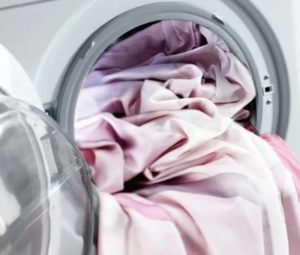
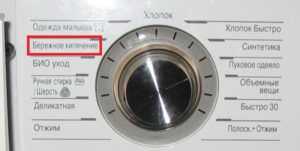 To remove stubborn stains from light-colored fabrics, many housewives resort to "hot" bleaching—boiling the laundry. It's done the old-fashioned way: water is boiled in a saucepan, then the items are dropped into the boiling water and "boiled" for a few minutes. And not everyone knows that you can boil clothes directly in the washing machine.
A washing machine doesn't always have a special boiling mode, but even without one, it can reach the desired temperature. The key is to set the cycle correctly.
Can all machines boil?
Almost any washing machine can boil water. The only exceptions are very old models, and the problem isn't with the functionality, but with the heating element—over time, it becomes coated with scale and performs poorly. Other machines heat up to near-boiling temperatures without any problems. To confirm this, just look at the machine's temperature scale—it specifies a maximum of 90-95 degrees Celsius. More than that is not required for fabrics.
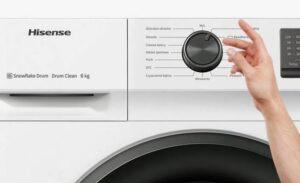
The special “Boiling” mode is found only in a few modern machines. Simple models heat up to maximum temperatures on 1-2 standard programs. Most often, these are "Cotton," "Prewash," or "Intensive Wash." To boil water and bleach laundry in these machines, you need to:
- activate any high temperature cycle;
- set the heating temperature to 90 or 95 degrees;
- add oxygen bleach to the powder dispenser;
- start the wash.
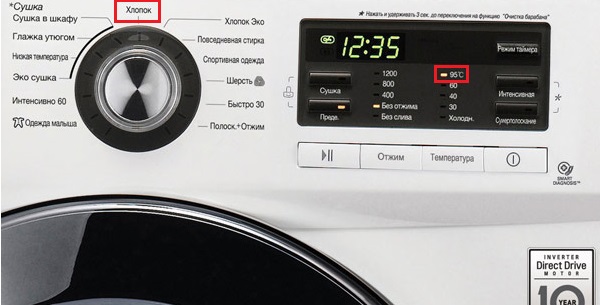
The high-temperature program takes a long time to wash. During the boiling process, the drum rotates slowly and pauses frequently to ensure even heating of the water and to agitate the laundry with the detergent. At the highest temperature, the washing machine runs for about 20-25 minutes, which is enough to whiten the fabric. Some models take longer to "boil," depending on the manufacturer's preset algorithm.
Experts recommend boiling laundry in the washing machine no more than once a month.
After boiling, the program smoothly switches to rinsing and spinning. There's no reheating—the washing machine rinses in cold water.
Frequently activating the boiling function on your washing machine is not recommended. Heating water above 60 degrees Celsius places additional stress on the machine's components and equipment. The heating element itself, as well as the seal, bearings, rubber seals, tub, and pump, bear the brunt of the strain. It's best to play it safe and limit the high-temperature wash cycle to 1-2 times a month.
The machine doesn't boil
Sometimes a washing machine refuses to heat up to boiling point. There are two possibilities: the machine doesn't heat up at all, or it doesn't reach the user-set temperature. In either case, the heating element is to blame. It's burned out, scaled up, or lost connection with the circuit board.
If you suspect a faulty heating element, you need to diagnose it by testing it with a multimeter. But first, you need to find the device. The location of the element varies by manufacturer. For example, on Indesit, Samsung, Beko, and Ariston washing machines, it's routed into the drum from the rear, while on Bosch and Siemens, it's routed from the front. It's best to avoid guessing and instead consult the wiring diagram for the heater in the manufacturer's instructions.
You can locate the heating element without instructions. Here's how:
- look at the back panel of the case (if the back is large, then the heating element is located at the back);
- lay the machine on its left side and look into the bottom (this way you can see the heater);
- remove the back panel and inspect the washing tank (the “thing” with wires at the bottom of the tank is the heating element);
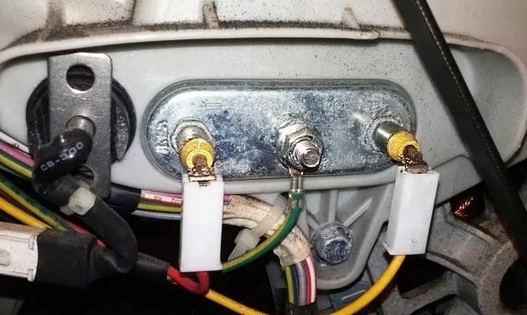
- try to see the heater through the drum (you will need a flashlight and good eyesight).
The tubular electric heater fails due to voltage surges and hard tap water.
You can find the heating element in the washing machine's tub, which makes the task much easier. There's no need to dismantle the appliance—you can test the element without removing it.
The heater diagnostics are carried out in the following order:
- the machine is disconnected from the power supply and water supply;
- access to the heating element is freed (the tray or back cover is removed);
- the location of the contacts on the element is photographed;
- the wiring from the heater connector is disconnected;
- take a multimeter and set it to measure resistance (set the value to 200 Ohm);
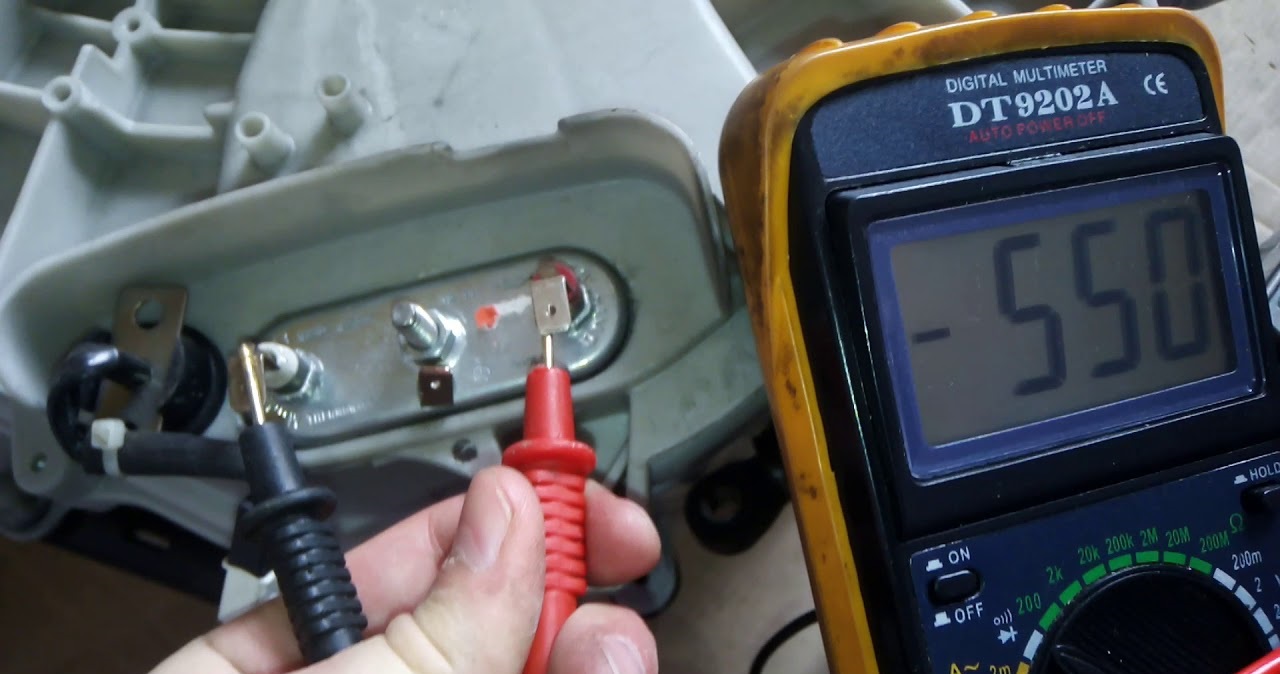
- the probes are attached to the contacts;
- indicators are assessed.
Normally, the heating element produces 26.8 ohms. Tolerances within the range of 21.8-31.8 ohms are acceptable. If the device shows “1”, it means the line is broken and the heater needs to be replaced. When “0” or another number less than 1 appears, a short circuit has occurred, followed by burnout of the contacts.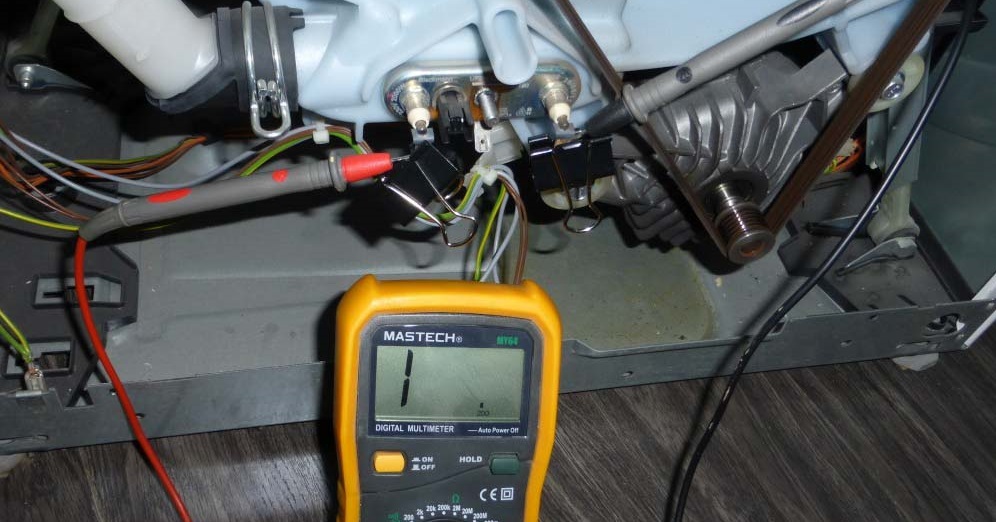
In addition to measuring the resistance, it's recommended to test the heater for breakdown. The dielectric inside the device often leaks onto the housing, causing current leakage. While everything appears clean, the element is not working and is dangerous. To ensure the heating element is working properly, you must:
- set the multimeter to buzzer mode;
- apply one clamp to the contact and the second to the tester body;
- listen carefully: a squeak will indicate a breakdown.
A faulty heating element cannot be repaired; it must be replaced. A new heating element is selected based on the washing machine's serial number or the old model. The element is connected in reverse order. To boil laundry in a washing machine, you don't need to buy an expensive machine with a special option. Simply set it to the high-temperature program with maximum heat.
Interesting:

Readers' comments
Headings
Washing machine repair




For buyers




For users


Dishwasher




Add a comment