
Korting dishwasher error codes
 Many Russian homes have German-made dishwashers made in China. Some really like them, while others regret choosing them. Among the complaints raised by critics of Korting machines is the incomprehensible self-diagnostic system, which is capable of identifying too few defects. Is this assessment fair? We decided to find out by identifying and detailing the Korting dishwasher's errors. Here's what we found.
List and decoding of codes
Before we begin, I'd like to point out that this time we've decided to deviate slightly from our usual plan. This time, we'll first list and briefly decipher all the Korting dishwasher error codes, and then move on to a detailed description of each code and the malfunctions that caused them. So, let's get started.
- E1 – water either does not leak into the dishwasher at all, or leaks too slowly, which is recorded by the control module.
- E2 – water is not removed from the dishwasher system.
- E4 – water from the dishwasher system has entered the tray.
- E8 – the level sensor incorrectly records readings and transmits them to the control module.
There are really very few codes, at least when compared to most dishwasher models sold on the Russian market.
Reasons
When the E1 error occurs, keep two main causes in mind: the first group is issues preventing water from entering the dishwasher, and the second group is a complete lack of water or low water pressure. Testing always begins with the second group of causes, as they are much more common. What to do? Turn on the faucet in the kitchen or bathroom and check the water flow. If there is no water, or the flow is too small, the dishwasher will not work.
In small towns, frequent water outages or drops in water pressure are common. If left untreated, your washing machine or dishwasher won't work. To increase the pressure in the water supply system, skilled craftsmen install special pumps, which, by the way, are readily available. By installing such a pump, you will forget about the E1 error for a long time, unless, of course, the water is turned off completely.
Let's move on to the first group of reasons that can obstruct water flow into the machine. First and foremost, these are blockages. Turn off the water supply to the dishwasher, unscrew the inlet hose, and locate the filter mesh at its base. This filter often becomes clogged and prevents water from entering the machine, so it should be cleaned at least once every six months.
You also need to check the intake valve to make sure it opens fully. Sometimes the valve starts to stick and won't open fully. In this case, repair is pointless; the part needs to be replaced. How do you do this?
- We unscrew the screws of the side wall and remove it.
- We get to the inlet valve and remove the connector with wires from it.
- We remove the valve mount.
- We remove the old valve and check it with an ohmmeter.
- We put a new valve in place of the old one, connect the connector with wires and assemble the dishwasher.
The E1 error may be caused by the wiring connecting the control module to the intake valve and the control module itself. The wiring can easily be checked with a multimeter, but it's best to have the control module tested by a technician.
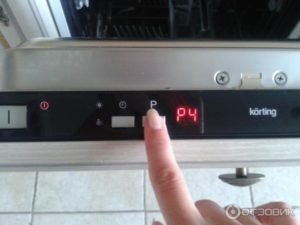 The E2 code appears due to an inability to remove the waste water and detergent mixture. What causes this? In about half of the cases, the culprit is dirt that has become clogged in some area: in a pipe, in a pump, in a drain hose, in a siphon, in a sewer pipe. It needs to be removed, and then everything will be fine. In the second half of cases, the culprit is parts such as the pressure switch and the pump. These parts need to be checked with a multimeter, the fault identified, and the burned-out module replaced.
When a water leak occurs, the dishwasher displays the E4 error code. The dishwasher's housing is designed so that any leaking water ends up in the tray. There's also a sensor with a float that, when water gets in, triggers the machine's shutdown. The control board responds by displaying the E4 code. This problem can be resolved as follows:
- We check the tray; if there is water there, we need to turn off the machine and tilt it on its right side in order to drain everything that has accumulated there;
- Next, you need to check all the pipes and the bottom of the washing chamber for damage;
- Having found the damage, it must be eliminated, and then the float of the leak sensor must be lowered;
- Next, you need to assemble the machine and run a test dish wash.
If you encounter the E8 error, try removing and inspecting the water level sensor. Pay particular attention to the sensor tube. This tube has a thin hose attached to it, which should be removed and inspected for blockages. The tube itself should also be inspected for blockages. You should also check that the level sensor is securely attached and that the wires connecting it are not broken. After this, check the wiring and sensor with a multimeter, and a final diagnosis can be made – either continue the investigation or replace the pressure switch. Learn more about replacing the pressure switch in a dishwasher, you can read in the article of the same name.
In slightly rarer cases, the E8 error is triggered by the control module. A malfunctioning firmware can display any error code, so it's important to take the problematic part to a technician who can properly test it.
Troubleshooting Techniques
We've just described the Corting dishwasher's error codes and explained their meaning. It does seem like the self-diagnostics system is limited. It doesn't even cover 25% of all possible dishwasher malfunctions. So what should you do if something breaks in your Corting and isn't indicated by an error code? The answer is simple: watch and listen to how the machine operates and trust your common sense.
Let's say the thermistor or heating element is broken. There's no error code for these faults in the Corting self-diagnostics system, meaning the machine will continue to operate regardless. Pay attention to the quality of the dishwashing process and the type of water used. You will probably understand that washing is carried out in cold water, and after that you can take measures to check the heating element and thermistor.
For example, if water has accumulated in the dishwasher's wash chamber and isn't draining, the Korting dishwasher may stop working but not display any error. How do you fix this? Turn off the machine, drain the water, and then remove and clean the debris filter. A clogged filter is what prevents water from circulating properly.
In short, we won't list all the possible defects of the Korting dishwasher; that's the topic of a separate article. Our main goal is to demonstrate that even without a self-diagnostic system, dishwasher defects can be easily identified. And if the system helps, that's a plus.
Interesting:
2 reader comments
Add a comment
Headings
Washing machine repair




For buyers




For users


Dishwasher




The topmost rocker arm, above the spoons, has fallen off. I can't put it back on myself. Help! What should I do? Thanks 🙂
The washing machine is taking a long time to finish washing. What could be the problem? Thank you.