
What communications are needed for a tumble dryer?
 Before purchasing any household appliance, it's a good idea to find out what utilities are required for its proper functioning. If something is missing, there's no point in buying the unit. Even if all the utilities are in place, you still need to carefully consider where to place the new appliance. Let's find out what utilities are needed for a dryer and consider other installation considerations.
Communications for the dryer
It's worth mentioning right away that absolutely all dryers require access to a power source. As for connection to the sewer system and ventilation, this depends on the specific unit. Some models require this, while others do not.
Ventilation-type dryers remove moisture from the chamber through a pipe directly to the outside. This type of unit is only permitted in private homes. The only advantage of this type of dryer is its low cost. Otherwise, it is unlikely to be to anyone's liking: it is difficult to use, suitable only for use in mild climates, and finding a suitable installation location is extremely problematic.
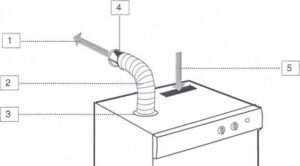
Ventilation is quite simple. The dryer body has a special vent with a soft air duct attached to it. A special clamp is included with the dryer, which connects the duct to the vent. The other end of the duct exits either through a vent or, if there's none, directly through a window.
Important! To ensure proper operation of the exhaust duct, avoid bends in the pipe greater than 90 degrees. The fewer bends and turns, the stronger the draft.
Another installation issue is room temperature. If the room where the dryer is located is frequently hot, it's best not to run the ductwork overhead. Doing so will cause condensation to accumulate in the pipe, seriously obstructing airflow. In such cases, it's recommended to cut an additional hole in the wall at the same level as the corrugated pipe, allowing it to horizontally connect the dryer vent to the wall.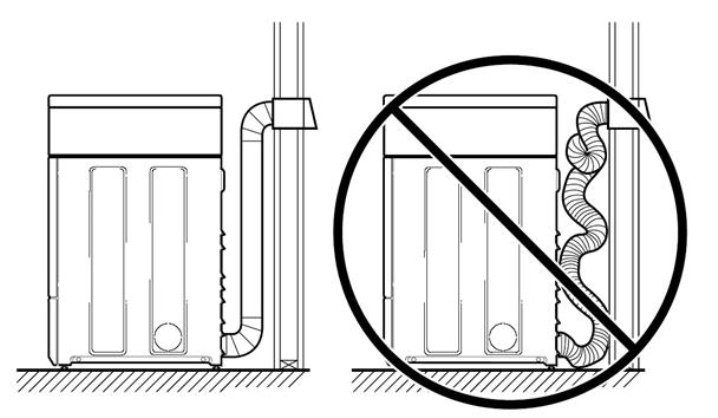
It seems like dryers of this type are a thing of the past, nothing but inconvenience. In fact, that's true; it's almost impossible to find such units on the modern Russian home appliance market. Most modern dryers are condensation dryers. This means that wet items are treated with hot air. The hot, moist air is exhausted into a cooling chamber. There, the water condenses and is discharged into a special container or down the drain. Some people prefer to drain the tray manually each time to avoid being tied to utilities, while others find it easier to connect the unit to the sewer system. This is possible due to a special hole in the machine body, which is connected to the sewer pipe via a regular hose.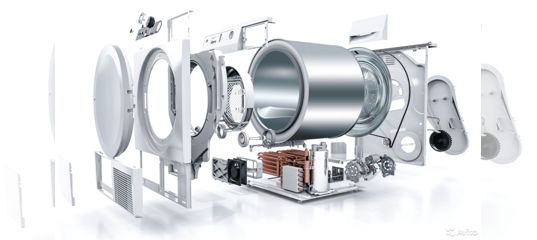
The connection mechanism for such a machine to the sewer system is similar to that for a washing machine. Therefore, if you decide to use this method, your washing machine will need access to both the power supply and the sewer system.
Today, heat pump dryers are considered the most advanced and efficient. Unlike the previous type, they don't use a heating element. The temperature difference is maintained by a built-in refrigeration unit. Due to the virtually complete lack of heat loss, these machines are very energy efficient and can be installed in virtually any room, as a single electrical outlet is sufficient for full operation. Users readily exploit this advantage, installing heat pump dryers not only in the bathroom or kitchen, but also in the hallway and even on the balcony, provided they have modern double-glazed windows. Excess moisture can cause corrosion inside the drum.
Where to put the dryer?
There are a number of ways to install a dryer in a living space. Users can choose from the following installation options:
- place vertically on top of the washing machine;
- place horizontally in the same row with the washing machine;
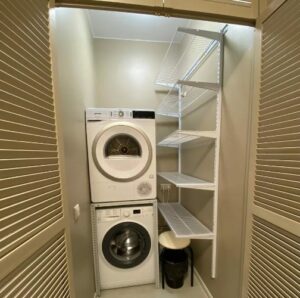
- place inside a cabinet or in a niche made of plasterboard;
- place under the kitchen countertop.
For small spaces where every square meter counts, especially when there's a need to consider nearby utilities, the best installation option is to place the unit on top of the washing machine.
Important! To place a dryer on top of a washing machine, you must use the special mounting kit and parts included with the dryer. For example, ready-made stands are often sold that allow certain dryer models to be placed on top of the washing machine.
When planning to stack a dryer on top of a washing machine, it's best to choose models from the same brand. They typically match in size and specifications, so there won't be any issues with mounting hardware. And, for purely aesthetic reasons, such a uniform arrangement will fit much better into the interior.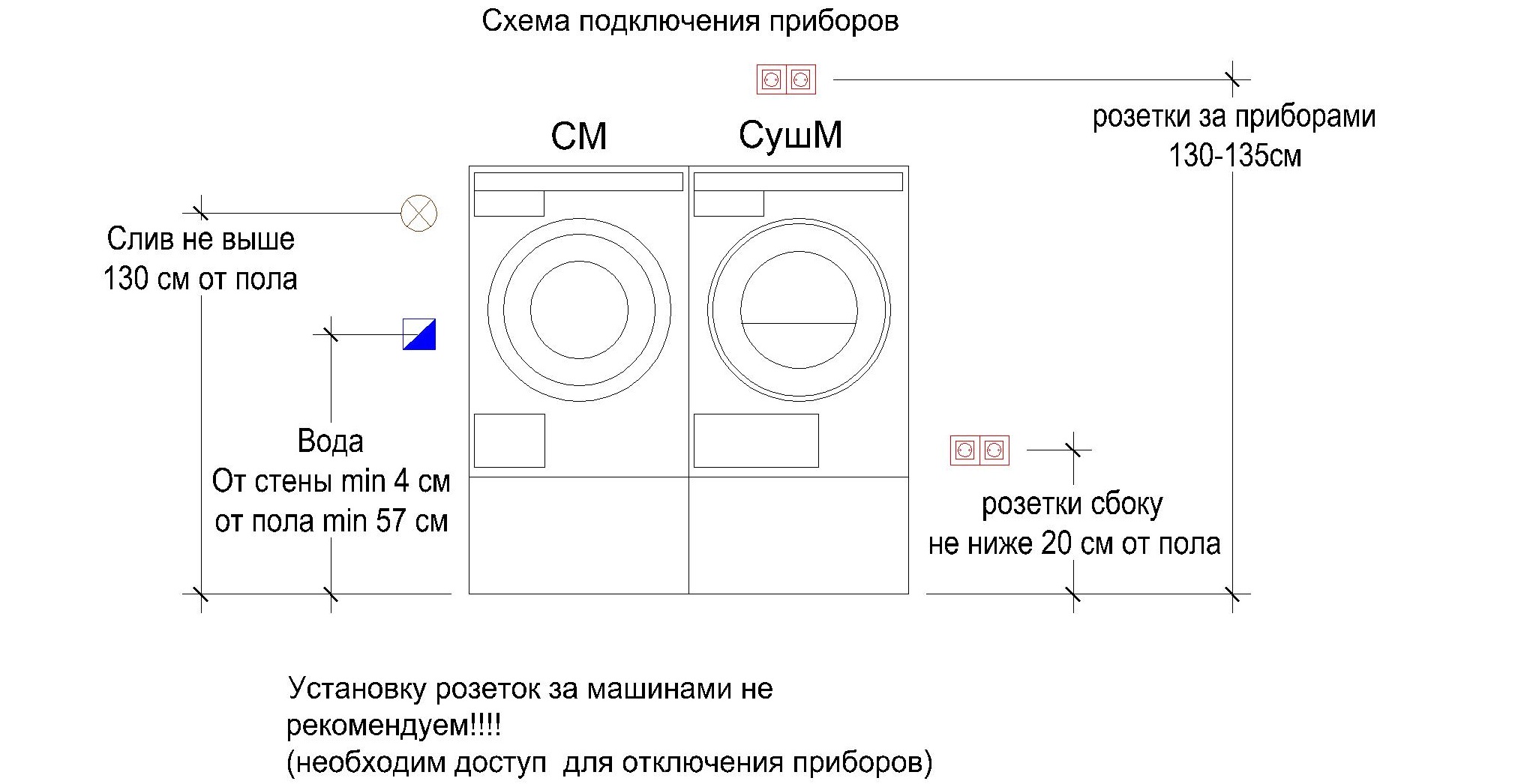
If you can't find a dryer from the same series as the SM, you should look for models from other brands that are as close as possible in depth and width. A dryer can be slightly smaller than a washing machine, but never larger. Otherwise, the entire column will be very unstable and will sooner or later collapse. You also can't place a washing machine on top of a dryer, as washing machines weigh more and vibrate more, and the dryer won't be able to withstand such a load from above. How to perform installation?
- Attach the mounting hardware to the top panel of the washing machine. These are like anti-tip frames with special caps.
- Secure the dryer body to the recesses of the caps.
- Adjust the unit to the level by unscrewing the legs.
For safety reasons, it is necessary to use the washing machine first, and then the washing machine, or vice versa if necessary, but never at the same time, as this will put too much strain on the column.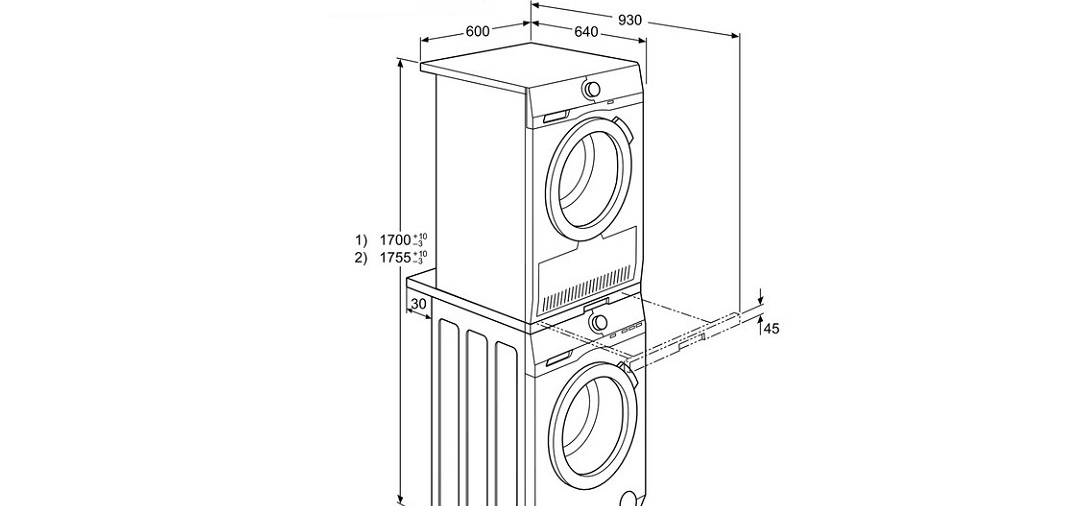
As for the in-line installation method, it's certainly the simplest. The only difficulty is finding enough free space next to the washing machine. But it pays off, as each unit will be stable and protected from the other. This method is often used by residents of spacious private homes or apartment owners with either a dedicated storage room or a sufficiently large bathroom. In this case, the entire installation is reduced to simply placing the dryer on the floor and leveling it by unscrewing the legs. Then you just need to connect the unit to the utilities, and that’s it, the installation is complete.
If you're in the early stages of a renovation, you can pre-build a space for a dryer and washing machine, or a stack of both. A plasterboard niche will complement the interior beautifully, although this option is more challenging to implement than the previous two.
Finally, the last possible installation option is under the counter or under the sink. This will maximize space savings while concealing the appliance from view behind the kitchen cabinetry. If feasible, this option is often chosen, especially for condensation dryers, where proximity to the drain is crucial.
Interesting:

Readers' comments
Headings
Washing machine repair




For buyers




For users


Dishwasher




Add a comment