
What is imbalance control in a washing machine?
 While a housewife calmly waits for the cycle to complete, the washing machine's drum spins at thousands of revolutions per minute. While the machine only hums and vibrates gently on the outside, centrifugal force within the machine places significant strain on the machine. The negative impact of this high-speed spin is unnoticeable due to the machine's built-in imbalance control. This article explains what this feature is, how it works, and why it's important to maintain proper balance.
The purpose of this function
In short, imbalance control in a washing machine is the system’s timely response to an imbalance that has occurred inside the machine. A special sensor detects uneven distribution of items in the drum or other deviations from the norm and sends a signal to the control board about the threat. The machine attempts to resolve the problem on its own, and if unsuccessful, it stops the wash cycle to prevent damage. Otherwise, the laundry bunched up on one side will cause vibrations, which will lead to severe vibration, impacts, and mechanical damage to internal components. This will ultimately result in failure of the bearing assembly, the shaft cross, and the drum surface.
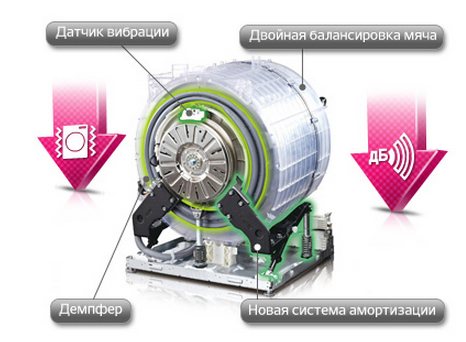
With the imbalance control system in place, this won't happen. The sensor will immediately detect any abnormal load, reduce the spin speed, dampen vibration, stop the cycle, and sound a warning signal. The owner can then correct the imbalance themselves, such as by opening the door and distributing the items evenly in the drum.
All modern washing machines with a spin speed above 1000 rpm are equipped with an imbalance control function.
It's best to carefully read the manufacturer's instructions after purchasing your washing machine and before starting your first wash. They provide recommendations for correcting imbalances in your specific model, as well as basic operating instructions. For example, the main issue that can cause excessive vibration is not maintaining the maximum load capacity. Remember that the capacity in kg indicated on the label applies to cotton fabrics. Synthetic materials and woolen items are somewhat heavier, so be careful about the weight of the laundry being washed.
Possible causes of imbalance
Most often, imbalance occurs due to exceeding the maximum load capacity and crumpled laundry. This problem is usually easily resolved by opening the door, removing excess laundry, or evenly distributing the laundry along the walls of the drum. However, it can be more difficult if the imbalance is caused by an installation error or a malfunction.
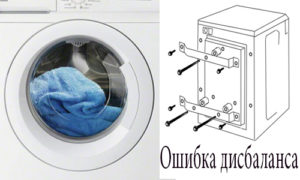
- Unremoved shipping bolts. Starting a cycle without removing the shipping bolts is a serious operating violation. It's important to understand that these bolts are designed to protect the drum during transport, so if the drum is compressed by the bolts, it won't rotate properly and will shake, bounce, and upset the balance of the washing machine. This is extremely dangerous, is not covered by the warranty, and can occur due to simple carelessness during self-installation. There are only four shipping bolts, located on the rear panel of the machine.
- Uncorrected position. The more stable the machine, the less vibration and the lower the risk of imbalance. Ideally, the machine should stand on a concrete or tiled floor and be leveled with a building level using adjustable feet. Special accessories, such as a thick rubber anti-slip mat or vibration-damping attachments for the feet, would also be helpful. It is not recommended to place the machine on wooden floors, linoleum, or carpets.
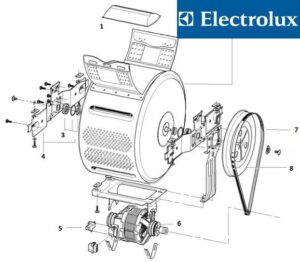
- Faulty shock absorbers. To reduce the risk of imbalance, your washing machine is equipped with shock absorbers. They help smooth out drum vibrations and dampen drum vibrations. If the pads are worn out or the fasteners are loose, the shock absorbers won't be able to handle the shock. Checking their functionality is easy: remove the top cover, apply pressure to the drum, and observe the result. If, instead of a sharp 2-3 cm bounce and then stopping, the machine begins to rock erratically and bounce, there's a problem and needs immediate replacement.
- Unstable counterweights. A massive artificial weight called a counterweight suppresses the centrifugal force from the drum, dampens vibrations, and acts as a shock absorber. There are several of these in the machine, located at the top, sides, and bottom of the drum, securely holding the drum in place on all sides. If they become damaged or deformed, an automatic imbalance occurs: vibrations are unchecked, the machine begins to bounce, and cast iron ingots, concrete, or plastic stones smash loudly against other parts of the machine. Therefore, remove the top or rear panel and carefully inspect the counterweights. The retaining bolts may be loose, or chips or cracks may appear. If replacement is necessary, proceed with extreme caution—concrete is very heavy and can easily bend parts of the washing machine if dropped.
Cracks in a concrete counterweight can be easily repaired by sealing the holes with cement mortar and PVA glue.
- Bearing failure. If one of the bearings fails, an imbalance will result in slow drum rotation and clunking noises during washing and spinning. We do not recommend attempting to figure out what a bearing assembly is and how to repair it yourself. It's easier, more reliable, and less expensive to contact a service center for a faster and more reliable solution.
It's no wonder that imbalance monitoring is called a washing machine's "self-preservation instinct." Only by sensing approaching danger can the machine stop operation promptly, minimize risks, and last for at least 5-7 years.
Interesting:





4 reader comments
Add a comment
Headings
Washing machine repair




For buyers




For users


Dishwasher




In theory, you only need to level the machine when you're installing a dryer on top of it. Otherwise, you need to adjust the machine's feet so it doesn't wobble. The drum doesn't care which plane it rotates in. And if it's properly balanced, nothing will happen.
Apparently, the citizen who believes that there is no need to install the washing machine level considers the engineers who produce the washing machine stupid.
Yuri, you are wrong.
What should I do to stop the washing machine from running away?