
Tap for connecting the dishwasher to the water supply
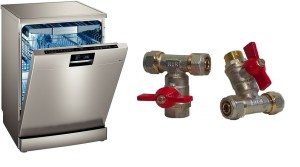 Properly and securely connecting your dishwasher to the water supply is crucial, especially if you live on the top floor of an apartment building. To ensure a reliable connection, you need not only the correct wiring diagram but also the appropriate components, including a faucet, tee, couplings, clamps, and so on. In such a matter, no detail is too trivial; a small leak caused by a weak connection can result in costly repairs in your neighbor's apartment, at your own expense.
Which faucet to choose: general recommendations
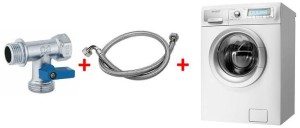
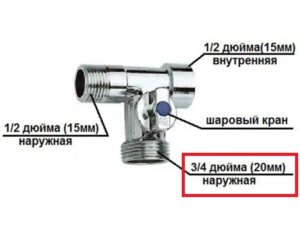
Let's start with the fact that when connecting a dishwasher to the water supply via a faucet or bypass, it is necessary to consider not only the quality of the faucets, but also all components without exception, including hoses, the pipes themselves, and those elements that ensure the normal functioning of the plumbing system. Most often, when connecting a dishwasher, technicians use a so-called tee, which has a built-in tap, or, in simpler terms, a tee tap. There are general recommendations for purchasing such a crane.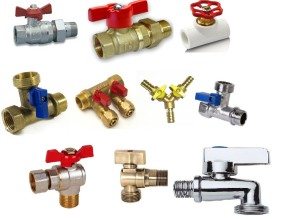
- Avoid buying a tee faucet (or any other type of faucet) made of plastic or silumin. Brass and bronze faucets are now available—they're much better and will last longer.
- When purchasing a tee faucet, check the integrity of its threads. Even the slightest chipping or nicks on the thread edge should raise red flags.
- Pay attention to the water shut-off mechanism. Experts say it's better to choose a faucet with a ball-type shut-off mechanism, as it's much more durable and reliable.
- The faucet's appearance isn't important, as it will be hidden, but ease of use is crucial. If the faucet has an inconvenient shut-off valve, you won't be able to quickly shut off the water in the event of an emergency, minimizing damage. Therefore, before purchasing, inspect the faucet, twist its valve, and make sure it turns easily and comfortably.
Please note! The ball-type shut-off valve mechanism lasts longer because it is less susceptible to mineral deposits in the water, which settle within its internal parts over time.
The type of faucet you choose will depend on the dishwasher's wiring diagram. In our opinion, the simpler the diagram, the better, but all sorts of situations arise, so we'll discuss possible wiring diagrams later. First, let's discuss the different types of faucets and other components that can be used in this case.
What kind of taps can be used for installing a dishwasher?
Since our article is primarily about faucets, we'll begin by discussing the types of faucets that are suitable for connecting a dishwasher. The following faucets are suitable for this purpose:
- tee;
- angular;
- double flow;
- with four terminals.
A tee tap is used in 95% of cases, as it is used in the simplest, most common and reliable connection schemes. The tee provides a minimum number of connections, which means the likelihood of leaks is reduced. It's easy to install and understand by everyone, even the most inexperienced. The angle faucet is so named because its outlets are bent at a right angle. This type of faucet is installed on a pre-existing branch pipe.
A double-flow faucet has two completely straight outlets with a shut-off mechanism and a valve in the middle. It is also installed on a pre-existing water pipe outlet to connect a dishwasher. A four-way faucet is one of the most complex. It is increasingly used recently when connecting multiple appliances to a water supply, although switching problems can occur with this type of faucet, as there is only one mechanism but two appliances.
Important! A four-port faucet allows you to connect two household appliances to the water supply at once with a minimum number of connections, ensuring maximum reliability of your plumbing system.
I'd also like to say a few words about the components that may be required, and will certainly be required, to connect the dishwasher to the water supply via a faucet or other means. What are these components?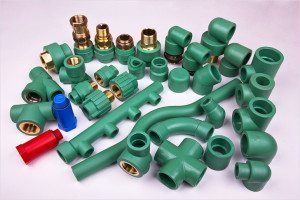
- Inlet hose. When connecting your dishwasher, you may find that the supplied hose isn't long enough. Fortunately, inlet hoses of various lengths are available.
- Fittings of various types. There are a great variety of fittings, and they are used in cases where it is not possible to create a simple connection diagram. Among them are: adapters, couplings, crosses, compensators, bypasses and others.
- Materials that ensure proper sealing of connections. Typically, this is a special FUM tape, or simply "FUMKA." It is wrapped around threaded connections in a special way, after which the connection is sealed from water leaks.
Diagrams for connecting a dishwasher to the water supply
There are a great many different ways to connect a dishwasher to the water supply. We'll cover only the most basic ones, without touching on preparation for the connection, the specifics of the work process, and so on. All of this is covered in detail in the article on the topic, namely, How to connect a dishwasher to the water supply and sewerage system.
The first diagram involves connecting the dishwasher through a faucet. Strictly speaking, the connection is not made through the faucet, but through the water pipe branches that lead to the faucet. How is this done?
- The water is turned off and the flexible hose that runs from the water pipe outlet to the mixer is disconnected.
- We screw a tee tap into the junction of the pipe and the hose.
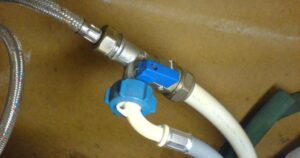
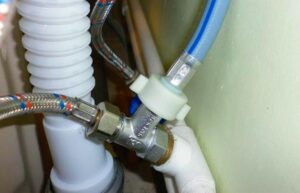
- We connect the branch pipe and the hose through a tee faucet. Now the cold water branch pipe will serve not only the faucet but also the dishwasher. The faucet will retain its full functionality.
- We screw a flow-through filter to the free outlet of the tee, and then screw an inlet hose to the filter, which in turn is connected to the dishwasher.
The second scheme is used in the case when the cold water supply pipe is specially installed for a dishwasher or washing machine.In this situation, the connection is made directly, not through a faucet, and you can use not only a tee, but also a flow-through or even an angle valve. The workflow, in this case, is even simpler.
- The water is shut off and the plug is removed from the pipe outlet.
- We screw a tap of the required type to the branch.
- We screw a flow filter to the tap.
- We screw the inlet hose to the filter. Then we connect the hose to the car.
To summarize, when connecting a dishwasher to the water supply, it's crucial to select the right components, including a suitable faucet. It must be made of high-quality materials and be easy to use, so as to avoid problems with emergency switching or disconnecting the dishwasher from the water supply. It's also important to select the correct wiring diagram to ensure flawless operation in the future.
Interesting:

Readers' comments
Headings
Washing machine repair




For buyers




For users


Dishwasher




Add a comment