
What criteria should I use to choose a dishwasher?
 While automatic washing machines have become a permanent fixture in our lives, replacing hand washing, a dishwasher is still considered an unaffordable luxury. Many homemakers dream of owning one, but are afraid of making a mistake when purchasing an expensive appliance and wasting money. Deciding on a dishwasher and avoiding overpaying is easy: just familiarize yourself with its pros and cons and learn the key criteria for choosing a practical and reliable model. We'll explain all this.
Is it worth buying a dishwasher?
The question of whether to buy a dishwasher is a highly personal one: some consider it a chore and can't stand the thought of washing two cups a day, while others are happy to spend hours cleaning the dishes after a large family. But many are at a crossroads and can't decide for themselves whether it's worth it or not. A detailed examination of the pros and cons of buying another appliance that makes everyday life easier will help. Let's outline the arguments in favor of a dishwasher.
- Saves time – the machine does everything for you. What's more, you can start the cycle and leave the house, or use the delayed start feature and have clean dishes when you return from work.
- Heats water. Cold water is sufficient, as the machine will automatically heat it to the required temperature.
- Less water consumption. It's estimated that the average dishwasher uses 14-17 liters per cycle, which is 3-5 times less than hand washing.
- It protects the homemaker's hands. There's no longer any need to come into contact with household chemicals, especially harsh cleaning products.
- Better cleaning. The machine's scrubbing, rinsing, boiling, and steaming technology thoroughly removes all dirt and harmful detergents from the surface.
But there are also serious counterarguments. Some of the theses are controversial, but they still need to be taken into account.
- The dishwasher takes up extra space in the kitchen, especially freestanding models.
- The new device will put a significant load on the power grid. You will need to think about a reliable connection to the network with a voltage stabilizer, a separate outlet and grounding. High energy consumption will also impact increased utility bills.
To reduce energy consumption, you can connect the dishwasher directly to hot water, so as not to waste electricity on heating.
- Not suitable for all dishes, as non-heat-resistant, cracked, or glued plates and cups are prohibited. Dishwasher-safe items include utensils made of rusty steel, copper, pewter, and wood, including those with small wooden inlays and elements. Fragile silverware, crystal, and earthenware should also not be washed in the dishwasher without a special delicate cycle.
- High-quality, smart units are very expensive. However, many argue that the investment is worth it.
- Not all models support the half-load function, so you have to “save” dishes to fill the machine.
- Dishwashers require special cleaning agents in the form of tablets, capsules, or powder. These are typically significantly more expensive than standard dishwashing gels.
The pros and cons of a dishwasher are something you need to know before you go shopping. This way, you won't be tempted and then regret your new purchase. Now, deciding whether to buy one is much easier. All that's left is to understand how to choose a good machine and avoid overpaying for useless devices.
Type of equipment, dimensions and its capacity
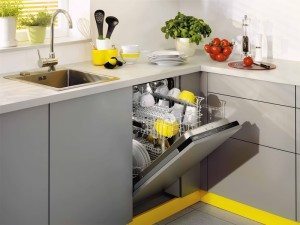
Today's market offers hundreds of dishwasher options, and sometimes choosing the perfect one can be challenging. First, you need to determine the type of dishwasher—freestanding, fully built-in, or partially integrated—depending on where you plan to install your new assistant. Next, choose the size and capacity that best suits your kitchen and needs:
- Full-size models have dimensions of 60 x 60 x 85 cm and can hold 12 to 14 place settings at a time. They are more expensive, more functional, and more reliable, boast excellent cleaning results, and are suitable for larger families.
- Narrow machines are 45 cm wide, allowing them to accommodate up to 9 place settings. Cleaning quality is not compromised; they feature two dish racks and clean dirt perfectly. They are considered ideal for small kitchens.
- Compact dishwashers are much smaller, measuring 45/55/45 cm. They are mounted on a shelf or countertop and are suitable for a maximum of three people. They can accommodate up to eight appliances at a time. They are inexpensive, but their cleaning performance suffers significantly.
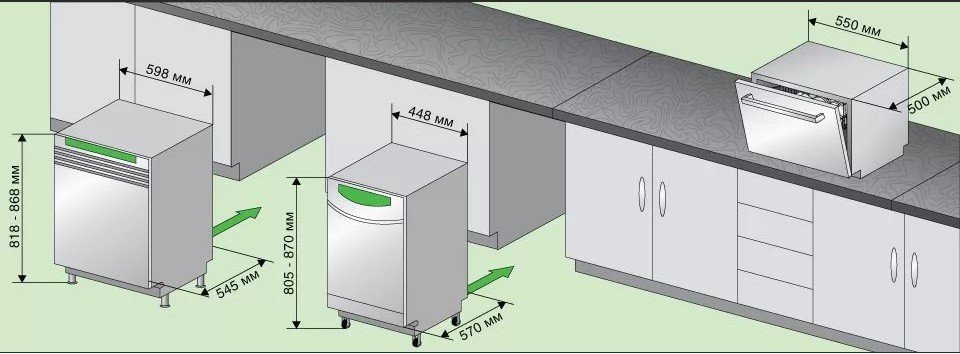
Although rare, we do encounter non-standard models that don't fit within the typical size range. Therefore, always pay attention to the dimensions listed on the label. Ideally, you should measure the space available in your kitchen and choose your dishwasher accordingly.
Energy consumption class and configuration
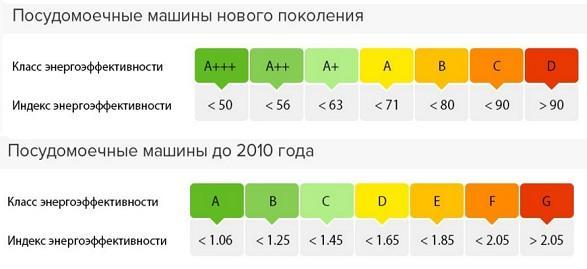
Energy consumption is one of the first things to consider when purchasing a dishwasher. It's indicated on the manufacturer's label as the appliance's energy class, a series of letters from A to G. Level A models are considered the most economical, among which there are also more advanced models of type A+++. These machines consume approximately 0.8-1.05 kWh per cycle, while Category B machines consume 1.06-1.09 kWh, and Category C machines consume 1.1-1.49 kWh. Logically, the closer to Category G, the more expensive each wash.
As for the accessories, there's a standard set: a dispenser, two levels of racks, a cutlery tray, and a filter. However, the number of accessories increases with the price of the appliance and may include:
- basket position regulators;
- illumination of the working chamber;
- external indicator;
- multi-level door fixation;
- heat exchanger;
- increased sound insulation;
- glass holders.
Dishwashers are often equipped with adjustable feet, allowing the machine to be positioned on uneven surfaces. Some machines also feature a display that allows you to monitor the progress of the wash and adjust the cleaning process.
What can the machine do?
For a family of two, a standard dishwasher with basic features will suffice. This type of appliance will first perform a pre-cleanse, then rinse with hot water and detergent, and then dry. However, if you want more, you'll need to consider more advanced models that offer:
- intensive washing at temperatures up to 75 degrees;
- delicate cleaning for fragile items;
- express wash, fast and surface.
But that's not the limit. New dishwashers feature a multi-layer filter system to prevent clogging, a built-in waste grinder to immediately remove food residue from plates, and a delayed start timer to start the dishwasher at a specific time.
Some models boast leak protection, half load and child lock.
Does brand matter?
 Another thing to look at when buying a machine is the manufacturer. Miele, Bosch, and Siemens are considered recognized leaders in the production of reliable and high-quality dishwashers. Next in the ranking are Whirlpool and Zanussi, followed by Beko, Gorenje, and Indesit. Chinese-made machines are the last choice.
But what matters more than the brand is following the operating instructions. To ensure your machine lasts longer and cleans better, keep these recommendations in mind:
- The baskets must be cleaned regularly, at least twice a month;
- after 2-3 cycles, wipe the body and door seal with a damp cloth;
- clean the filter as it becomes dirty;
- If a greasy film accumulates on the walls of the chamber, treat it with special products.
To choose the best dishwasher model, you'll need to consider your needs in advance and carefully read the labels. The key is to avoid skimping on essentials and overpaying for unnecessary features.
Interesting:




Readers' comments
Headings
Washing machine repair




For buyers




For users


Dishwasher




Add a comment