
How to dry sneakers in a Bosch tumble dryer?
 When tumble dryers first appeared on the market, they were designed to dry only clothing. But as is often the case, people immediately began experimenting and, through trial and error, discovered the ability to automatically dry shoes as well. Initially, this went against the operating instructions, but manufacturers soon listened to customer feedback and developed tumble dryers that can dry shoes without damaging the unit or the shoes themselves. Sneakers are especially often needed. For example, how do you dry sneakers in a Bosch tumble dryer?
Drying program for sneakers
Unfortunately, Bosch machines don't have a dedicated shoe drying mode. This can make it difficult for users to choose the right program and can leave them confused. In this case, it's a good idea to consult the care label on your sneakers to understand the appropriate settings to avoid damaging them.
If the tag has already been lost, you will have to rely on your own ideas and intuition. In this case, it's best to dry your sneakers naturally, but if you're eager to take the risk, choose the gentlest setting. They can be called "Wool", "Delicates", "Delicate", "Sensitive", etc. These modes are characterized by low air temperature, so the risk of damaging shoes is minimal.
Rules for drying sneakers
It's also important to remember that improperly drying sneakers in a tumble dryer can damage not only the shoes but also the machine's components. Did you know that the drum in a tumble dryer rotates just like in a washing machine, at a fairly high speed—1200 rpm? This rotation helps distribute hot air evenly throughout the drum and accelerate the evaporation of moisture from the clothes. Drying shoes at this spin speed will only result in damage.
So, there are a few important rules to follow if you want to dry your sneakers efficiently and safely in the dryer:
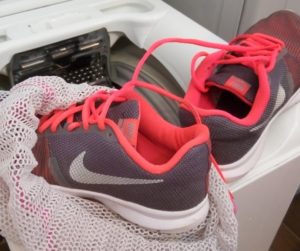
- Unless you have a dedicated shoe drying program, never place sneakers in the drum alone. Add a blanket, bulky or soft items, or duvet covers to reduce the inertia and impact of the shoes against the inside of the machine. This will also significantly reduce the noise level during drying.

- Before loading sneakers into the dryer, wash them thoroughly. Clumps of dirt and dust can damage the dryer and ruin the appearance of items drying alongside the sneakers. Sometimes small stones can get stuck in the soles; remove them. If the shoes have removable decorative elements (such as bells on the laces for children's shoes), be sure to remove them.
If your sneakers are heavily decorated with non-removable elements, it's best to hand-dry them rather than machine-dry them. The same goes for shoes that are glued rather than stitched.
Some dryer models come with special racks for the drum. These are placed in the drum like a shelf, with sneakers placed on top. This will speed up drying, as air will reach the shoes from all sides, eliminating any mechanical impact from the shoes on the inside of the drum.
Potential risks
Low-quality shoes almost certainly won't survive a machine dryer. This is because the cheap materials used in production aren't designed to withstand high temperatures. The glue may melt, the coating may crack, the colored decorative elements may fade, and rhinestones, beads, etc. may peel off and get stuck somewhere. Therefore, it is better to dry shoes on a stand, it reduces such risks.
Another unpleasant thing you might encounter when drying shoes at high temperatures is shrinkage. Your shoes may shrink several sizes, so you might have to give them to someone younger or throw them away altogether.
Interesting:
Readers' comments
Headings
Washing machine repair




For buyers




For users


Dishwasher




Add a comment