
Where do I put salt in an Indesit dishwasher?
 Any dishwasher is an expensive pleasure, because simply buying the appliance isn't enough. Not only do you need to properly care for it, but you also need to constantly purchase additional cleaning products. These include not only household cleaning products for dishes and cutlery, but also special salt that helps combat water hardness and protects key components from damage. Therefore, adding salt to the dishwasher before each cycle is crucial to ensure long-lasting service. We'll explain how much salt your "home helper" needs, where to add it, and how exactly it works right now.
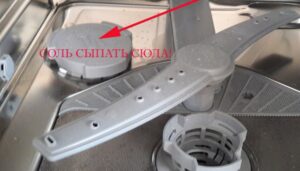
Where can I find the salt compartment?
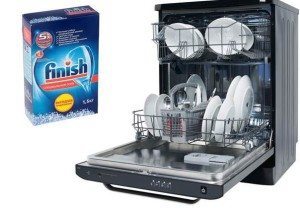
Where is the salt container located in Indesit dishwashers? This is the first question that usually concerns new owners of these smart household appliances. As in all other dishwashers, the salt reservoir is located at the bottom of the washing chamber of the device, hidden by the lower tray for dishes. For ease of pouring in salt granules, it is better to use a special funnel, which is usually supplied with the dishwasher.
Before adding salt to the bin for the first time, it is necessary to completely fill the compartment with water. Any excess water will easily drain into the sewer during the process of filling with salt.
If you purchased special "Three-in-One" tablets, they should not be crushed into the same bin but placed in a separate compartment. The tablet compartment is located on the inside of the Indesit dishwasher door.
How much salt do you need?
Don't rush adding salt; first, determine exactly how much salt granules to add. The exact amount depends directly on the type of salt you plan to use in your Indesit dishwasher:
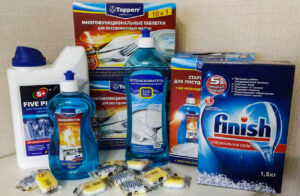
- specialized regenerating salt for dishwashers, for example, from Finish, Somat and other brands;
- special tablet salt, for example from the Topperr company;
- Extra class evaporated salt, which is occasionally used as a replacement for special salt for dishwashers;
- Finally, tablet salt, based on the same substitute type "Extra".
First, check the packaging of the salt granules if you purchased specialized salt for your Indesit dishwasher. The instructions typically state that you should fill the salt container to the very top. Because each dishwasher's salt reservoir is different, the amount of salt it can hold varies. On average, the salt container holds one kilogram of regenerating salt.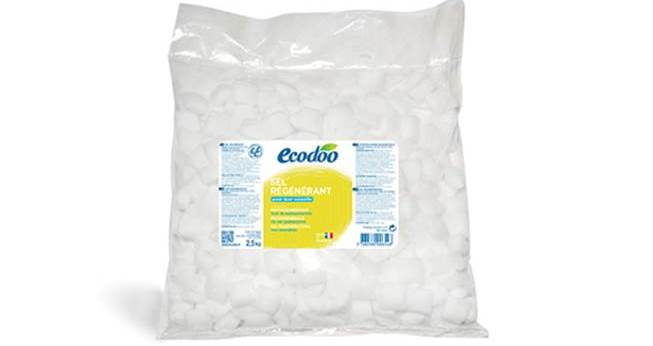
Regular table salt should also be added in about a kilogram to completely fill the bin. Three-in-One tablets should be added until the container is completely full.
As for how often to add salt, your Indesit dishwasher can help you with that. Modern dishwashers automatically prompt you when it's time to refill the salt granules. A special indicator on the control panel flashes to indicate when it's time to add salt immediately.
How is salt used?
To combat hard tap water, household appliances are equipped with ion exchangers containing resins containing negatively charged chloride ions. These ions attract magnesium and calcium impurities found in hard water, making the water much softer. If the ion exchanger does not function properly, then due to exposure to high temperatures, magnesium and calcium will form scale, which will settle on the heating element of the Indesit dishwasher, and over time, it will fail. Also, because of excessively hard water, dishes and other tableware are washed worse than in soft water.
So what is the purpose of special salt, and how does it help reduce water hardness? Regenerating salt affects hardness indirectly, as it's needed to restore chloride ions in the ion exchanger, which then work to reduce the hardness of tap water.
The higher the water hardness, the higher the salt consumption, so take this into account in advance when planning the consumption of salt granules.
To determine the correct water hardness setting for your Indesit dishwasher, you need to determine the water hardness level in your water supply. This can be done in several ways.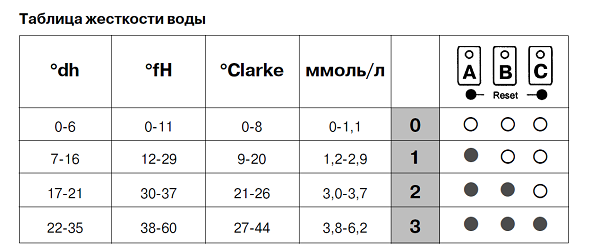
- Check with your city's official water utility, which should regularly publish accurate, up-to-date information on water hardness and other indicators.
- You can determine this by eye using laundry soap, which you can lather or apply to a sponge. If the sponge is difficult to rinse and doesn't lather well, your water is hard.
- Inspect your faucets, toilet, and other surfaces that frequently come into contact with water. If there's a layer of limescale on them, your water is definitely hard. The faster the layer forms, the worse the tap water quality.
- You can also use the most accurate method: purchase test strips or a special device for measuring liquid hardness.
Please note that the hardness of your tap water usually depends on the time of year, so it is best to measure your water hardness once a quarter.
Finally, the final method of testing is a special water hardness table, compiled for all regions of the country. This table is compiled by experts, so there's no reason to doubt its reliability. This table conveniently divides water into four types: soft, medium, hard, and very hard.
Based on the data obtained, you can select the water hardness level for your Indesit dishwasher. How to adjust this setting is always described in the official instructions or on the manufacturer's website.
Ultimately, the most important thing isn't how much salt to add to the reservoir, but rather regularly refilling it to ensure it's always there. The frequency of salt granule replacement depends solely on the settings on your Indesit dishwasher and the hardness of the tap water in your area.
Interesting:



Readers' comments
Headings
Washing machine repair




For buyers




For users


Dishwasher




Add a comment