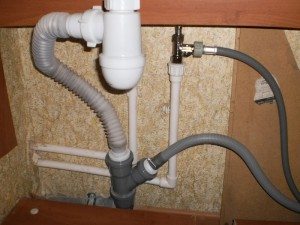
Sometimes, draining wastewater from the washing machine's tank becomes a real challenge for users. When the washing machine is installed some distance from the main house utilities, and these utilities are difficult to quickly rewire, homeowners are left with no choice but to find creative ways to connect the drain hose to the sewer system. One unusual option is to secure the hose to a tee, using a special cuff for the washing machine drain. Let's look at how to connect using this principle.
How is the connection made?
If your apartment is equipped with a modern metal-plastic drainage system with a 40 or 50 mm diameter pipe, connecting the drain hose will be no problem. You'll need to purchase a suitable tee with a 45° angle (if installing under the sink) and a seal with a 25 mm inner diameter ring from a specialist retailer.
When installing the cuff into the purchased tee, it is important to follow one rule. Do not remove the sealing ring from the pipe cavity; it will serve as a guarantee of the reliability and tightness of the connection being created. If you're having trouble inserting the cuff, try warming it in hot water for 2-3 minutes. The heat will soften and flex the elastic, making it easier to slide into place.
After installing the cuff, only a thin limiting edge of the seal should be visible from the tee outlet.
Got a non-standard tee
Sometimes, a 50 mm diameter tee simply won't fit onto a modern sewer pipe of the same size. A couple of extra millimeters prevent the tee from fitting freely, preventing it from fitting properly. This is due to the age of the components, as well as the fact that in the recent past, manufacturing standards differed from those of today. A standard collar, therefore, is also unsuitable for this type of connection.
If you find yourself in this situation, there are two ways to solve the problem:
After removing the sealing ring, fill its seat with waterproof sealant and treat the part of the tee's surface that extends into the sewer system. This will allow the part to easily fit a couple of centimeters into the sewer system.
By purchasing a 40 mm diameter tee and a 50 x 40 mm adapter sleeve, connecting the elbow to the pipe will be very easy.
The first method is suitable for vertical installation of the elbow. The tee will fit very tightly, and when used with sealant, it will completely seal out water. If the structure is horizontal, the second method is preferable.
In the vast majority of cases, the diameter of the corrugated pipe connected to sinks is no more than 40 mm. This means that using a tee of the appropriate size will not affect the pipe's water flow. If the end of the corrugated pipe has a 50 mm diameter elbow, it can be cut with gentle movements. The socket is quite fragile, so do not apply too much pressure to the cutter; the cut is made with gentle circular motions.
Which cuff should I buy?
When installing a sewer drain yourself, pay special attention to purchasing the essential components. When purchasing a cuff, pay attention to its diameter. In 90% of cases, a rubber element measuring 50*25 (outer and inner diameter, respectively) is required; however, cuffs with an inner diameter of 32 mm can be found on the shelves. It is quite difficult for a non-professional to distinguish such a discrepancy, so it is necessary to inform the seller not only of the external diameter, but also to clarify the internal dimensions.
We advise you not to give in to the persuasion of managers who insist that a 32 mm diameter grommet is ideal for securing a drain hose. This is untrue. The drain pipe will fit very loosely into it, which could lead to it "popping out" of the grommet in the future. Therefore, to prevent this, you should purchase a rubber seal that fits snugly against the hose—the tighter the grommet fits, the more secure and airtight the connection will be.
Thus, arranging the drainage of waste water from a washing machine into a sewer pipe using a special tee and sleeve is quite simple. It's important to select all the necessary parts correctly, paying attention to the diameter of the components, so the work will be quick and efficient.

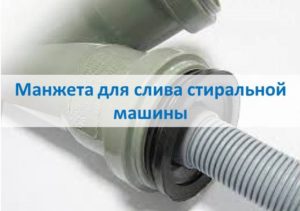 Sometimes, draining wastewater from the washing machine's tank becomes a real challenge for users. When the washing machine is installed some distance from the main house utilities, and these utilities are difficult to quickly rewire, homeowners are left with no choice but to find creative ways to connect the drain hose to the sewer system. One unusual option is to secure the hose to a tee, using a special cuff for the washing machine drain. Let's look at how to connect using this principle.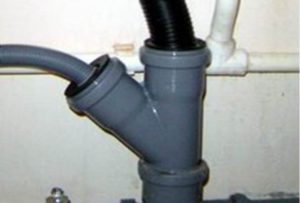
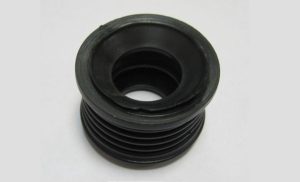 When installing a sewer drain yourself, pay special attention to purchasing the essential components. When purchasing a cuff, pay attention to its diameter. In 90% of cases, a rubber element measuring 50*25 (outer and inner diameter, respectively) is required; however, cuffs with an inner diameter of 32 mm can be found on the shelves. It is quite difficult for a non-professional to distinguish such a discrepancy, so it is necessary to inform the seller not only of the external diameter, but also to clarify the internal dimensions.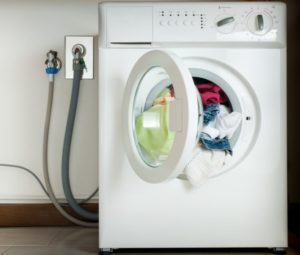
















Thank you, it helped 🙂
The sealing ring, plus hot water. I was about to cut it.