
Deciphering Samsung washing machine markings
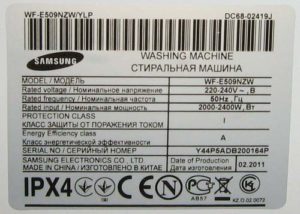 You've decided to buy an automatic washing machine. The most common confusion when choosing is the string of numbers and letters indicating the type of machine. In fact, the markings on Samsung washing machines aren't that difficult to decipher. In this article, we'll explore the meaning of these markings and how to read them.
How to recognize the marking designation?
A set of specific letters and numbers contains information about an automatic washing machine. Let's try to decipher the code using the WF602 sample.
- In this marking, the English letter W denotes a type of household appliance, namely, an automatic washing machine.
- F – in the code, it indicates the loading type. In this case, it's front loading.
- The third position of the code is a number indicating the maximum capacity of the washing machine. In our example, it's 60. This corresponds to a 6 kg load. If this position is 49, we understand that it's 4.9 kg. Therefore, if it were 40, it would be 4 kg. However, this only applies to loads up to 9 kg; after 14, it would indicate a maximum load of 14 kg.
- The last position is -2. Here the manufacturer indicates the year in which this model was released. Please note that this is not the year of manufacture of one specific washing machine. We're talking about the entire series and the date of its introduction to the consumer market. So, from the number 2, we understand that this washing machine model was first released in 2012. A specific washing machine could have been manufactured in 2016 or any other year, but not earlier than the date indicated in the code.
Now let's look at the sequential sets of letters and numbers and determine what they tell us about the technology. In the figure, focus on the labels "Letter 1," "Number 1," and so on.

When deciphering the markings under "Letter 1," we see the W/B/U combination. What does this tell us about this specific device?
- The "W" symbol indicates that this washing machine has a belt-driven motor and an additional Eco Bubble feature for enhanced washing performance. This feature creates a large amount of tiny bubbles, which enhance the cleaning action of detergents.
- The letter B designates machines with an inverter direct-drive motor. This means there's no belt connecting the motor to the drum. This allows for a virtually silent washing process. There's also no bubble function.
- U means that this appliance combines the power and reliability of a direct drive motor with the Eco Bubble function.
The next position can be designated by the numbers 0 or 2. The first position is assigned at 1000 rpm during spinning, and 2 at 1200. Please note that if you see 7 in the marking in this section, this indicates a spin power of 700 rpm, and not 7,000.
The "letter 3" indicates the type of the washing machine's control panel. For example, if you see a C, the machine is equipped with a display and has 10 wash programs to choose from. The K option indicates the presence of additional options and allows you to choose from 14 basic programs. Additional features include the ability to program a self-cleaning drum and control it via a mobile device.
The last item indicates the washing machine's exterior color. For example, WA has a white exterior, while SD has a gray exterior. Both versions have a chrome-plated loading door.
Sometimes there are models on which the markings differ from the standard ones.
In this case, you'll need to read the information on the control panel. We'll try to guide you through the information you can glean from this data.
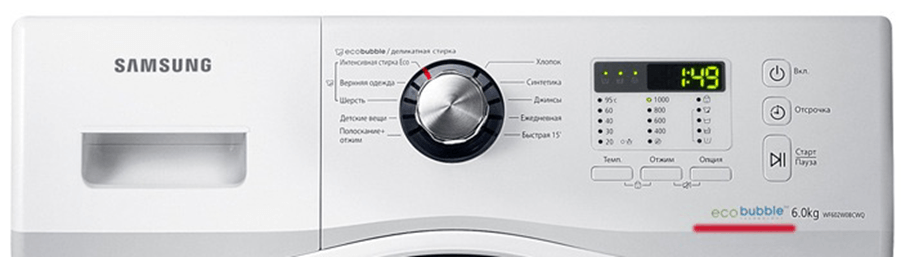
The photo shows the panel. In the lower right corner, the word "EcoBubble" is marked with a red line. As you can guess, the machine is equipped with an additional option for improved washing quality. And based on the information above, we can determine that it has a brushed motor with a drive belt.
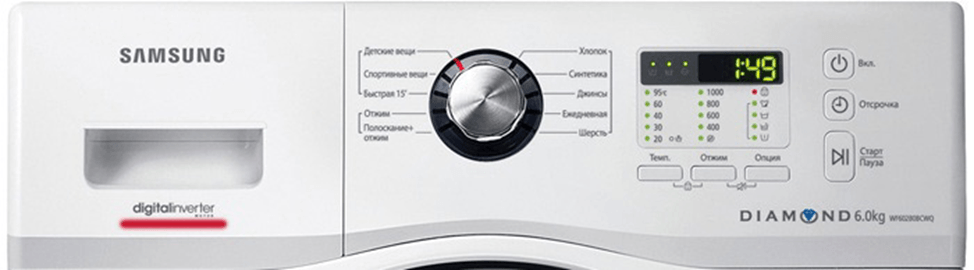
In the second picture, the words "Digital Inverter Motor" are highlighted in red. They correspond to the letter "B" in the markings. This means the motor has a belt drive, but there's no bubble function. As you can see, there's no indication of this feature on the control panel. The words "Diamond" in the lower left corner refer to the drum's unique design. Its name derives from the honeycomb shape, which promotes gentle washing and helps preserve the integrity of items.
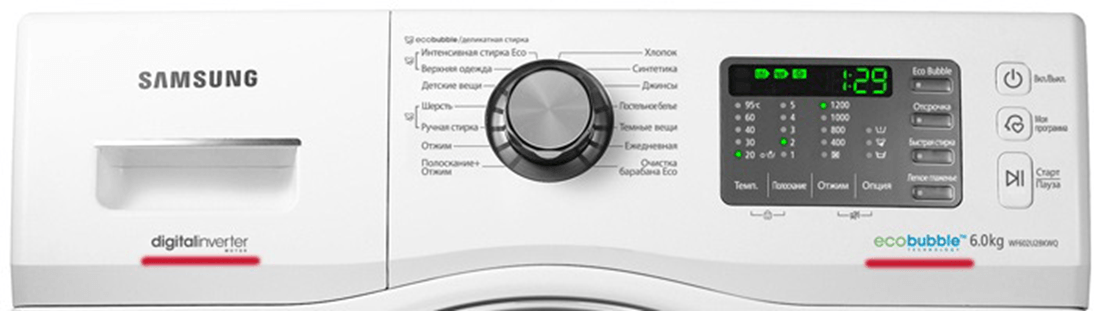
From the third image, we can determine that the machine has a drive motor and an additional Eco Bubble option. This is a combination washing machine, which corresponds to the letter U in the marking. We've already described it above. Let's take a closer look at the part of the control panel where the programs are located.
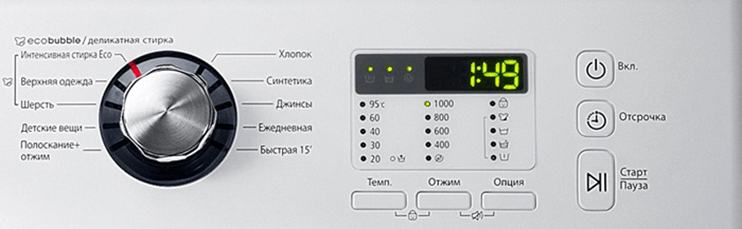
So, on the left, you can see the 10 main washing programs. Below is the LED display. And buttons for adjusting the temperature, spin power, and additional options.
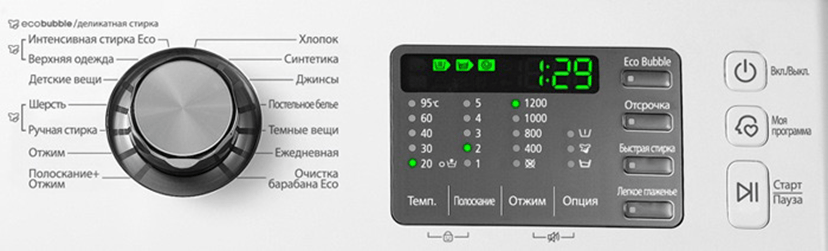
The second panel makes it clear at first glance that the number of basic programs is significantly larger. This is the K model, which features a graphic display. The list of additional options is more extensive, and there's a memory function. This allows the washing machine to remember the settings for your favorite program. In addition to the marking designations considered, there are others. These can be seen on a sticker, usually located on the front or back of the washing machine. Let's look at these cases using a clear example.
Let's give an example
In fact, understanding the coding on appliances isn't all that difficult. Let's try it on a specific machine. For example, we'll use the Samsung WW80J5410GW/LP automatic washing machine.
- The first two capital letters, WW, indicate that this is a washing machine, not some other household appliance. Sometimes, the first letter W is followed by a D. This is used to indicate an additional function—drying.
- The next item is the number 80. This tells us the maximum load. In this particular case, it can carry up to 8 kg. Accordingly, if it were 60, it would be 6 kg, and so on.
- The third position is the letter J. This is another designation for the year of development. 2015 is designated J, and the year before that is designated H.
- The number 5 contains encrypted information about the number of programs in the machine. It is important to note that the number five indicates 7 basic washing programs, while the number eight indicates 15.
- The next number, 4, indicates the spin power. In our case, it's 1400 rpm.
- Ten indicated the design type of a specific washing machine.
- The color of the body and loading hatch was coded with the letters GW.
- And the last position reveals the secret of where this equipment was manufactured. In our case, the letters "LP" indicate the CIS. And when you see the combination "EU" at the end, the manufacturer is located in Europe.
We've covered the most common markings for Samsung washing machines, but the most reliable way is to check the product's data sheet. A store salesperson may not always be able to provide a comprehensive answer about the features of a specific device. Knowing how to read the data sheet will help you accurately determine all the parameters and options of the product you're purchasing.
Interesting:
Readers' comments
Headings
Washing machine repair




For buyers




For users


Dishwasher




Add a comment