
Installing a Siemens dishwasher yourself
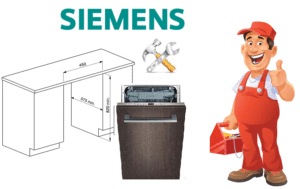 Siemens dishwashers embody German quality, but to ensure they continue to function well for many years, they need to be carefully positioned and connected to the appliance. In this regard, the instructions for your specific model are a vital resource. Even professionals need to consult them occasionally, not to mention those who decide to install them themselves. In this article, we'll cover the installation details of Siemens dishwashers. These nuances are few in number, but they are crucial.
Features of component selection
During the standard installation process for a Siemens dishwasher, you can easily use the included accessories. However, according to installation specialists, approximately half of the time, custom solutions are required, requiring additional accessories. For example, if the inlet hose of a particular dishwasher model doesn't have an Aqua-Stop valve, you'll need to purchase one separately.
Be careful! The Aqua-Stop valve for a Siemens dishwasher must be either the original (Siemens) or from a Bosch dishwasher, but it is not compatible with some Siemens models.
Genuine parts are always more reliable and will fit, but they're also slightly more expensive than replacements, so it's up to you to decide. If you want to save a little money, choose your parts carefully. If the standard inlet or drain hose is not long enough for you and you decide to purchase a longer one, then it is also better to buy an extended hose from Siemens.
The problem is that this manufacturer didn't standardize many components when developing specific dishwasher models, resulting in hoses of unusual diameters and non-standard fittings. This is perhaps the main drawback of Siemens dishwashers; otherwise, they are reliable, practical, and technologically advanced. To install a Siemens dishwasher to the water supply and sewer system, you will need:
- water inlet hose;
- water drain hose;
- shut-off valve (with two, three or four outlets);
- filters;
- gaskets;
- adapters.
This is a standard kit used for a typical water and sewer connection, but other parts may be required. Incidentally, this is mentioned in the instructions for some Siemens dishwashers.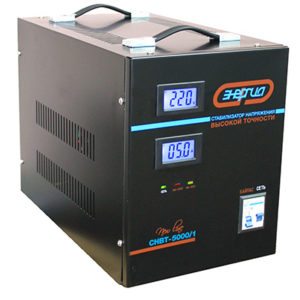
- Pressure-reducing valve. If the pressure in your water supply system is above 1 MPa, a pressure-stabilizing valve is installed to prevent leaks, hose bursts, and other problems.
- An electrical stabilizer. It's used to connect the dishwasher to the power grid if the network experiences regular voltage drops or surges—this is a way to protect the dishwasher and other appliances.
- An additional hose and faucet with filter for connecting to hot water. Some Siemens dishwasher models are equipped with a hot water connection, but may not include an additional hose; it must be purchased separately along with the faucet, filter, adapters, and gaskets.
About the installation location and its dimensions
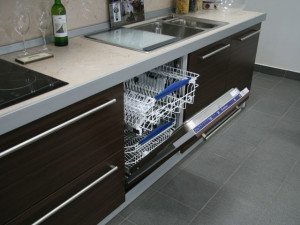
We've decided on the components for the Siemens dishwasher, now We install a dishwasher into a countertop and furnitureEven installing a standard dishwasher in a cabinet can present many challenges, and a Siemens dishwasher is a whole other story. Let's look at expert recommendations for organizing the dishwasher space and its dimensions.
- If you are preparing a space for a fully integrated or partially integrated dishwasher
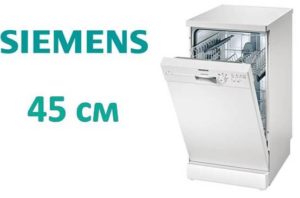
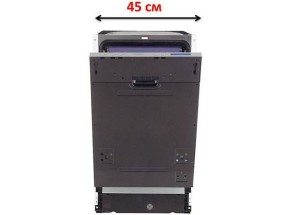
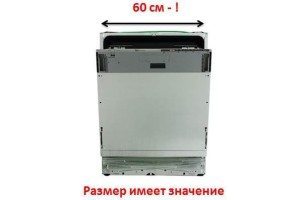
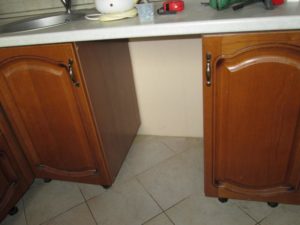 When choosing a car, first carefully measure the model you've chosen. Don't rely on the dimensions listed in the specifications. Measure each protrusion, and also allow for a margin of 2 cm from the walls of the niche to the machine body on the left, 2 cm on the right, and 1 cm on the top.
 - Make sure to install the fasteners for the façade and the metal sheet for protection against steam (if any) in advance; this will be inconvenient to do after connecting the utilities.
- Reinforce the floor under your Siemens dishwasher; almost all models of this brand don't like unstable surfaces, unlike, for example, Bosch dishwashers. It's also advisable to level the floor, although Siemens dishwashers are well-stabilized and can withstand surface curvatures of up to 7 degrees.0 and more.
Please note! Before installing a dishwasher, washing machine, refrigerator, or any other appliance, it's best to address any flooring issues, leveling and strengthening it thoroughly and permanently – this will extend the life of each appliance.
- Avoid arranging the space for a Siemens dishwasher further than 2 meters from the water supply and sewer lines. This is not only due to the length of the hose, but also to the inlet valve and pump. If the distance is greater, the pump will last significantly less, as will the valve.
We connect to the water and sewer pipe
If the space preparation process has been successful and you've confirmed that your specific dishwasher model fits into the niche you've prepared, you can proceed with installation. The next step is connecting the dishwasher to the water supply and sewer lines. There are two options for connecting a Siemens dishwasher to the sewer system: the first involves connecting the drain hose to a siphon, the second to the sewer pipe directly. The first option is used more often, so let's consider it.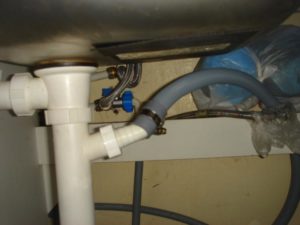
- First, you need to install a special trap with a side outlet under the sink. This is designed to connect the drain of a washing machine or dishwasher.
- We seal the threads on the siphon outlet with FUM tape. The FUM tape should be applied against the thread, not along it; this is more secure.
- We screw the drain hose to the siphon and move on to the next step.
Next, connect the inlet hose to the cold water supply. First, unscrew the sink faucet inlet hose from the pipe. Then, screw the tee onto the pipe, making sure to seal the connections. Screw the faucet inlet hose onto the tee on one end and the cleaning filter on the other. Screw the Aqua-Stop valve and the dishwasher inlet hose to the filter. Screw the other end of the hose to the thread of the dishwasher inlet valve, and that's it – the job is done.
Please note! When installing a tap water filter, don't forget about it. Clean it at least once every 6 months, and if your water contains significant amounts of sand or other debris, clean it every 2 months.
The final stage of work
Now all that's left to do is connect the power cord to the outlet and put the dishwasher back in place. Keep in mind that the dishwasher should only be connected to a dedicated, moisture-resistant outlet. Do not connect the appliance through a multiple-use adapter, extension cord, or power strip. It would be great if you connected a copper wire with a cross-section of at least 2 mm, well-insulated, to the socket, and installed a residual-current circuit breaker and a voltage stabilizer.
Remember! Working with electrical systems requires skill and some knowledge. If you don't have this, don't experiment – it could be life-threatening! Consult a specialist.
After connecting the power cord to a power outlet, perform a test run of your Siemens dishwasher, strictly following the instructions, without loading any dirty dishes. After completing the test program, if your Siemens dishwasher displays no errors, you can begin using it.
To summarize, installing a Siemens dishwasher yourself isn't much more difficult than installing any other dishwasher. Just remember and consider the nuances described in this text, and everything will work out just fine!
Interesting:

1 reader comment
Add a comment
Headings
Washing machine repair




For buyers




For users


Dishwasher




I'm looking to buy a Siemens SR 64E003 dishwasher. Could you please tell me if it's mounted on the top or side of the kitchen cabinet? Or maybe both?