
Electrolux washing machine power
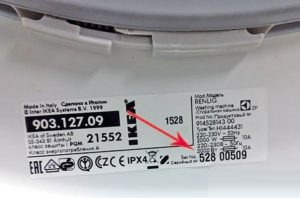 It's no wonder that the power consumption of an Electrolux washing machine is always indicated on the manufacturer's label—it determines its efficiency. If you choose a machine that's too power-hungry, even a low price won't save you, as your utility bills will outweigh the savings. To avoid making a mistake, you need to weigh this parameter alongside price, capacity, and features.
But first, it's important to understand what power is, how it's measured, and how it benefits the consumer. Let's delve into the nuances and consider the most energy-efficient washing machines from Electrolux.
How to calculate this parameter?
The power consumption of the appliance is calculated at the factory, using a strictly defined procedure. This is done in practice: the washing machine is loaded with cotton laundry up to its maximum capacity, after which the cycle is started, heating the water to 60 degrees Celsius. The machine is connected to special equipment that records the electricity consumed during the cycle. The resulting figure is divided by the weight of the washed items and the program duration. The result is the number of kilowatts the machine consumes per hour to clean 1 kg of cotton fabric.
In reality, the power consumed by the washing machine differs from the “norm” as the washing conditions change.
The power recorded during testing is not a constant parameter. It remains constant only under specified conditions: when washing cotton with a maximum drum load and a temperature of 60 degrees Celsius. This rarely happens in everyday life; sometimes synthetics or wool are washed, on a quick or economy cycle, and with a half-empty drum. All this affects the final energy consumption. More specifically, the final kilowatts are affected by:
- type of washing machine (semi-automatic machines are more economical than automatic machines);
- type of fabric (synthetics, blends, or silk differ from cotton in weight and fiber structure, which affects the watts consumed);
- running program (low-temperature and accelerated modes do not require long-term operation of the heating element or motor, therefore, when they are turned on, the machine consumes less);
- drum loading (the more laundry is washed at once, the more intensively the units work and the more electricity is consumed).
Despite its variability, power remains an important and indicative parameter. It can be used to compare models, choosing the most energy-efficient and, therefore, cost-effective unit. The calculation is simple: if a machine consumes less kW when washing cotton at high temperatures, it will also wash more efficiently on other programs and fabrics.
Let's decipher the signs
Power consumption, like other key washing machine parameters, is always indicated on the manufacturer's label and the retail price tag. For customer convenience, the rating is not given as a number, but rather as a letter from A to D, based on the energy efficiency scale. Modern washing machines often have a "+" sign, indicating greater efficiency. Modern washing machines are typically assigned one of the following generally accepted energy efficiency classes:
- A+++ is the most economical class, in which the machine washes a kilo of cotton, consuming 0.13 kW per hour;
- A++ – “eats” no more than 0.15 kilowatts per hour;
- A+ – maximum consumption 0.17 kW;
- A – the washing machine uses 0.19 kilowatts per hour;
- B – here the machine can spend 0.23 kW on an hourly cycle with cotton;
- C – permissible energy consumption up to 0.27;
- D is the most uneconomical class, as it uses about 0.31 kW per hour per kilo of cotton.
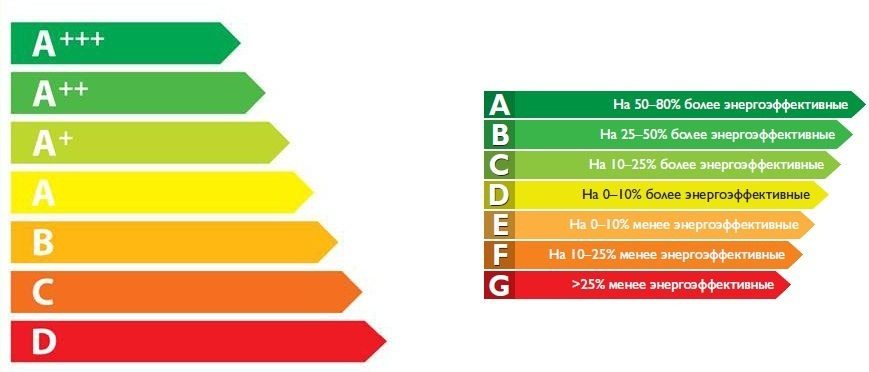
Electrolux machines with class A+++ are considered the most economical.
Using the energy efficiency class as a guide, you can estimate future costs. Simply multiply the given figure by the maximum load weight of the Electrolux. For example, a 5 kg capacity machine with an A+++ rating will require approximately 0.65 kilowatts per hour cycle.
It is important to remember that the calculations will be approximate. In everyday life, washing machines operate in “non-sterile” conditions, at different temperatures, with different loads, and not only with cotton laundry. Much also depends on the cycle length: the shorter the program and the lower the heat, the more energy-efficient the Electrolux washes. Semi-automatic machines have a different energy efficiency rating, as the maximum power rating varies greatly.
How energy-hungry are Electrolux products?
It's hard to find a truly "gluttonous" Electrolux: Class D machines are not produced at all due to their high cost, and Class C and Class B models are very rare. As a rule, even budget models in stores are rated at least Class A. Which Electrolux models are the best value? Let's take a look at a mini-review of top-tier washing machines.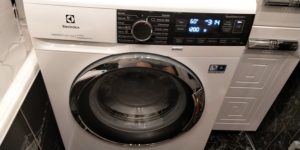
- Electrolux PerfectCare 600 EW6S2. This freestanding front-loading washer impresses not only with its stylish design and black touchscreen control panel, but also with its energy efficiency. It has an A+++ rating, consuming approximately 0.12 kWh. The drum holds a maximum of 7 kg of laundry, features electronic controls and a digital display. It also boasts a spin speed of up to 1200 rpm, 14 programs, and full leak protection.
- Electrolux PerfectCare 600 EW6S4. An affordable washing machine with a capacity of up to 4 kg, a display, and touch controls. In terms of power consumption, this model, with an energy efficiency rating of A+, falls into the Economy range. Other features are also on par: spin speed up to 1000 rpm, 14 washing modes, and noise levels of 58-77 dB.
- Electrolux EW6F4R21B. "Giant" with a capacity of 10 kg. Despite the impressive load, the machine “eats” a record 0.06 kW, which indicates the high efficiency of the equipment. Interestingly, the standard cycle uses a modest amount of water—around 46 liters. Yet, the model offers impressive functionality: a spin speed of up to 1200 rpm, a child lock, 14 programs, and a delayed start of up to 20 hours.
- The Electrolux EW7WR447W is a front-loading washing machine with a 7 kg drum. Its signature feature is a 4 kg drying cycle that uses residual moisture. Its advanced features have resulted in a more efficient model: it has an energy efficiency rating of "A" and uses up to 92 liters of water per cycle.
Ignoring your washing machine's power consumption is irrational—this parameter can help you save on utilities. The key is to look at the Electrolux as a whole, comparing its kilowatt consumption with its price, capacity, and features.
Interesting:
Readers' comments
Headings
Washing machine repair




For buyers




For users


Dishwasher




Add a comment