
What is the power of a washing machine motor?
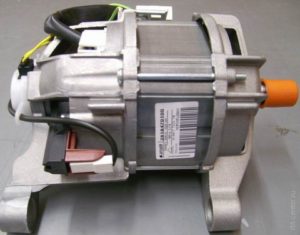 The motor is the "heart" of a washing machine, one of its key components, determining its performance. The key characteristics of this component are power and RPM. When buying an automatic machine, we rarely pay attention to these parameters. Or maybe we shouldn't? That's why we decided to explain the power of a washing machine motor and its impact.
Types of engines
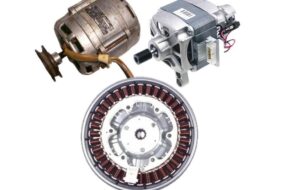
The conversion of electrical energy into mechanical energy (drum rotation) in a washing machine is accomplished by a motor. Engineers have developed three types of motors used in automatic machines:
- asynchronous motor;
- collector motor;
- brushless motor.
Asynchronous motors can be two-phase or three-phase. Modern washing machines produced after 2000 do not use two-phase motors. The power of such motors ranges from 180 to 360 watts, and the speed is low, not exceeding 2800 rpm during spinning, and around 300 rpm during washing. Machines with such motors spin at only 400-600 rpm, and in rare cases, 800-1000 rpm.
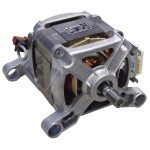
Commutator motors, which can operate on both AC and DC, have practically replaced asynchronous motors. They are smaller and feature smooth speed control via electronics. Their main drawback is their design, which includes brushes, which wear out and become unusable. To restore the motor's performance, they must be replaced periodically. Commutator motors have a power rating of 380–800 W, with the armature speed varying from 11,500 to 15,000 rpm.
Please note! The motor power consumption during washing and spinning varies. This information is only listed on the motor itself by the motor manufacturer; you won't find it in the machine's manual.
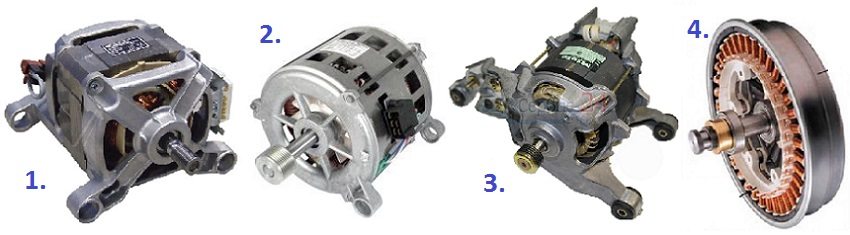
The brushless motor or inverter motor first appeared in washing machines in 2005, and LG was the first company to use it. Its difference is that it is directly connected to the drum without a belt drive. It's more compact than the other two motor types, simple in design, and has the highest efficiency. The inverter motor is just as powerful as the previous motors and can spin the drum at up to 1,600-2,000 rpm during the spin cycle.
Energy consumption versus power
The washing machine's electric motor power determines its overall energy consumption—or, more simply, how many kilowatts of power the machine consumes per hour. This is what consumers are most often interested in, rather than the machine's motor power. A machine's energy consumption is determined by: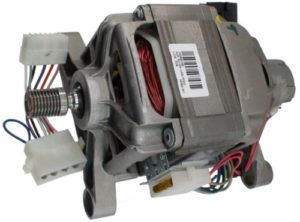
- the engine power consumption changes throughout the entire washing process, more during spinning, less during washing and rinsing;
- heating element power, which on average ranges from 1.7 to 2.9 kW. Moreover, the higher the water heating temperature, the greater the power consumption will be;
- the pump power, which is 24-40 W, is quite sufficient for pumping out water;
- the total power consumed by the bulbs, control module, sensors, etc. is approximately 5-10 W.
The power consumption of the washing machine is calculated for the Cotton mode, in which the water is heated to 600C, and the machine is loaded to its maximum capacity. Based on this indicator, the washing machine is assigned energy efficiency class, designated by the Latin letter.
The maximum number of revolutions during spinning depends on the power of the washing machine motor.
The more powerful the motor, the more rotations the drum will make when spinning the laundry. This indicator is reflected in washing machine spin classAutomatic machines rotating at 1600 rpm belong to class A. But it is not at all necessary to buy such a machine, because even with a spin of 800-1000 rpm, the laundry will be well wrung out, without the risk of being torn.
Motor power of different washing machine models
Washing machines of different brands are equipped with different motors, which means they have different technical specifications and vary in price. Here are a few examples.
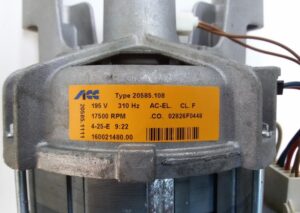
- CESET MCA 52/64-148/AD9 MOTOR – a motor installed on Hotpoint-Ariston and Indesit washing machines, its power is 430 W and 11,500 rpm;
- MOTOR CESET MCA38/64-148/CY15 – motor for Candy, Hoover, Zerowatt washing machines, power is 360 W and 13000 rpm;
- MOTOR CESET CIM2/55-132/WHE1 – electric motor for Whirlpool, Bauknecht washing machines, power 800 W and 17000 rpm;
- WELLING HXGP2I.05 WASHING – motor for Indesit or Vestel washing machines, spin power 300 W, washing power 30 W;
- Electronic Control Motor Haier HCD63/39 – motor for Candy and Haier machines, power 220 W and 13000 rpm;
- HXGP2I Welling Electronic Control Motor – motor for Samsung washing machine, power 300 W.
So, automatic washing machines manufactured in the 2000s have either a brushed or brushless motor. Their power consumption may vary, but this doesn't matter much to the consumer. What's more important is the machine's energy efficiency, which can be determined by its energy efficiency class, which for modern machines is A or A+.
Interesting:
Readers' comments
Headings
Washing machine repair




For buyers




For users


Dishwasher




Add a comment