
Washing machine power – how many kW does it consume?
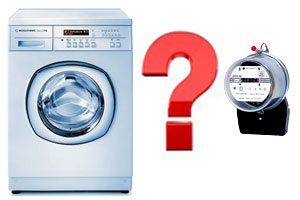 Machine power can vary. To determine the amount of kW your appliance uses, you can check the sticker on its body. This information may be listed on the sticker. You can also find it by checking the model number. energy efficiency class of washing machines This applies to your model. Let's discuss this issue in more detail.
Energy consumption classes
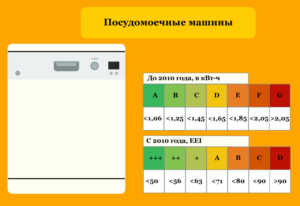
Based on their energy efficiency, all washing machines are divided into classes. Those classes that are more economical are designated by the Latin letter "A." A "+" sign may also be added. These symbols indicate even more modest consumption. The highest and most economical designation is "A++." The least economical is "G."
Typically, symbols indicating the class of household appliances, whether refrigerators, washing machines, or other large units, are located on stickers. These are also found on the appliance body. You can also find them in the detailed description of your appliance on the manufacturer's website.
The number of kWh per kilogram of laundry is calculated under laboratory conditions. This is then used to assign energy efficiency classes to various household appliance models.
How many kWh do different classes of washing machines use?
- Let's start with the most energy-efficient option. Class "A++" requires the minimal amount of energy. These machines consume less than 0.15 kWh per kilogram of laundry.
- Next comes "A+." A washing machine with this rating requires less than 0.17 kWh per 1 kg of laundry.
- The letter “A” means that electricity consumption will be within the range of 0.17 to 0.19 kW/h per kg of laundry.
- For a machine with the designation “B” you will need 0.19-0.23 kW/h/kg.
- For class “C”, 0.23 to 0.27 kW/h per kg of laundry will be sufficient.
- A machine with a “D” rating will require from 0.27 to 0.31 kWh per kg of items.
- There's no point in listing the remaining options in detail, as modern household washing machines don't use them. It's worth noting that they require more than 0.31 kWh/kg.
Laboratory tests typically use a 60-degree wash cycle. Cotton items are used for washing. The drum is loaded with the maximum permitted load. All calculations leading to the energy efficiency class are based on this wash cycle.
As you can imagine, a real wash may use a different number of kWh. Since items may be made of different materials, the temperature and washing conditions may also be different.
What else can affect the number of kilowatts consumed by the machine?
It should also be noted that the actual amount of energy consumed is also influenced by the following factors. Specifically:
- The program selected for washing clothes. It may differ in heating temperature, duration, intensity, number of engine revolutions during spinning, presence/absence of additional options (for example, adding a second rinse), etc.
- The type of fabric from which the washed items are made also matters. Because different fabrics can have different dry and wet weights, they may also require different washing cycles.
- In addition to the above, the amount of kW can also be affected by how loaded the washing machine drum is.
How much electricity is needed for other household appliances?
Below we provide a table showing the average power consumption values of various household electrical appliances that can be used at home.
| Type of electrical appliance | Power consumption |
| Cooking surface | From 1 to 2 kW. |
| Kitchen hood | From 0.12 to 0.24 kW. |
| Water heater for up to 150 liters | Approximately equal to 6 kW. |
| Household air conditioner | 0.4 – 0.24 kW. |
| Microwave | 0.6 – 2 kW. |
| Mixer | About 0.2 kW. |
| Home vacuum cleaner | Approximately 1 kW. |
| Drying machine | 2-3 kW. |
| Desktop computer | 0.3-1 kW. |
| Dishwasher | About 3 kW. |
| The TV is ordinary | 0.15 kW. |
| Iron | 1 kW. |
| Fridge | 0.2 kW. |
| Electric stove | 3-8 kW. |
| Electric grill | 1-3.6 kW. |
| Toaster | 0.8-1.5 kW. |
| Pressure cooker | From 1 to 2 kW. |
| Built-in oven | From 2 to 5 kW. |
| Coffee machine | From 0.5 to 1 kW. |
| Instantaneous water heater | About 3.5 kW. |
| Freezer | About 0.2 kW. |
Interesting:



3 reader comments
Add a comment
Headings
Washing machine repair




For buyers




For users


Dishwasher




Electricity is measured not in kW/h, but in kW*h.
The power rating isn't what's written in the article. This article describes how many kilowatts a washing machine will consume, which can be multiplied by the tariff to determine the monetary value of an hour of washing. The average power rating of a washing machine is 1.5 to 2 kW. Let's say the heating element uses 1.2 kW, the pump 0.24 to 0.5 kW, and the motor that rotates the drum. Adding all this up yields the power rating, which can be used to calculate the wire cross-section and circuit breaker size in the electrical panel. Classes A, A++, and so on represent the average number of kW consumed per wash cycle at 60°C.
Great! I found everything I needed thanks to your answer! It's all a blur, and I can't find the answer anywhere. I need the power just to size the extension cord.