
Dishwasher power in kW
 Electricity rates in both Europe and Russia are rising every year, and so are their bills, so most people are interested in saving at least a little, but how can they do this? The problem is that the number of energy consumers in our apartments and homes is steadily increasing: televisions, vacuum cleaners, multi-cookers, water heaters, split-system air conditioners, and now even dishwashers—consumption is rising, making it increasingly difficult to save. But it turns out you can save money, starting with your dishwasher. First, you need to calculate its capacity and take other steps, which we'll discuss in this article.
Why are some dishwashers energy efficient and others are not?
The efficiency of a dishwasher depends on the energy efficiency of its components and the technical solutions used in a particular model by its manufacturer. A lot of electricity is used to operate the heating element, circulation pump and pump. The first element is, of course, the heating element that heats the water, followed by the heating element that powers the drying process. Dishwashers without a hot drying function consume significantly less energy.
Important! Dishwashers with convection drying eliminate the need for a second heating element or fan, meaning they consume approximately 40% less energy.
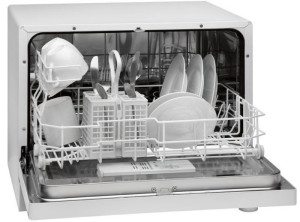 Energy consumption depends significantly on the capacity of the water tank and the temperature of the water. Consequently, the smaller the tank capacity and the less water the dishwasher uses per wash cycle, the lower the overall energy consumption. Various innovative technical solutions also reduce energy consumption in dishwashers. In particular, Bosch dishwashers have recently begun to feature heat exchangers. These heat exchangers conserve thermal energy, meaning the machine uses less electricity.
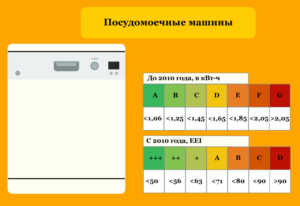
Before buying a new dishwasher, it's a good idea to find out how energy efficient it is. This is easy to do; just look at the specifications of the specific model. They'll look for the "energy efficiency class" followed by a letter of the alphabet.
- The letter A means that the dishwasher consumes 0.7-1.07 kW.
- The letter B means that the dishwasher consumes 1.08-1.1 kW.
- The letter C means that the machine consumes up to 1.5 kW.
- The letters D and E are less common in modern machines and mean that they take up to 2 kW.
- And finally, the most uneconomical machines are those with energy consumption classes F and G, they consume 2.5 and 2.7 kW.
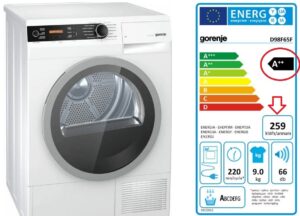
If the manufacturer has managed to ensure that its machine consumes less than 0.7 kW of energy, then in its specifications it adds a “+” sign to the letter A, or two or three pluses if the model’s energy efficiency is significant.
How to make your dishwasher more energy efficient?
 To ensure your dishwasher is as efficient as possible and uses the least amount of energy, you need to consider this before purchasing your dishwasher. This doesn't mean you have to look for a model that maximizes every watt. Instead, consider the following expert recommendations.
- Wash dishes with a delayed start. Start the wash cycle, and once the machine has filled the tanks with water, pause the cycle and set a delayed start so the machine will run the wash cycle at night. This will save you energy, as the rate is lower at night, and the water in the tanks will warm up to room temperature within a few hours, requiring less energy to heat it.
- Don't leave dirty dishes. If food residue sticks to the dishes, it will take more energy to clean them. This will require hotter water, a double rinse, and, well, you get the idea!
- Buy dishwasher models with a built-in heat exchanger. You can read about the features of this element in the article. What is a heat exchanger in a dishwasher?.
- Use appropriate washing modes. If the dishes are not very dirty, they can be washed with water at a temperature of 30°C. 0C, on the shortest program. Think about how much energy you can save.
Please note! Some dishwasher models feature energy-efficient modes, such as a "quick wash" mode that completes the entire dishwashing cycle in just 30 minutes.
- Don't run the dishwasher if you have, for example, only 3 plates and two glasses, save up the dishes by soaking them in some large container, and then put everything in the dishwasher and wash it all at once.
- If your washing machine model allows for a half-load, then take advantage of this feature; it's very convenient and allows you to save hundreds of watts of energy, water, and detergent.
- Stack dishes properly in wash baskets. This way, you won't have to rewash them, saving time, hundreds of watts of energy, water, and detergent.
- Descale your dishwasher regularly. A heating element covered with scale wastes much more energy than a clean heating element.
Examples of energy-efficient dishwashers
High power is a major drawback for a dishwasher. Unlike other electrical appliances, high power doesn't offer any advantages to a dishwasher, but rather only disadvantages, as high power means high energy consumption. In this case, the primary question is how much energy the dishwasher consumes and how this can be minimized, without compromising the quality of washing and drying dishes.
We've discussed how much electricity a dishwasher uses and how to reduce it. Now let's discuss which dishwasher models are the most, or among the most, energy efficient. We'll publish a short review on this topic.
- The Zigmund & Shtain DW6009X full-size, fully integrated dishwasher holds 15 place settings and features turbo drying, yet its average energy consumption is approximately 0.5 kW—a record-breaking A++ rating.
- It has surpassed the previous model of the Flavia BI60 KAMAYA dishwasher. It consumes about 0.4 kW, which corresponds to the A+++ designation. At the same time, its tank can accommodate 14 sets of dishes, and its washing modes are striking in their variety.
- Rounding out the top three most energy-efficient dishwashers is the "iron helper" from Germany, the TEKA DW8 41FI. It consumes approximately 0.5 kW, which equates to an A++ rating. This model is noteworthy because it is completely energy-efficient, meaning it consumes not only a small amount of energy but also water and detergent, making it one of the most economical dishwashers in Europe.
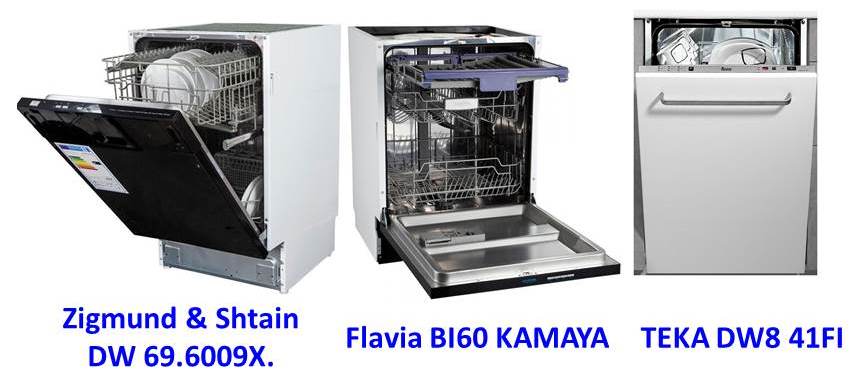
Please note: The TEKA DW8 41FI uses approximately 8-9 liters of water per wash, using half the amount of detergent and salt.
Finally, let's look at how many watts of energy a dishwasher uses. These figures vary from model to model. To find out how much a specific model consumes, look at its specifications, specifically the line that indicates its energy efficiency class. You can find out how much this energy consumption class represents by reading the symbols. Remember one thing: the less powerful your dishwasher, the fewer watts of energy it consumes.
Interesting:


1 reader comment
Add a comment
Headings
Washing machine repair




For buyers




For users


Dishwasher




Thank you, everything is clear!