
Can you use regular dishwasher salt?
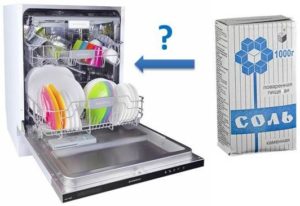 There's a lot of conflicting information online about using dishwasher detergent substitutes. Some users claim that buying expensive powders, salt, and tablets is wasteful and that it's perfectly fine to make them at home. Others agree with the manufacturer, discouraging others from using homemade products. We have a specific question: can you use regular salt in your dishwasher? We'll try to answer it in this post.
Will table salt damage appliances?
Warning! According to comments at the bottom of this page, using regular table salt can damage your appliances!
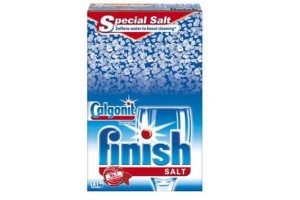
A rather tempting option for those looking to save money. A pack of table salt costs 15 times less than branded salt. Finish dishwasher saltsNaturally, you might want to use regular table salt, but should you? Experts say, and experienced users confirm from bitter experience, that using finely ground table salt (especially extra-fine grade) is absolutely forbidden.
The thing is, a packet of table salt, even coarsely ground, contains quite a bit of suspended matter. In this case, suspended matter refers to fine salt particles that settle to the bottom of the dishwasher's salt reservoir. What happens next?
- The suspension crystallizes in a dense layer in the tank.
- Over time, the tank becomes so clogged that water stops passing through it or passes through it, but with great difficulty.
The tank may become so clogged that it will have to be removed from the machine in order to clean it.
- The ion exchanger receives insufficient or insufficient salt and fails.
- A huge amount of scale accumulates in the machine, causing the equipment to break down quickly.
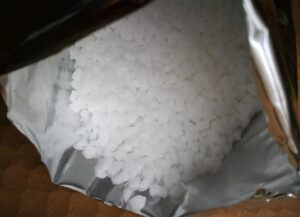
The outlook, though distant (1.5-2 years), is still not rosy. It's better to buy Finish salt; at least the dishwasher will stay in good condition. By the way, why doesn't Finish salt crystallize at the bottom of the tank and cause problems? The secret is that it's pressed into granules. Granulated salt does not contain suspended matter, so it dissolves evenly and is washed into the system. When salt water enters the machine's ion exchanger, it promotes the regeneration of the resin, which in turn prevents limescale deposits. That's how it works. No salt, no resin, and without resin, limescale deposits will grow horribly.
Acceptable replacement options
There's a common misconception that you can use 3-in-1 tablets instead of salt and detergent. They say they contain everything you need, including salt, so you don't need to add anything else to the tank if you buy tablets or capsules. In reality, this is a fatal misconception. 3-in-1 tablets do contain salt, but not enough to fully enrich the dishwashing mixture (water + detergent + salt). The result will be disastrous. After 3-4 years, the ion exchanger will fail.
Some DIYers try adding granulated industrial salt to their dishwasher. The danger of this is that industrial salt contains impurities. These impurities clog not only the salt reservoir but also the entire water system. This can lead to the machine needing to be completely disassembled, thoroughly cleaned, and its filters replaced within 1-2 years, otherwise it simply won't work.
The only option is to use granulated, purified industrial salt for professional dishwashers. Firstly, it's quite pure, and secondly, it's in granular form, with a minimal percentage of fine suspended solids. It's a worthy substitute, although it's slightly cheaper than salt for household dishwashers. Savings will be no more than 10-15%. Another option is to make your own granules from table salt.
Making industrial salt at home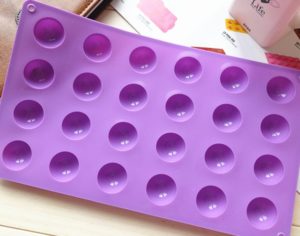
What can replace store-bought dishwasher salt? Let's use logic. Dishwasher salt must have two important qualities: first, it must be pure, and second, it must be coarsely dispersed with minimal suspended matter. Table salt is pure, as it's even edible. But it contains a lot of suspended matter. If this fine dust can be removed and the table salt can be formed into granules, you'll get an excellent product for your dishwasher. How can this be done?
- We take the smallest silicone molds for homemade lollipops (0.8-1 cm).
- Pour highly purified table salt onto a baking sheet.
- Wet the salt evenly with water from a spray bottle until a thick paste forms.
- We tightly fill the molds with salt porridge, making sure that there are no small particles of salt left around the edges.
- Place the mold with salt near a strong heat source.
Be careful not to let the heat damage the mold.
- When the salt is completely dry, you will have large granules from which you need to brush off the small salt crystals with a dry brush.
- We put the granules in a bag and try to handle them carefully so that they do not crumble.
These granules are perfectly safe to use in the dishwasher. They're just as good as the much-advertised Finish salt, and their cost is equal to the cost of the molds and a pack of regular table salt. How is this salt different from special dishwasher salt? It's not different, meaning you can safely use it every day.
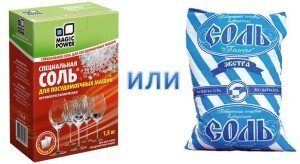
Let's sum it up. You cannot replace special dishwasher salt with 3-in-1 tablets, table salt from a packet, or technical salt! You can make dishwasher salt at home, and if you do it right, you'll really save money without damaging your appliance. Good luck!
Interesting:

5 reader comments
Add a comment
Headings
Washing machine repair




For buyers




For users


Dishwasher




I stupidly read a bunch of articles online and ruined my dishwasher with “Extra” salt in 1.5 years.
It wasn't you who ruined it, it was the dishwasher. I've been using table salt and laundry detergent for 15 years—it's been working perfectly!
Don't believe all these advertising gimmicks.
Are you out of your mind? Who wrote the article? Since when is table salt considered pure enough? After your article, people will kill their ion exchangers!
There's rock salt or sedimentary salt, meaning it's mined in an open-pit mine, ground, and packaged. It may contain rocks, sand, dust, and other mineral inclusions. Try dissolving a couple of tablespoons of rock salt in a glass of water—you'll get a sediment. However, if you buy extra evaporated salt, which is produced by evaporation and has a NaCl content of at least 99.7%, it will dissolve completely in a glass of water without leaving a sediment. When purchasing dishwasher salt, look for the GOST standard on the packaging: Extra Evaporated Salt (GOST R 51574-2000 or GOST R 51574-2018).
P.S.
Granulated dishwasher salt, sold in stores for 1.5 kg per pack, is essentially Extra salt, but 10 times more expensive. Granulated salt allows water to flow between the salt particles inside the dishwasher without reducing water pressure. However, over time, the granules become smaller and finer, eventually resembling grains of Extra salt. Overall, I believe that if you use the right Extra salt, the resin in your dishwasher will last a long time.
Well written, well written. Make the salt into granules to prevent any sediment. Then pour the granules into the dishwasher, where the same water will dissolve the salt. And sooner or later, the sediment will wash out just like that. Well, if you have nothing better to do, you can play around with it. I usually use finely ground salt, which has been around for about 12 years, and it works perfectly. The salt process in a dishwasher is like this: there's water in the tank where the salt is poured. Salt can't dissolve indefinitely, so it dissolves to a certain concentration. As water is poured into the dishwasher, some of the salt water enters the ion exchanger, and from there, it flows into the dishwasher. But maybe 50 grams is added there, and this same salt water with sediment is then poured into the dishwasher itself. And it won't clog anything there. Do you put perfectly clean dishes in the sink? Can you imagine how much grease and sediment there is? and nothing gets clogged..