
Can you put a dishwasher on top of a washing machine?
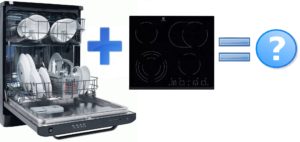
 People start piling appliances on top of each other for a reason. Limited space forces you to use your brain and come up with the most incredible ideas. Some even try stacking a dishwasher on top of a washing machine, but these experiments aren't always successful. Today, we'll tell you how to properly place a dishwasher above a washing machine without damaging the appliances or the interior.
Installation options
If you're considering stacking a dishwasher on top of a washing machine, discard the idea immediately. While it's possible to place a dishwasher above a washing machine, the body of one machine must not touch the body of the other. Our explanation may seem like nonsense right now, but don't worry, we'll explain it further and everything will become clear.
Placing a dishwasher above a washing machine is advantageous because it saves space. This saves 50 to 70 cm of usable space. In a small kitchen, these centimeters are a real treasure. How do you install the appliance?
- For the dishwasher and washing machine, you need to prepare in advance a reinforced, stable tall cabinet with two niches of suitable sizes.
The upper niche of the tall cabinet can be slightly smaller than the lower one, but not vice versa.
- The cabinet must be installed on a perfectly flat and reinforced surface.
- The crossbar connecting the upper and lower niches of the cabinet is additionally reinforced with a steel angle, and large holes must be made in the back wall of the cabinet to accommodate communications.
- First, the washing machine is installed and connected, then the dishwasher is installed and connected.
Of course, this installation option is only available for front-loading washing machineIf your washing machine is top-loading, you can't place anything on top of it, otherwise the door won't open to load laundry. You should not place anything on a washing machine that vibrates heavily during the spin cycle. Some models are so "jumpy" that it's impossible to even think about putting anything on them.
You can find many images online of dryers installed above washing machines. In almost all cases, dryers work perfectly above washing machines, and a direct analogy could be drawn, if not for one "but." Dryers can't leak because they only collect a tiny amount of water, but dishwashers can. If you're willing to live with that, then this option is perfect for you.
What are the consequences of incorrect installation?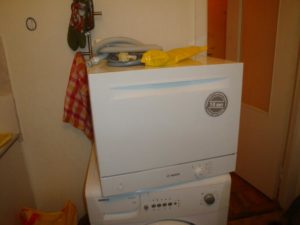
Experience shows that installing a dishwasher above a washing machine is perfectly possible, but it must be done correctly. Even the slightest mistake during installation can result in significant costs. What could happen if the installation is done incorrectly?
- During the spin cycle, the washing machine will simply shake the dishwasher onto the floor. Many machines begin to rock violently during the spin cycle at high speeds, which is enough to cause the dishwasher to fall to the floor, ripping the inlet hose and flooding the entire kitchen floor.
- When the appliance bodies touch, vibration from the washing machine will be transferred to the dishwasher, and a lightweight dishwasher isn't designed to withstand such vibration. What will this lead to? It will almost certainly result in damage to the dishwasher (damage to fasteners, connecting rods, the locking mechanism, etc.).
- If your dishwasher doesn't have a leak protection system, it's best not to install it on your washing machine. A leak will almost certainly damage the washing machine's electronics, which will cost you money in repairs.
Even if everything is done correctly, this installation option is not ideal. Firstly, the dishwasher will be positioned quite high off the floor. Loading dishes and cutlery into the racks will require reaching up, risking dropping items on the floor. Furthermore, it will be difficult to properly arrange the dishes in the racks without using a stool, which is inconvenient. Secondly, the dishwasher will only work when the washing machine is unplugged. Running two appliances simultaneously is dangerous due to vibration.
In short, if you're considering installing your washing machine and dishwasher this way, consider not only whether it's possible, but also whether you really need it. We recommend installing your appliances this way only if there are no other options, as there is a real risk to the machines and the entire kitchen.
Interesting:
Readers' comments
Headings
Washing machine repair




For buyers




For users


Dishwasher




Add a comment